
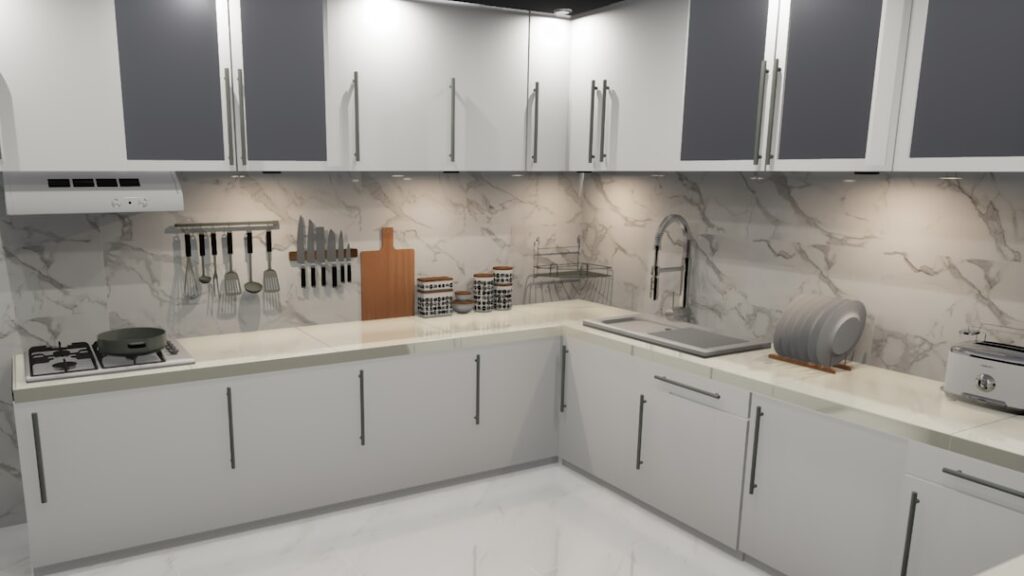
Most homeowners assume the kitchen is the worst room for wall coverings. Grease, steam, splatters from the cooktop, and humidity from the dishwasher all gang up on paper-backed prints. But modern kitchen wallpapers have come a long way since the vinyl-coated catalogs of the 1990s, and the right product on the right wall will outlast a paint job by years. The trick is matching paper type to the actual wall it covers.
Part of our Kitchen Remodeling guide — explore the full guide →
- Why Wallpaper Belongs in a 2026 Kitchen
- Vinyl, Non-Woven, and Peel-and-Stick: What to Pick
- Washability Ratings You Should Actually Look At
- Where to Hang It and Where Not To
- Prep Work That Decides the Outcome
- Cost Breakdown for a Typical Kitchen
- Maintenance That Doubles Its Life
- When to Replace Versus Repair
- Pattern, Scale, and How to Match It to Your Kitchen
- Final Thoughts Before You Order
Why Wallpaper Belongs in a 2026 Kitchen
Paint dominated kitchens for the last fifteen years, but designers are pushing pattern again because cabinet colors have gone neutral. A muted Shaker kitchen in Sherwin-Williams Repose Gray reads flat without something on the walls. A patterned wallpaper above the chair rail or behind open shelving adds depth without forcing you to repaint every cabinet.
Resale appraisers no longer flag wallpaper the way they did during the early 2010s, especially in breakfast nooks, pantries, and accent walls. A removable peel-and-stick keeps your buyer pool wide.
Vinyl, Non-Woven, and Peel-and-Stick: What to Pick
Solid vinyl, sometimes labeled Type II commercial, is the workhorse for high-traffic kitchens. It wipes clean with a damp microfiber and resists scuffs from passing carts and chair backs. Expect $45 to $90 per double roll from brands like York Sure Strip or Brewster Home Fashions.
Non-woven papers cost more, around $80 to $180 per roll, but they breathe. They are the right pick on exterior walls where condensation forms. Peel-and-stick from Tempaper, Chasing Paper, and Spoonflower runs $35 to $120 per roll and removes cleanly in three to five years. Skip standard pulp wallpaper. It will bubble within a month near any heat or steam source.
Washability Ratings You Should Actually Look At
Manufacturers publish three ratings that matter. Look for scrubbable, which means you can use a soft brush and mild detergent. Stain resistant matters near the cooktop. Greaseproof is the highest tier and the only one rated for the wall behind a range without a backsplash extension.
- Washable: damp sponge only, OK for breakfast nooks
- Scrubbable: soft brush and mild soap, OK most kitchen walls
- Greaseproof: solvent-cleanable, required behind cooktops
The European RAL marks and the American CCA grading both use these terms. If you cannot find the rating on the spec sheet, assume it is washable only and plan the install accordingly.
Where to Hang It and Where Not To
The safest walls are the breakfast nook, pantry interior, the wall above wainscoting, and the ceiling. Avoid the four-foot zone directly above the cooktop unless you extend tile or stainless backsplash up that high. Skip the wall behind the sink unless the faucet has a low arc, since pull-down sprayers will wet wallpaper repeatedly.
Cabinet ends and the inside of glass-front cabinets have become popular in 2025 and 2026. A bold pattern inside a single cabinet lets you test a print before committing to a whole wall.
Prep Work That Decides the Outcome
Wash every square inch with a TSP substitute like Krud Kutter. Grease film is invisible but it will reject adhesive immediately. Patch nail holes, sand smooth, and prime with a wallpaper-specific primer such as Roman PRO-977. Standard latex primer is too porous and either pulls the wallpaper down too tight or fails to hold it at all.
Plan your first strip from a plumb line, not from a corner. Corners in old kitchens are rarely true. Snap a line 24 inches in from the corner and hang the second strip first, then work outward.
Cost Breakdown for a Typical Kitchen
A medium kitchen accent wall, roughly 8 feet by 10 feet, takes two to three double rolls. Material runs $90 to $360. A pro installer charges $4 to $7 per square foot, so labor on that same wall lands between $320 and $560. DIY tools, including a smoother, seam roller, snap-off knife, and laser level, add about $45 once.
Whole-kitchen wallpaper jobs above wainscoting come in around $1,200 to $2,800 turnkey. That is competitive with two coats of premium Behr Marquee paint by a pro, and it lasts twice as long in a busy household.
Maintenance That Doubles Its Life
Wipe weekly with a damp microfiber. Skip ammonia, bleach, and citrus cleaners on anything but greaseproof grade. For stuck-on grease, Mr Clean Magic Eraser used very gently works on vinyl; test it on a hidden seam first. Touch up lifting seams with Roman 880 adhesive and a seam roller within a week of noticing them, before the curl sets.
When to Replace Versus Repair
If more than a quarter of the seams are lifting, or the pattern has fading on the sun-facing wall, replacement is cheaper than spot repairs. For isolated damage near a switch or outlet, cut a clean square, slide a fresh patch behind, and align the pattern. The repair disappears if you matched the original lot number, which is why you should always order one extra roll and store it flat in a dry closet.
Pattern, Scale, and How to Match It to Your Kitchen
Small kitchens look bigger with smaller-scale patterns, contrary to design instinct. A delicate Schumacher Acanthus or a tight Cole and Son geometric reads as texture from across the room and does not visually compress the space. Large kitchens with high ceilings can carry bolder prints like a Rifle Paper Co. botanical or a House of Hackney mural without overwhelming the cabinetry. Hold a 12-inch sample piece at arm’s length and squint; if the pattern dissolves into a uniform color, the scale is right for your room.
Color drag matters too. A wallpaper with a warm beige base shifts pinker under incandescent bulbs and grayer under LED. Order samples in both warm and cool color families to see how your kitchen’s actual lighting reads them across morning, afternoon, and evening.
Final Thoughts Before You Order
Good kitchen wallpapers can run a decade in a real cooking family if you pick a vinyl or non-woven, prep the wall honestly, and keep grease off them with weekly wipes. Order a sample, tape it up for a week with the light cycling from morning to dinner, and only then commit. The pattern that looked perfect online at noon may not survive your 7 p.m. pendant lights.


