Real knotty pine is soft, dents if you look at it wrong, and turns amber the moment sunlight hits it. That’s exactly why knotty pine vinyl plank flooring has become the go-to for homeowners who love that warm, cabin-lodge character but don’t want to babysit a delicate softwood. Modern LVP reproduces the swirling grain, dark knots, and honey tones of pine so convincingly that most people can’t tell until they touch it, and it does so while being waterproof, scratch-resistant, and half the maintenance. Here’s what the look actually delivers, what it costs, and how to pick a plank that reads as authentic instead of plasticky.
What Knotty Pine Vinyl Looks Like
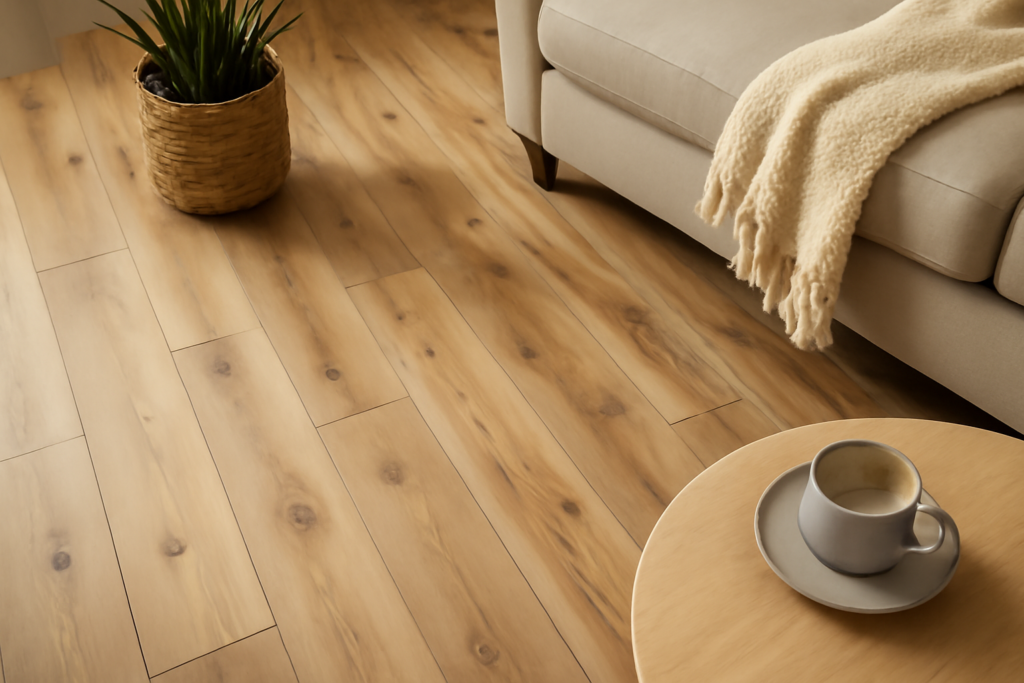
The whole appeal of pine is imperfection. Genuine knotty pine has tight, dark knots scattered across a pale golden field, long straight grain lines, and occasional streaks of resin. Good vinyl versions capture all of it with high-resolution photographic layers and embossed-in-register (EIR) texture, meaning the surface bumps and grooves line up with the printed grain and knots you see. Run your hand over a quality plank and you’ll feel the knots dip and the grain rise.
Color ranges from creamy near-white “white pine” and “sun-bleached pine” to warmer “honey pine” and rich “heart pine” with reddish undertones. Because it’s printed, the pine won’t yellow or fade the way a real softwood does under UV, so the tone you buy is the tone you keep.
Why Choose Vinyl Over Real Pine
Solid pine is one of the softest flooring woods, ranking around 380 to 870 on the Janka hardness scale depending on species, far below oak’s 1,290. It scratches, dents under furniture, and shows every dog nail. Vinyl flips those weaknesses:
- Waterproof: 100 percent waterproof SPC and WPC cores handle kitchens, baths, mudrooms, and basements where real pine can’t go.
- Scratch and dent resistant: a 12- to 22-mil wear layer shrugs off pet nails and dropped pans that would ding softwood.
- Stable: it won’t cup, gap, or yellow with sun and humidity swings.
- Low maintenance: no sanding, sealing, or refinishing; just sweep and damp-mop.
- DIY-friendly: click-lock planks float over most subfloors without glue or nails.
The trade-off is authenticity for anyone who wants a real wood floor they can refinish decades later. For everyone else, the rustic look with none of the fragility is an easy call.
How Much Does Knotty Pine Vinyl Plank Flooring Cost
Pricing tracks with core type, wear-layer thickness, and brand. Here’s what to budget in 2025 dollars:
- Budget peel-and-stick or thin glue-down LVP: $1.00 to $2.00 per sq ft. Thin wear layers; fine for low-traffic rooms.
- Mid-range click-lock SPC (5 to 6 mm, 12–20 mil): $2.50 to $4.50 per sq ft. The sweet spot for most homes.
- Premium WPC or thick SPC with attached pad: $4.50 to $7.00 per sq ft. Best texture, quietest underfoot, longest warranties.
Professional installation adds $1.50 to $4.00 per sq ft. For a 200 sq ft room, expect a materials-only DIY cost of roughly $500 to $900 for a solid mid-range floor, or $1,200 to $2,000 installed. Budget an extra 7 to 10 percent for cutting waste, more if you’re running a pattern or lots of angles.
What to Look for When Buying
Not all pine-look vinyl is created equal. Pull a sample and check these before you commit.
Wear Layer Thickness
This clear top layer determines scratch and traffic resistance. Aim for 12 mil in bedrooms and 20 mil or more in kitchens, entries, and homes with dogs. Below 6 mil, expect visible wear within a few years.
Core Type
SPC (stone plastic composite) is rigid, dent-resistant over imperfect subfloors, and best for wide temperature swings. WPC (wood plastic composite) is a touch softer and warmer underfoot. Both are waterproof; choose SPC for slabs and sunrooms, WPC for comfort in living spaces.
Realism Details
Look for embossed-in-register texture, matte or low-sheen finish (real pine isn’t glossy), and at least 8 to 12 unique plank faces in the run so the knots don’t obviously repeat. Micro-beveled edges add depth and read as individual boards.
Plank Size
Wider planks (7 to 9 inches) with lengths of 48 to 60 inches showcase pine’s long grain and look more authentic than narrow strips. Longer boards also mean fewer seams.
Best Rooms for the Pine Look
Knotty pine vinyl leans rustic, farmhouse, coastal, and cabin. It shines in living rooms, bedrooms, and open kitchens where you want warmth, and it’s a natural fit for a lake house or mountain retreat. The waterproof core makes it viable in spots real pine would never survive: full baths, laundry rooms, three-season porches, and finished basements. Pair honey and heart pine tones with warm white walls and iron hardware; pair sun-bleached pine with coastal blues and whites.
Installation Tips
- Acclimate the planks 48 hours in the room at 65 to 85 degrees F before installing.
- Start with a flat subfloor; SPC tolerates minor imperfections, but anything over 3/16 inch across 10 feet needs leveling.
- Leave a 1/4- to 3/8-inch expansion gap at every wall, covered by baseboard or quarter-round.
- Stagger end joints at least 6 to 8 inches and mix planks from several boxes so knots don’t cluster.
- Use a tapping block and pull bar to close the click seams fully; gaps invite dirt and lifting.
Knotty Pine Vinyl vs. Other Wood Looks
Pine occupies a specific niche among wood-look vinyls. Against oak, the most common vinyl print, pine reads lighter, softer, and more rustic, with those scattered dark knots doing the heavy lifting instead of oak’s uniform straight grain. Against hickory or acacia, pine is calmer and less high-contrast, which makes it easier to live with in a large open floor plan. And against a gray-washed or driftwood look, pine brings genuine warmth, an amber-honey glow that makes a room feel cozier rather than cooler.
That warmth is the deciding factor for most buyers. If your goal is a bright, casual, lived-in feel, pine delivers it better than nearly any other print. If you want something more formal or contemporary, oak or walnut tones suit better. Pine is also forgiving of clutter and everyday mess; its busy, knotty surface hides crumbs, pet hair, and minor scuffs that would show plainly on a clean, dark floor, which is one reason it’s popular in cabins, kids’ rooms, and lake houses.
Care and Maintenance
This is where vinyl earns its keep. Sweep or dry-mop for grit, and damp-mop with a pH-neutral vinyl cleaner. Skip steam mops, wax, and abrasive pads. Add felt pads under furniture legs and a mat at exterior doors to trap grit. With that routine, a quality pine-look floor holds its finish for 15 to 20 years, no sanding or resealing ever required.
The Bottom Line
Knotty pine vinyl plank flooring gives you the golden knots, rustic grain, and cabin warmth of real pine without the dents, yellowing, and constant upkeep. Budget $2.50 to $4.50 per sq ft for a mid-range click-lock floor, prioritize a 20-mil wear layer and embossed-in-register texture for the most convincing result, and you’ll get a waterproof, dog-proof floor that keeps its lodge charm for two decades. For the look of pine in a room where real softwood would fail, it’s hard to beat.
Prefer to explore on your own?
See how new flooring looks in your actual room in seconds — free, no signup.
Try the free Floor Studio →