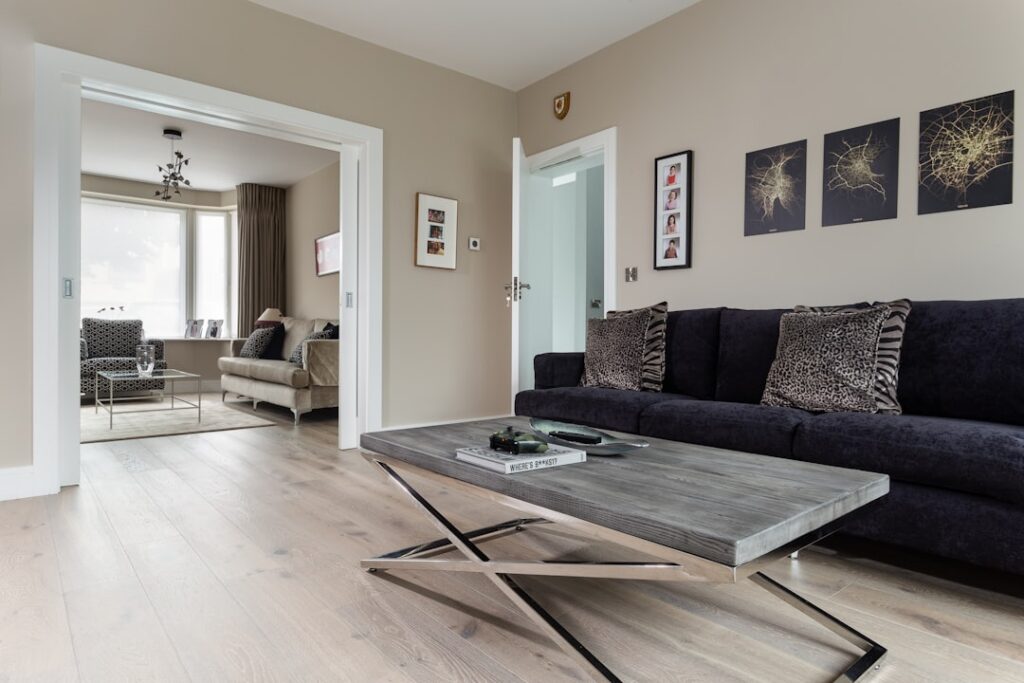
Walk into any flooring showroom in 2026 and you will see laminate that looks like wood sitting right next to engineered oak at one-third the price. Pergo TimberCraft and Mohawk RevWood now print up to 64 unique plank faces, run register-embossed grain that you can feel with your fingertips, and bevel four edges so individual boards read as real timber from six feet away. The trick is sorting the convincing products from the shiny knock-offs that scream fake the moment afternoon sun hits them.
What Makes a Laminate Plank Look Real
Three things separate believable laminate from the cheap stuff. First, the decorative film: high-end lines use 1200 dpi scans of actual white oak, hickory, or walnut, with at least 24 unique board patterns repeating across a pallet. Cheap laminate repeats every 6 to 8 boards, which the eye picks up as a pattern within an hour. Second, the texture layer should be embossed in register (EIR), meaning the grain texture lines up with the printed grain you see. Run your fingernail across it; you should feel knots, cathedrals, and saw marks in the exact spots they appear visually.
Third, edge treatment matters more than buyers expect. Micro-beveled edges on all four sides cast a thin shadow line that mimics how real hardwood planks meet. Painted bevels in a matching stain color sell the illusion completely, while square-edge laminate tends to read like one continuous sheet under raking light.
AC Ratings and Wear Layer Basics
The AC rating tells you what abuse the plank can take. AC3 (12,000 cycle Taber test) handles normal residential traffic. AC4 jumps to 18,000 cycles and shrugs off pets, kids, and rolling office chairs. AC5 and AC6 are commercial-grade and overkill for most homes, but worth the small premium if you have a big dog or run a daycare. Wear layer thickness on laminate is measured differently than on LVP; instead of mils, look for melamine overlay weight, with premium products listing 80 to 110 grams per square meter.
Most reputable brands now bond a 12 mm HDF core rated to 900 to 1000 kg/m3 density. Anything thinner than 10 mm tends to telegraph subfloor imperfections and click joints that pop apart under load.
Top Brands Worth Comparing
Pergo Outlast+ runs about $2.79 to $3.49 per square foot at Home Depot and uses SpillProtect24 surface sealing on click joints. Mohawk RevWood Plus costs $3.29 to $4.49 and ships with the SignaTouch EIR texture that is genuinely hard to distinguish from real oak. Shaw Repel sits in the $2.49 to $3.19 range with a 30-year residential warranty and waterproof core technology. For budget projects, Tarkett Crossville and Quick-Step Studio start around $1.79 per square foot but skip the deep register embossing.
- Pergo TimberCraft+ WetProtect: 12 mm core, AC4, $3.99 sq ft
- Mohawk RevWood Premier: 10 mm core, AC4, $4.29 sq ft
- Shaw Repel Anchorage Oak: 12 mm core, AC4, $2.89 sq ft
- AquaGuard from Floor and Decor: 12 mm core, AC4, $2.49 sq ft
Installation Realities for DIYers
Laminate clicks together with Uniclic or Valinge 5G joints, which means no glue and no nails. You will need a 3/8 inch expansion gap around every wall, every column, and every transition to hard surfaces. Skip the gap and the floor will buckle the first time humidity swings from 35% in February to 65% in July. Use a $35 tapping block and a $20 pull bar from Roberts, never a hammer directly on the plank edge.
Subfloor flatness tolerance is 3/16 inch over 10 feet. Plywood that exceeds this needs grinding or self-leveling compound before you start. On concrete, a 6-mil polyethylene vapor barrier is required by every major manufacturer, and skipping it voids the warranty. Most products include an attached 1 mm IXPE underlayment; do not add a second pad on top, as the stacked cushion causes joint fatigue.
Where Laminate Beats Engineered Hardwood
For high-traffic areas with kids, dogs, and the occasional spilled juice box, laminate wins on cost and durability. A AC4 plank shrugs off dog claws that would dent white oak in a week. The melamine wear layer also blocks UV fading, so south-facing rooms keep their color while real hardwood bleaches near the windows. Refinishing is impossible, but replacement is cheap; pull up the damaged plank and click in a new one in about 15 minutes.
Where It Still Falls Short
Laminate cannot be sanded and refinished, so a single deep scratch lives forever unless you swap planks. The hollow sound underfoot bothers some homeowners; a thicker IXPE or cork underlayment helps but never matches the solid thud of nailed hardwood. Resale appraisers in upscale markets still value real wood higher, though that gap is closing fast as photo realism improves.
Underlayment and Acoustic Performance
Even with attached IXPE underlayment, second-story installations benefit from an upgraded acoustic mat to reduce footstep transmission. Look for an STC (Sound Transmission Class) rating of 60 or higher and IIC (Impact Insulation Class) of 65 or above. QuietWalk Plus at $0.85 per square foot and Roberts Super Felt at $0.40 per square foot are condo-board favorites for meeting HOA quiet-floor mandates. Cork underlayments at 3 to 6 mm thickness add another 5 to 8 STC points but require longer expansion gaps because cork compresses unpredictably.
Final Buying Checklist
Before you pull the trigger, pull a sample plank out of the box at the store and look at it under both fluorescent and natural light. Check for repeating patterns across at least 10 boards. Press your thumbnail into the surface; quality wear layers resist marking. Confirm AC4 minimum, 12 mm core, four-sided micro-bevel, EIR texture, and a waterproof core warranty of at least 25 years. Look for FloorScore or GreenGuard Gold certification to confirm low formaldehyde emissions under CARB Phase 2 limits. Get the laminate that looks like wood right and most guests will never guess what is under their feet, and the budget savings versus engineered oak puts the difference back into the rest of the renovation.
Prefer to explore on your own?
See how new flooring looks in your actual room in seconds — free, no signup.
Try the free Floor Studio →