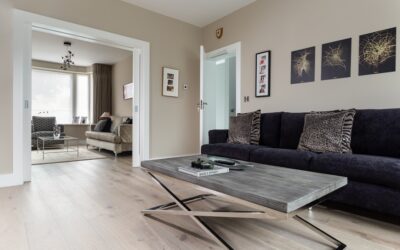
Few flooring products are as misunderstood as laminate. Shoppers lump it in with vinyl, dismiss it as the “fake wood” of the 1990s, or assume one splash of water will destroy it. The truth is that modern laminate is a precision-engineered wood-fiber product that outscratches nearly everything else on the market — including hardwood and luxury vinyl — at $1 to $4 per square foot. Here’s exactly what laminate is, how to read its ratings, and which rooms it belongs in.
What Laminate Actually Is: Four Layers
Laminate flooring is a fused sandwich of four layers pressed together under heat and roughly 1,400 psi of pressure:
- Wear layer: A clear coating of melamine resin infused with aluminum oxide — one of the hardest materials used in flooring. This is what makes laminate so scratch resistant.
- Design layer: A high-resolution photographic print of wood, stone, or tile. Modern printing includes embossed-in-register (EIR) texturing, where the surface grain physically lines up with the printed grain.
- Core layer: High-density fiberboard (HDF) — wood fibers and resin compressed to 50+ pounds per cubic foot. The core provides the structure and hosts the click-lock joint. This is also the vulnerable part: HDF swells if it absorbs water.
- Backing layer: A melamine stabilizing layer that balances the board and resists moisture from below.
Total thickness runs 6 mm to 14 mm. Thicker planks (10 to 12 mm) feel more solid underfoot, bridge minor subfloor dips better, and sound closer to real wood, but thickness by itself doesn’t equal durability — the wear layer does that work.
AC Ratings: The Number That Actually Matters
Every legitimate laminate carries an Abrasion Class (AC) rating from standardized testing of abrasion, impact, staining, and burn resistance.
| Rating | Intended use | Buy it for |
|---|---|---|
| AC1 | Light residential | Closets, rarely — mostly obsolete |
| AC2 | Moderate residential | Bedrooms, formal rooms |
| AC3 | Heavy residential | Whole-house use; the residential sweet spot |
| AC4 | Light commercial | Busy family homes, home offices, entries |
| AC5 | Heavy commercial | Retail-grade; overkill and rougher texture at home |
For most households, AC3 is the floor and AC4 is the smart upgrade for stairs, hallways, and homes with large dogs. If a bargain product lists no AC rating at all, walk away — that’s not an oversight, it’s a dodge.
Water Resistance: What “Waterproof Laminate” Really Means
Traditional laminate’s Achilles heel is its HDF core. Standing water that penetrates the seams swells the fiberboard, and swollen edges never flatten back out. Since around 2019, though, most major brands sell water-resistant lines — Pergo WetProtect, Mohawk RevWood Plus, AquaGuard, Shaw Repel — that combine tighter joints, hydrophobic edge coatings, and denser cores. These are typically warranted against topical spills for 24 to 72 hours, and some carry lifetime surface-water warranties.
Understand the limit: these products are water resistant from above, not waterproof through and through. A failed dishwasher line that floods the subfloor will still ruin them. For genuinely wet areas or below-grade concrete with moisture questions, a rigid-core vinyl like WPC flooring is the safer call.
Where Laminate Works Best
Great fits: living rooms, dining rooms, bedrooms, hallways, home offices, and — with a water-resistant line — kitchens and half baths. Laminate’s scratch resistance makes it arguably the best floor in the house for dog claws, chair legs, and kids’ toys. It also installs as a floating floor over existing vinyl, tile, or wood, which keeps renovation costs down.
Use caution: full bathrooms and laundry rooms (only with a waterproof-rated product and sealed perimeter), and basements (fine over a proper vapor barrier if the slab passes a moisture test — tape a 2×2-foot plastic sheet to the concrete for 24 hours; condensation underneath means fix moisture first).
Skip it: mudrooms with snow-melt puddles, sunrooms with extreme temperature swings, and anywhere with known slab moisture. If you’re finishing a basement, get the concrete slab conditions right before any wood-fiber product goes down.
Laminate vs the Lookalikes
At arm’s length, laminate, luxury vinyl plank, and engineered hardwood can be indistinguishable. The differences live in the core. Laminate (wood-fiber core) wins on scratch resistance, realistic texture, and price. Vinyl (plastic core) wins on waterproofing and softness underfoot. Engineered hardwood (real wood veneer) wins on authenticity and resale value but scratches far more easily and costs 2 to 4 times more. A useful rule: pets and traffic point to laminate, water points to vinyl, resale value in a higher-end home points to wood. For deeper side-by-sides between categories, our carpet and hard-surface guides cover when soft flooring beats hard flooring room by room.
What Laminate Costs
Material runs $1 to $2 per square foot for entry AC3 product, $2 to $3.50 for water-resistant mid-range, and $3.50 to $5 for premium 12 mm EIR planks with attached pads. Professional installation adds $2 to $5 per square foot including underlayment and trim. A 1,000-square-foot main level therefore lands between $3,500 and $8,000 installed — roughly half the cost of engineered hardwood. Laminate is also among the most DIY-friendly floors made: click-lock joints, no glue, no nails. A capable homeowner can floor a bedroom in a weekend with a saw, spacers, and a tapping block.
Living With Laminate
Maintenance is simple and cheap. Sweep or dry-mop regularly; grit underfoot is the main ager of any floor. Damp-mop with a barely wet microfiber pad and a laminate-specific cleaner — never steam mops, which force vapor into joints and void most warranties, and never wax or polish, which haze the melamine surface. Use felt pads under furniture and walk-off mats at exterior doors. One honest limitation: laminate cannot be refinished. When the wear layer is finally gone, the plank is done. That’s why the AC rating and a realistic 15-to-25-year expectation matter more than any marketing claim on the box.
How to Shop the Laminate Aisle
Once you know the specs, comparing products takes minutes. Start with the AC rating and eliminate anything below AC3. Next check thickness — 8 mm is the practical minimum, 10 to 12 mm the comfort zone — and whether an underlayment pad is attached (attached pads save $0.30 to $0.50 per square foot but are usually thinner than a good separate underlayment; on concrete you’ll still want a vapor barrier beneath either way). Then examine the joint: better products use reinforced, wax-impregnated click profiles that survive a couple of disassemblies; bargain boards chip at the locking tongue during installation. Look at plank size too — 7-inch-plus widths and 48-to-54-inch lengths lay out with fewer repeating joints and read more like real hardwood across a big room.
Finally, judge the visual honestly. Count the unique plank designs in a box (ask for the “screen count” — quality lines print 20+ distinct boards before repeating), check for embossed-in-register texture, and favor low-gloss matte finishes, which hide micro-scratches and look more like oiled wood than the shiny laminates of the 2000s. Buy 10% overage for cuts and future repairs from the same dye lot, and keep the leftover boxes: a laminate floor can’t be patched from a different production run without a visible shade shift. A final sanity check on warranties — a “lifetime” residential warranty with a 25-year water clause tells you more about the maker’s confidence than any showroom pitch.
Laminate FAQ
Is laminate real wood? Partly. The core is real wood fiber (HDF), but the surface is a printed image under a resin wear layer — no wood veneer.
Does laminate scratch easily? No — the aluminum-oxide wear layer is harder than hardwood finishes and most vinyl. It’s the best mainstream floor for scratch resistance.
Can you mop laminate? Damp-mop yes, wet-mop no. Standing water at the seams is the enemy.
Why does laminate sound hollow? It floats over the subfloor rather than being fastened down. A quality underlayment and thicker (10 to 12 mm) planks reduce the clack substantially.
How long does laminate last? 15 to 25 years for AC3/AC4 product that’s kept dry and gritted mats at the doors — often longer in bedrooms.
Laminate earned its second act. If your priorities are scratch resistance, realistic wood looks, and a budget that leaves room for the rest of the renovation, it’s not the compromise choice — it’s frequently the correct one.
Prefer to explore on your own?
See how new flooring looks in your actual room in seconds — free, no signup.
Try the free Floor Studio →