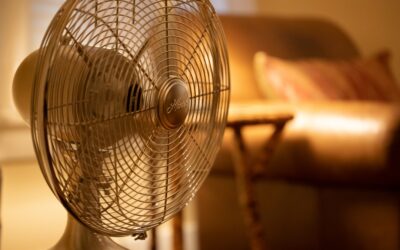
When a ceiling fan and a desk fan just are not enough, you need something with real muscle. A large portable fan moves a high volume of air across big spaces — garages, workshops, patios, gyms, and open-plan rooms — while still rolling or carrying to wherever the heat is. Unlike a fixed installation, you buy it once and use it everywhere, from cooling a stuffy bedroom in summer to drying out a flooded basement. The trick is matching the fan’s airflow, power source, and design to how you actually plan to use it.
Why Bigger Fans Move More Air
Airflow comes down to one main spec: CFM, or cubic feet per minute. A small tabletop fan might push 200 to 500 CFM, while a large portable fan moves anywhere from 2,000 to 13,000 CFM. That difference is the gap between stirring the air near your desk and creating a breeze you feel across an entire garage.
Bigger blades and stronger motors do the work, but blade design and tilt matter too. For cooling people, you want air thrown far and wide; for drying or ventilation, you want focused, high-velocity airflow.
Common Types to Consider
“Large portable” covers several distinct designs, each built for a different job. Knowing the categories helps you avoid overbuying or underbuying.
- High-velocity floor fans — compact metal fans, often 20 inches, that throw a strong directed stream; great for garages
- Pedestal fans — tall, oscillating fans that cover wide living areas and adjust in height
- Drum fans — barrel-shaped powerhouses moving 8,000-plus CFM for warehouses and big shops
- Air movers — low-profile blowers used for drying carpets and floors after spills
- Misting fans — outdoor fans that add a fine water spray to cool patios in dry heat
For most homeowners, a 20-inch high-velocity fan or an oscillating pedestal model hits the sweet spot of power and practicality.
Corded vs Battery-Powered Models
Power source shapes where you can actually use the fan. Corded fans plug into a standard 120-volt outlet and run indefinitely with consistent power, making them the workhorse choice for garages and rooms with outlets nearby.
Battery-powered fans from cordless tool brands like DeWalt, Milwaukee, and Ryobi run off the same packs as your drills, so they shine on patios, job sites, and during outages. Runtime varies from a few hours on high to over a day on low, depending on battery size. If you already own a tool battery platform, a matching fan is a smart pickup.
Key Features Worth Paying For
Beyond raw airflow, a few features separate a fan you tolerate from one you love. Oscillation spreads air across a room instead of one spot. Adjustable tilt lets you aim airflow at the ceiling, a workbench, or wet flooring. Variable speed control matters more than a high top speed, since you will often run it on medium.
Look for sturdy wheels or a rugged handle for true portability, and a metal cage or housing if the fan will live in a garage or shop. Quieter brushless motors are worth it for bedrooms, while noise matters less in a workshop.
Matching Fan Size to Your Space
Buy for the room, not the showroom. A rough guideline ties CFM to square footage and how aggressively you want to move air.
- Up to 200 sq ft — a pedestal or 12- to 16-inch fan around 2,000 CFM
- 200 to 400 sq ft — a 20-inch high-velocity fan, 3,000 to 4,500 CFM
- 400 to 800 sq ft — a drum fan in the 6,000 to 8,000 CFM range
- Garages and shops over 800 sq ft — a large drum fan at 10,000-plus CFM
When in doubt, size up. A large fan on a lower speed runs quieter and lasts longer than a small fan maxed out.
Indoor, Outdoor, and Job-Site Uses
One of the best arguments for a large portable fan is versatility. Indoors, it supplements air conditioning, pushing cool air into rooms the AC struggles to reach and cutting your cooling bill. During the off-season, it doubles as a ventilation tool when you are painting, sanding, or running a generator-free workshop.
Outdoors, a misting or high-velocity fan makes a hot patio or garage bearable in summer. After a plumbing leak or basement flood, an air mover dries flooring and drywall fast, helping prevent mold before it starts.
Safety and Smart Placement
A powerful fan moves a lot of air, and where you put it changes how well it works and how safe it is. For cooling a room, position the fan to create cross-ventilation — point it toward an open window to push hot air out, or aim it across the room from a doorway to pull cooler air in. Aiming a fan directly at yourself feels good but does little to actually cool the space.
Keep cords clear of walkways and never run a fan’s cord under a rug, where heat can build up. In garages and shops, mount or position the fan so the metal cage cannot catch loose clothing, hair, or shop rags near moving parts. Drum fans and high-velocity units are powerful enough to tip lightweight objects, so set them on stable, level ground.
- Cross-ventilate by aiming the fan toward an open window or door
- Keep cords clear of foot traffic and never under rugs
- Use a GFCI outlet for any fan running in a damp garage or basement
- Stabilize tall or heavy fans so they cannot tip over
For outdoor or damp use, confirm the fan is rated for it and plug into a GFCI-protected outlet to guard against shock.
Choosing and Caring for Your Fan
Set a budget based on use: a solid 20-inch high-velocity fan runs $60 to $120, quality pedestal fans $40 to $100, and heavy-duty drum fans $150 to $300. Cordless models cost more once you factor in batteries.
Maintenance is simple but important. Dust the blades and cage monthly, since buildup chokes airflow and strains the motor. Wipe the housing of garage fans to keep grime off the bearings, and store battery fans with a partial charge. A well-chosen large portable fan will keep you comfortable for years, moving from room to room and season to season as your needs change.