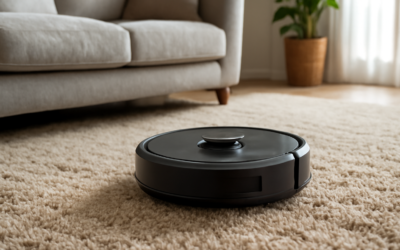
If you have shopped budget robot vacuums, you have run into Lefant. The Lefant robot vacuum shows up constantly in the $100 to $250 range, undercutting Roomba by a wide margin while promising the same hands-off cleaning. I have run these on hardwood, tile, and low-pile carpet across a few homes, and I want to give you a straight answer on what they do well, where they fall short, and how to get the most out of one.
Which Lefant Model Fits Your Home
Lefant sells several models, and the differences matter more than the price gap suggests. The Lefant robot vacuum lineup breaks down roughly like this:
- Lefant M210 / M210 Pro: The entry point, around $100 to $130. Small 3-inch-tall puck, random-path navigation, and roughly 2200Pa suction. Great for apartments and under low furniture.
- Lefant M310 / U200: Mid-tier at $150 to $200, stronger suction near 4000Pa, and better app control.
- Lefant N3 / M1: The upper end near $200 to $260, with laser or gyro-assisted mapping, up to 4000Pa, and self-emptying options on some bundles.
The key spec split is navigation. Cheaper Lefants use random bounce-around cleaning with no map, while the N3-class models actually build a floor plan you can see in the app. If you have one open room, random is fine. For a multi-room home where you want zone cleaning, spend up for mapping.
Suction and Real Floor Performance
Numbers on a box only tell you so much. Here is how these actually clean:
- Hard floors (hardwood, tile, LVP): This is where Lefant shines. The bagless design and brushless suction inlet pull up crumbs, dust, and pet hair without a spinning brush to tangle. On my hardwood, a single pass gets 90-plus percent of visible debris.
- Low-pile carpet and area rugs: Solid on 2200Pa-plus models. It grabs surface dirt but will not deep-clean like an upright.
- Thick or high-pile carpet: This is the weak spot. Light pucks with modest suction struggle, and some models get stuck climbing thick rug edges.
The brushless main inlet is genuinely clever for pet owners. Traditional roller brushes wrap long hair into a tangled mess you cut out weekly. Lefant’s design avoids most of that, which is a real maintenance win in a house with a shedding dog or long-haired occupants.
App Setup and First-Run Tips
Getting it running takes about 15 minutes. Do it right the first time:
- Charge the dock and let the vacuum sit on it until the battery hits 100 percent before the first clean.
- Download the Lefant app and create an account.
- Connect to 2.4GHz Wi-Fi only. This trips up more people than anything else. The vacuum cannot see a 5GHz network, so if your router combines both bands under one name, temporarily split them or use a 2.4GHz guest network.
- Run one full cleaning cycle to let it learn the space (on mapping models, this builds the map).
- Set a schedule, for example weekdays at 10 a.m. once you have left for work.
Pro tip: for random-navigation models, run it more often rather than expecting one perfect pass. Two shorter runs beat one long one because the bounce pattern eventually covers everything.
Battery Life, Run Time, and Coverage
Runtime decides how much floor one charge can cover. The Lefant models land in a useful range for typical homes:
- M210 series: Around 100 minutes on a charge, enough for roughly 900 to 1,200 square feet on hard floors before it needs to dock.
- M310 / N3 class: Up to 120 minutes, covering a larger single-level home in one pass.
- Recharge time: Expect 4 to 6 hours from empty. Mapping models can recharge and resume where they left off; random-path models simply restart.
The puck itself is about 12 inches across and roughly 3 inches tall, which is the number that matters most for furniture. That low profile slides under most couches, beds, and toe-kicks where an upright vacuum never reaches. Measure your lowest clearance before you buy; if your sofa sits at 2.75 inches off the floor, no robot fits under it, Lefant or otherwise.
Prep Your Space So It Actually Works
The biggest complaints about any budget robot come from poor prep, not the machine. Before you hit start:
- Pick up cords, socks, and phone chargers. These are the number-one cause of a stuck-and-beeping vacuum.
- Use boundary strips or the app’s no-go zones to block pet water bowls and rug tassels.
- Set the dock against a wall with about 1.5 feet of clearance on each side and 4 feet in front so it can find its way home.
- Watch dark rugs and thresholds. Cliff sensors sometimes read very dark flooring as a drop-off and back away. If it avoids a black rug, that is why.
Cleaning and Maintaining the Unit
A robot vacuum only stays effective if you maintain it. Budget a few minutes a week:
- Empty the dust bin after every one or two runs. The bins are small, around 500ml, so they fill fast in a busy house.
- Tap out or rinse the filter weekly, and let it fully dry before reinstalling. Replace it every two to three months. Keep a spare on hand.
- Wipe the cliff sensors and charging contacts with a dry cloth so it docks reliably.
- Clean the side brushes of wrapped hair, and check the wheels for lint every couple of weeks.
Batteries typically deliver 90 to 120 minutes per charge and last a couple of years. Replacement batteries and filters are cheap and available, which is a point in Lefant’s favor over some off-brands that vanish after a year.
How Lefant Compares to Roomba and Eufy
Nobody shops a budget robot in a vacuum, so here is the honest head-to-head:
- Lefant vs. iRobot Roomba: A comparable Roomba runs $250 to $600. Roomba maps better, empties itself on higher trims, and handles thick carpet with a dual rubber brushroll. Lefant gives you 80 percent of the daily-clean value for a third of the money, and its brushless inlet actually beats Roomba on hair tangles.
- Lefant vs. Eufy (Anker): Eufy’s RoboVac line is the closest competitor on price. Eufy edges it on app polish and mapping consistency; Lefant counters with stronger suction numbers and the no-tangle design at a similar cost.
- Lefant vs. a corded stick vacuum: Different jobs. The stick deep-cleans on demand; the robot keeps floors maintained daily so debris never builds up. Many homes run both.
Where Lefant clearly wins: price, low-profile access under furniture, and pet-hair handling on hard floors. Where it loses: deep-pile carpet, whole-home mapping precision, and self-emptying convenience unless you buy the top bundle.
Common Problems and Quick Fixes
Most issues have simple causes:
- Won’t connect to Wi-Fi: Almost always the 5GHz problem above. Force 2.4GHz.
- Weak suction: Full bin or clogged filter. Empty and clean before assuming it is broken.
- Won’t return to dock: Move the dock to an open wall and clear clutter around it.
- Misses spots: On non-mapping models, run it more frequently. On mapping models, re-run the mapping cycle.
- Gets stuck under the same chair every time: Set a no-go zone in the app or drop a boundary strip. It is learning the hard way otherwise.
- Squealing or grinding noise: Hair or a wood chip is wrapped around a wheel axle or lodged in the inlet. Flip it over, clear the debris, and it quiets right down.
- Short runtime after a year: The battery is aging. A replacement pack is inexpensive and swaps in with a couple of screws, cheaper than a whole new unit.
Common mistake I see constantly: people expect one robot to replace a full-size vacuum. It will not. Treat it as a daily maintenance tool that keeps dust and crumbs from ever accumulating, and run your upright every week or two for the deep clean. Framed that way, a budget robot delivers exactly what it promises.
The Bottom Line
For the money, a Lefant robot vacuum is a smart buy if your home is mostly hard floors and low-pile rugs, and if you have pets that shed. You get genuinely useful daily maintenance cleaning for a fraction of a premium robot’s price, with the brushless inlet as a standout feature. Just go in with the right expectations: it maintains a clean floor, it does not deep-clean thick carpet, and it needs a tidy space to do its best work. Split your Wi-Fi to 2.4GHz, keep the filter fresh, and pick up the cords, and this little puck will quietly earn its keep every day.