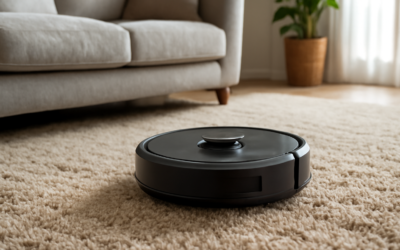
Robot vacuums have gone from novelty pucks that bounced off walls to genuinely capable cleaners that map your home, empty themselves, and mop hard floors. Our best robot vacuum 2025 reviews cut through the marketing to focus on the specs that actually matter on real floors: suction in pascals, navigation accuracy, and how often you have to touch the thing. Whether you have wall-to-wall carpet, a house of hardwood, or a pet that sheds year-round, these best robot vacuum 2025 reviews point you to the right pick and price.
- How We Judged Each Model
- iRobot Roomba j9+ — Best for Pet Owners
- Roborock Q Revo — Best All-Around Value
- Eufy Clean X9 Pro — Best Mopping
- Shark AI Ultra 2-in-1 — Best Budget Self-Empty
- Eufy RoboVac 11S — Best Under $200
- Quick Comparison at a Glance
- Carpet Versus Hard Floors
- Ongoing Costs to Budget For
- How to Choose the Right One
- Features That Are Actually Worth Paying For
- Setup and Maintenance Tips
- The Bottom Line
How We Judged Each Model
Suction alone doesn’t make a good robot vacuum. A unit that pulls 8,000 pascals but gets lost every third run is worse than a smarter machine at 5,000 Pa. We weighed four factors: cleaning power, navigation and mapping, self-maintenance features like auto-empty and self-washing mops, and total cost including the docking station.
Battery runtime matters for larger homes, so we noted how many square feet each covers per charge. And because carpet and hard floors demand different things, we flagged which models handle each best.
iRobot Roomba j9+ — Best for Pet Owners
The Roomba j9+ runs around $599 to $899 depending on sales and whether you add the combo mop. Its standout feature is obstacle avoidance: iRobot’s PrecisionVision genuinely dodges pet waste, cords, and socks, and the company backs it with a pet-mess guarantee. The self-empty Clean Base holds up to 60 days of debris in a bag.
On carpet it lifts embedded dirt well thanks to dual rubber rollers that resist hair tangles. Runtime covers roughly 1,500 square feet before it docks to recharge and resume. The main downside is price and the ongoing cost of replacement bags, but for homes with shedding dogs and cats, it’s the most hands-off option here.
Roborock Q Revo — Best All-Around Value
At $699 with frequent drops to $499, the Roborock Q Revo delivers flagship features for a mid-range price. It combines strong suction near 5,500 Pa with dual spinning mop pads that lift 7 millimeters to clear low carpet, then wash and dry themselves at the multifunction dock.
LiDAR navigation builds an accurate map on the first run and lets you set no-go zones and room-specific cleaning from the app. For a mixed home of tile, laminate, and area rugs, this is the model most buyers should start with. It handles both vacuuming and mopping without you refilling water every day, since the dock stores clean and dirty tanks.
Eufy Clean X9 Pro — Best Mopping
If your floors are mostly hard surfaces, the Eufy Clean X9 Pro, around $649, mops better than anything at its price. Two rotating mop pads spin at 180 rpm and press down with actual downward force, so dried coffee and juice spills come up rather than smearing. The pads auto-lift for carpet and self-wash with hot water at the base.
Suction sits near 5,500 Pa, plenty for daily dust and crumbs on tile and vinyl. It’s not the best deep-carpet cleaner in this list, so heavy-carpet homes should look elsewhere, but for open-plan hard floors it leaves a genuinely mopped shine.
Shark AI Ultra 2-in-1 — Best Budget Self-Empty
Shark’s AI Ultra, often $399 to $549, is the value pick for anyone who wants a self-emptying base without the flagship premium. The bagless auto-empty dock holds up to 60 days of debris and saves money since there are no bags to buy. Its row-by-row navigation cleans methodically rather than randomly.
Suction handles pet hair and everyday messes well on both carpet and hard floors, and the self-cleaning brushroll cuts down on tangles. Mapping isn’t as sharp as LiDAR rivals, and it can struggle in very complex floor plans, but for a straightforward home the price-to-feature ratio is hard to beat.
Eufy RoboVac 11S — Best Under $200
Not everyone needs mapping and mopping. The slim Eufy RoboVac 11S, usually $199 or less, is only 2.85 inches tall, so it glides under couches and beds that taller robots can’t reach. It navigates by bump-and-continue rather than a map, which means no app zones, but it’s quiet at around 55 decibels and cleans reliably.
There’s no self-empty dock, so you’ll empty the small bin every couple of runs, and no mopping. For a small apartment or a single level of hard floor and low carpet, it does the core job at a fraction of the cost.
Quick Comparison at a Glance
Prices shift with sales, but here’s roughly where each model lands and who it’s for:
- Roomba j9+ — $599 to $899. Best obstacle avoidance and pet-mess handling; premium price.
- Roborock Q Revo — $499 to $699. Best all-around; LiDAR mapping plus self-washing mops.
- Eufy Clean X9 Pro — around $649. Best mopping with real downward pressure for hard floors.
- Shark AI Ultra — $399 to $549. Best budget self-empty with a bagless dock.
- Eufy RoboVac 11S — under $200. Slimmest body at 2.85 inches; basic but reliable.
Carpet Versus Hard Floors
The single biggest factor in your choice is what you’re cleaning. Deep or plush carpet demands high suction and stiff rubber rollers that agitate fibers, which is why the Roomba j9+ and Roborock Q Revo pull ahead there. Low-pile carpet and rugs are more forgiving, and nearly any model in this list handles them.
Hard floors flip the priorities. On tile, luxury vinyl, laminate, and sealed hardwood, suction matters less and mopping matters more, so the Eufy X9 Pro’s pressing, rotating pads leave a cleaner finish than a pad that just drags water around. If your home mixes both, look for auto-lifting mops that raise when the robot detects carpet, a feature the Q Revo and X9 Pro both include, so you don’t soak your rugs.
Ongoing Costs to Budget For
The sticker price isn’t the whole story. Self-empty bases that use bags, like the Roomba Clean Base, cost roughly $15 to $20 for a multi-pack that lasts a few months, while bagless docks such as Shark’s avoid that expense entirely. Every robot also needs replacement filters every two to three months and new side brushes and mop pads once or twice a year, adding up to somewhere between $40 and $80 annually.
How to Choose the Right One
Match the robot to your floors and your tolerance for maintenance. A few quick rules:
- Lots of pet hair: Prioritize rubber rollers and strong suction, like the Roomba j9+ or Roborock Q Revo.
- Mostly hard floors: A robust mopping robot such as the Eufy X9 Pro pays off.
- Hate emptying bins: Get any model with a self-empty base; a bagless Shark dock avoids recurring bag costs.
- Tight budget: The Eufy 11S covers the basics under $200.
- Large or multi-room home: LiDAR mapping with room zones and resume-after-charge is worth the premium.
Features That Are Actually Worth Paying For
Self-empty docks top the list, because emptying a tiny 0.3-liter bin by hand every run gets old fast, and a base extends that to weeks. Accurate mapping is next; it lets you send the robot to just the kitchen after dinner instead of running the whole floor. Self-washing mop pads matter only if you have significant hard flooring, otherwise you’re paying for hardware you won’t use.
Skip paying extra for turbo suction numbers above 6,000 Pa unless you have deep pile carpet, since most homes never notice the difference on hard floors and low pile. Spend the money on navigation and self-maintenance instead, because those are the features that determine whether the robot actually runs on its own or becomes another gadget you babysit.
Setup and Maintenance Tips
Get the most from any of these by prepping your home before the first run. Clear cords, small rugs with tassels, and loose items off the floor so the robot maps a clean layout, then let it complete one full mapping run before setting up zones. Empty the dustbin or check the self-empty bag on a schedule so suction never drops, and rinse the mop pads the same day you use them to avoid mildew.
Once a week, flip the robot over and cut hair from the brushroll and axles, wipe the drop sensors and charging contacts, and check the side brush for bends. A five-minute weekly cleaning keeps navigation accurate and suction strong, and it’s the single biggest factor in whether a robot vacuum lasts three years or ten.
The Bottom Line
For most homes, the Roborock Q Revo is the smart starting point, balancing suction, mopping, and mapping around $499 to $699. Pet owners who want maximum hands-off convenience should stretch to the Roomba j9+. Hard-floor households get the cleanest results from the Eufy X9 Pro, budget shoppers can trust the Shark AI Ultra for self-empty value, and anyone furnishing a small apartment can start with the Eufy 11S under $200.