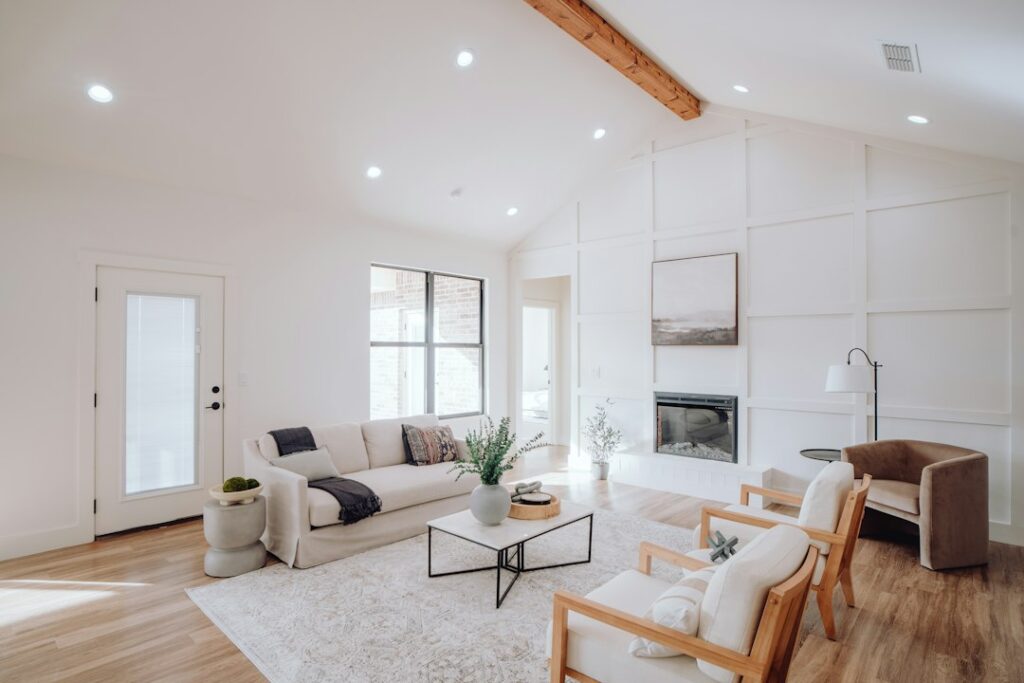
More sectional sofas get returned for the wrong orientation than for almost any other reason, and the fix is simple once you know the rule. A left facing sectional has its chaise, corner or longer section on your left when you stand in front of the sofa and look at it, the way you would look at it in a showroom. It is not about which side is on your left when you are sitting on it. That single point of view clears up most of the confusion, because sitting down flips everything.
Retailers shorten the terms to LAF (left arm facing) and RAF (right arm facing). A right facing sectional is the mirror image: the chaise or return sits on your right as you face it. Before you order, you need to decide which layout fits your walls, doorways, windows and TV, and the fastest way to be sure is a tape mock-up on the floor. The sections that follow walk through each step.
- What a Left Facing Sectional Actually Means
- Tools and Materials for Planning the Layout
- How to Decide Between Left and Right Facing
- The Tape-on-Floor Mock-Up Method
- Measuring for Delivery and Fit
- Troubleshooting Common Orientation Mistakes
- General Cost Ranges
- When to Get Help
- Frequently Asked Questions
What a Left Facing Sectional Actually Means
The phrase “facing” describes the viewer, not the sitter. Picture yourself standing a few feet in front of the sofa with the seat cushions pointed at you. If the chaise lounge or the L-shaped return extends toward your left hand, the piece is a left facing sectional, often listed as a left chaise sectional or left facing chaise. If it extends toward your right hand, it is right facing.
Where people trip up is when they sit down. Once you turn around and sit on a left facing chaise sectional, the chaise ends up on your right side. That is why shoppers who measure while sitting on their current sofa often order the opposite of what they need. Always decide while standing and looking at the front of the piece.
The same logic applies to individual modular pieces. A left arm facing loveseat has its only arm on the left as you face it, and a right arm facing corner unit has its arm on your right. When a listing calls something a left hand sectional couch, a left sectional sofa or a left hand facing sectional, it almost always means the same LAF orientation, but read the product diagram to confirm. Some sellers label by the sitter’s view, and the drawing is the only reliable tiebreaker.
Quick reference
- LAF (left arm facing): arm, chaise or return on your left while facing the sofa
- RAF (right arm facing): arm, chaise or return on your right while facing the sofa
- Armless pieces: no orientation, fit anywhere in a modular run
- Reversible chaise: a loose ottoman-style chaise that clips to either end, so orientation can change later
Tools and Materials for Planning the Layout
You do not need anything special to plan a sectional, but a few basics save a lot of guesswork:
- A 25-foot tape measure
- Painter’s tape (1.5 or 2 inch) in a color that shows on your floor
- Graph paper or a free room-planning app
- The product’s dimension sheet, including overall width, depth, chaise length and seat height
- A helper, so one person can stand in the doorway while the other adjusts tape
- A phone camera, to photograph the mock-up from the entry and main seating spots
Painter’s tape matters more than it seems. It will not lift finish from hardwood, it peels cleanly off tile and vinyl plank, and it shows up well on carpet if you pick a contrasting color.
How to Decide Between Left and Right Facing
Orientation comes down to how people move through the room and what they look at once they sit. Work through these factors in order.
1. Start with the main entry
Stand in the doorway you use most. The open side of the L should generally face that entry so the room feels welcoming and you are not walking in to the back of a chaise. If the door is on the left side of the wall where the sofa goes, a right facing piece usually keeps that side open, and the reverse is true for a door on the right. Keep a walkway of at least 30 to 36 inches between the sectional and any door swing.
2. Locate the TV or focal point
The chaise is the prime lounging seat, so it should give a comfortable, straight-on or slightly angled view of the TV or fireplace. If the chaise ends up pointed away from the screen, the person stretched out on it will be twisting their neck all evening.
3. Check windows and radiators
Avoid placing the tall back of a return across a low window you want to open, and keep upholstery a few inches away from baseboard heaters or radiators. Direct afternoon sun on one end can fade fabric, so consider which side gets the harsher light.
4. Plan traffic paths
Trace the routes to the kitchen, hallway and patio door. A sectional that juts into a main path gets bumped constantly. The short arm end is easier to walk past than a long chaise.
5. Account for corners and outlets
If the L tucks into a room corner, confirm that the corner is square and that outlets, floor vents and cable jacks will still be reachable. A floor vent under a chaise is a common oversight that makes a room feel stuffy.
The Tape-on-Floor Mock-Up Method
This is the step that prevents almost every orientation mistake. It takes about 20 minutes.
- Pull the overall width, overall depth and chaise or return length from the spec sheet.
- Clear the area, or at least move small furniture aside.
- Tape the back line of the sofa along the wall, leaving 2 to 4 inches of breathing room from the drywall and baseboard.
- Tape the front edge of the seat at the listed depth, usually 34 to 40 inches for the main run.
- Tape the chaise or return on the side you think you want, using its full length, often 60 to 70 inches from the back.
- Write “LAF” or “RAF” on a strip of tape inside the outline so you never forget which version you mocked up.
- Walk in from every doorway, then sit on the floor inside the outline facing the TV.
- Photograph the layout from the entry. Then re-tape the mirror version and repeat.
Comparing the two photos side by side usually makes the choice obvious. If both feel cramped, the sectional is simply too large for the space, and a sofa with a separate ottoman might serve you better.
Measuring for Delivery and Fit
Orientation is only half the fit. Sectionals ship in pieces, but each piece still has to clear the path from the curb to the room. Measure every doorway width, hallway width, stair turn and elevator depth. Compare those numbers to the depth and height of each boxed section, since boxes are larger than the finished furniture.
Also look at your floors. Heavy modular pieces can scratch hardwood, laminate and luxury vinyl when they are dragged into place. Put felt pads on every leg before the sections go down, and lift rather than slide when connecting them. On carpet, expect the legs to leave dents that fluff back with a little steam or a coin brushed across the fibers.
Troubleshooting Common Orientation Mistakes
You ordered the wrong side. Check whether the chaise or corner unit is reversible or modular. Many modular systems let you swap a left arm facing piece for a right arm facing one without replacing the whole set, and some retailers exchange just the single unit.
The chaise blocks a walkway. Try rotating the whole piece 90 degrees against a different wall, or float it in the room with a console table behind it. Floating a sectional often opens up paths you did not realize were possible.
The connectors do not line up. Most sections join with metal brackets or clips under the seat. If they fail to meet, check that every leg is installed, confirm the floor is level, and add thin felt shims under the low side.
The sofa creeps apart. On smooth floors the sections can drift over time. Non-slip furniture grippers or a large area rug with a quality pad underneath keep everything tight.
General Cost Ranges
Sectional prices vary widely with size, frame construction and fabric. As a rough guide, budget sectionals in a basic L shape often run from several hundred dollars to around a thousand. Mid-range pieces with kiln-dried hardwood frames, better cushions and performance fabric usually fall in the low to mid thousands. Custom, leather or large modular sets can climb well past that. White-glove delivery and assembly are often extra, and restocking fees on returned orientation mistakes can take a meaningful bite out of your refund, which is another reason the tape test is worth doing.
When to Get Help
Most homeowners can handle sectional planning on their own. Consider bringing in an interior designer or the retailer’s design service if the room has multiple doorways, an open floor plan with no clear walls, or an awkward angled corner. Professional movers are worth the cost for narrow stairwells, since a stuck section can gouge walls and railings. If the move requires removing a door from its hinges or taking off trim, a handyman can do it and reinstall everything cleanly.
Frequently Asked Questions
Is a left facing sectional judged while sitting or standing?
Standing. Face the front of the sofa as if you were looking at it in a store. If the chaise or return is on your left, it is left facing. Once you sit on it, the chaise will be on your right.
What is the difference between LAF and RAF?
LAF stands for left arm facing and RAF stands for right arm facing. They describe which side the arm, chaise or corner sits on when you face the piece.
Can I switch a sectional from left to right later?
Only if it has a reversible chaise or modular sections that can be rearranged. Fixed L-shaped sectionals cannot change orientation, so confirm the layout before ordering.
How much clearance should I leave around a sectional?
Leave about 30 to 36 inches for main walkways, 14 to 18 inches between the seat and a coffee table, and 2 to 4 inches between the back and the wall.
Which side should the chaise go on?
Put the chaise where it gives a clear view of the TV or focal point and does not block the main entry or a walkway. A floor tape mock-up of both options is the easiest way to decide.