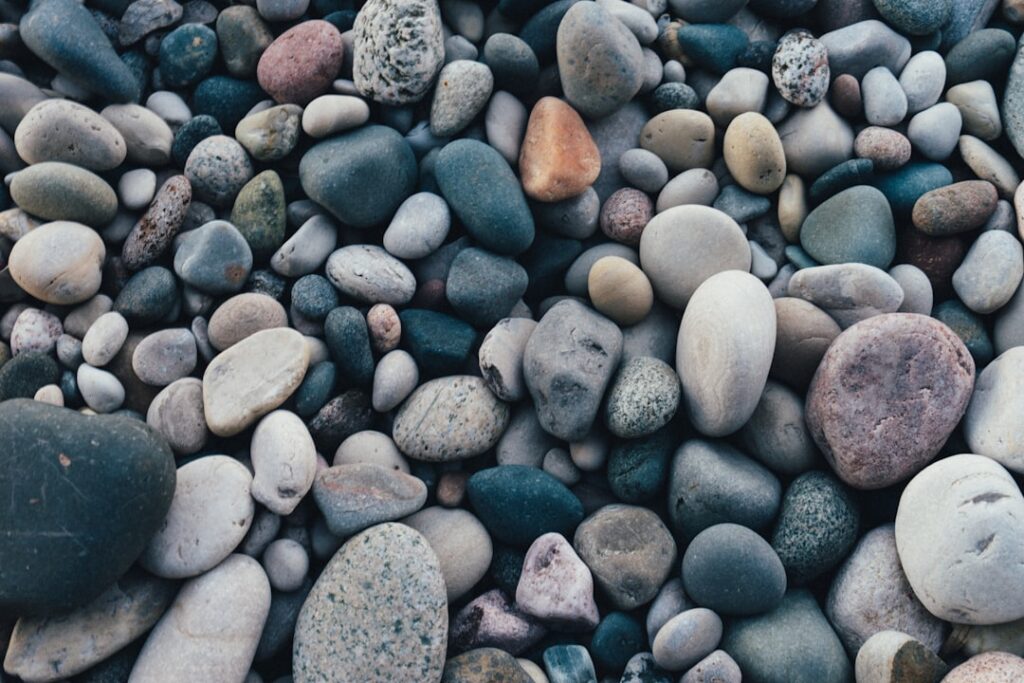
Low maintenance river rock landscaping is the closest thing to a set-it-and-forget-it yard that actually looks good. Smooth, rounded river rock never needs mowing, never rots, and when installed over quality fabric it chokes out weeds for years. I use it constantly for clients who travel, rent out properties, or are simply done with weekend yard chores. Done correctly, a river rock installation can look sharp for a decade with almost no input from you.
- Why River Rock Works for Low-Maintenance Yards
- Choosing the Right Size and Color
- Calculate How Much You Need and What It Costs
- Install It Right: Fabric and Depth Are Everything
- Build a Dry Creek Bed as a Focal Feature
- Pair River Rock With Tough, Drought-Tolerant Plants
- Keep It Looking New
- Where River Rock Works Best in the Yard
- Combining Rock With Other Materials
The catch is in the word “correctly.” I have been called to fix plenty of rock beds that turned into weed-choked, sunken messes because someone skipped the base prep or dumped rock straight onto bare dirt. Get the foundation right and river rock delivers on its low-maintenance promise. Here is exactly how to do it.
Why River Rock Works for Low-Maintenance Yards
River rock is inert, so unlike bark mulch it does not break down and need replacing every year or two. It resists wind, tolerates foot traffic, improves drainage, and reflects the natural look of a streambed. In arid and fire-prone regions it doubles as a defensible-space groundcover that will not ignite. Once it is down, your maintenance drops to an occasional leaf blow and a spot weed treatment.
The trade-offs are worth knowing. Rock absorbs and radiates heat, so avoid large expanses right against south- or west-facing windows. It is heavier and pricier than mulch up front. And it does not feed the soil, so any plants living in a rock bed need to be tough, drought-tolerant species that do not depend on rich, organic ground.
Choosing the Right Size and Color
Size drives both looks and function. Match the stone to the job rather than buying one size for everything.
- Pea gravel (3/8 inch): comfortable underfoot, good for paths and patios, but small enough to scatter and track indoors.
- Small river rock (3/4 to 1 inch): the workhorse for planting beds and general groundcover; stays put and reads as fine texture.
- Medium river rock (1 to 3 inches): ideal for dry creek beds and areas with water flow; heavy enough to resist washing.
- Large river rock and cobble (3 to 6 inches): accents, borders, and focal groupings where you want visual weight.
For color, pull from your home’s exterior. Warm tan and gold blends flatter brick and earth-tone stucco; cool gray and blue-gray mixes suit modern homes with black or white trim. Buy a single 5-gallon sample bucket before committing to a delivery; rock always looks different in your yard than in the stockyard bin.
Calculate How Much You Need and What It Costs
River rock is sold by the ton or cubic yard. For general coverage at a 2- to 3-inch depth, one ton covers roughly 70 to 100 square feet. To estimate, multiply length by width to get square footage, then divide by the coverage figure for your depth. A 10-by-20-foot bed is 200 square feet, so at 3 inches you need about 2 to 3 tons.
Expect to pay $45 to $90 per ton for common river rock at a landscape supply yard, plus a $50 to $150 delivery fee. Specialty colors and polished Mexican beach pebbles run far higher, sometimes $200 to $500 per ton. Bagged rock from a home center costs three to four times the bulk price, so order in bulk for anything over a few hundred square feet.
Install It Right: Fabric and Depth Are Everything
The single biggest factor in whether river rock stays low-maintenance is what goes underneath. Skip the fabric and weeds will colonize the gaps within a season while soil migrates up into the rock. Follow this sequence and your bed stays clean for years.
- Excavate 3 to 4 inches of soil so the finished rock sits flush with surrounding grade, not mounded above it.
- Grade the base smooth and slope it slightly for drainage, at least 2 percent away from structures.
- Lay a heavy woven landscape fabric, not the flimsy spun kind, overlapping seams by 6 inches and pinning every 2 feet with 6-inch staples.
- Install steel, aluminum, or paver edging around the bed to keep rock from spilling into lawn and mulch.
- Spread rock 2 to 3 inches deep, raking it level; deeper than 3 inches wastes stone and traps debris.
Use professional-grade woven fabric rated for 20-plus years. The cheap black plastic sheeting sold in some stores traps water, tears easily, and fails fast. Good fabric costs $0.30 to $0.60 per square foot and is the cheapest insurance in the whole project.
Build a Dry Creek Bed as a Focal Feature
A dry creek bed is the standout use of river rock, and it pulls double duty by channeling stormwater. Lay out a gentle, meandering line, then dig a shallow trench 2 to 3 feet wide and 8 to 12 inches deep at the center, tapering to the edges. Line it with fabric, set larger 3- to 6-inch cobbles along the banks, and fill the channel with 1- to 3-inch rock so it mimics a natural streambed.
Vary the width and drop in a few boulders and a bridge of flat flagstone for realism. Route it from a downspout or low spot to a rain garden or drainage outlet, and it will carry runoff during storms while looking like an intentional design element the rest of the year.
Pair River Rock With Tough, Drought-Tolerant Plants
Rock beds look their best with a scattering of architectural, water-wise plants poking through. Cut a generous X in the fabric at each planting spot, fold it back, dig your hole, plant, then fold the fabric around the stem so bare soil never shows.
For sunny, hot beds, ornamental grasses shine. Blue fescue (Zones 4-8) forms neat blue-gray tufts, and ‘Karl Foerster’ feather reed grass (Zones 4-9) adds vertical structure. Succulents and agaves suit warm regions: ‘Autumn Joy’ sedum (Zones 3-11) and hens-and-chicks (Zones 3-8) thrive in the sharp drainage rock provides. For flowers, lavender (Zones 5-9), Russian sage (Zones 4-9), and yarrow (Zones 3-9) all love the reflected heat and lean conditions.
In shadier rock beds, try Japanese forest grass (Zones 5-9) or hostas (Zones 3-9) tucked among larger cobbles. Keep plantings sparse and deliberate; the point of low maintenance river rock landscaping is negative space, not a crowded bed you have to prune constantly.
Keep It Looking New
Maintenance is minimal but not zero. Blow or rake leaves and debris out before they decompose into the rock, because rotting organic matter is what eventually creates a seedbed for weeds. Any weeds that do sprout in windblown dust on top of the rock pull easily or wipe out with a spot spray of herbicide. Every few years, rake the rock and, in high-traffic areas, top up with a fresh partial ton to restore depth and color.
If the rock ever looks dull or dusty, a hose-down or a light pressure wash brings back its color instantly. That is the entire chore list. For the payoff of a clean, modern, weed-free yard that survives drought and neglect, river rock remains one of the smartest low-maintenance moves you can make in the landscape.
Where River Rock Works Best in the Yard
River rock is versatile, but it shines in certain applications. Use it as a mulch substitute in foundation beds where you are tired of remulching every spring; the rock never breaks down and keeps a crisp look for years. It excels in side yards and utility strips, those narrow, awkward zones between the house and fence where grass struggles and mowing is a nuisance.
Rock also makes an excellent transition and drainage layer. Run a 12- to 18-inch band of river rock beneath roof drip lines to absorb the pounding of runoff and prevent the mud splatter that stains siding. Ring downspout outlets and air conditioner pads with it for a clean, functional surface. And in fire-prone regions, a 5-foot band of rock against the foundation creates defensible space that will not carry flame toward the house.
One caution: keep large expanses of rock away from the sunniest sides of the house if you live in a hot climate. Rock stores and radiates heat, which can push cooling bills up and stress heat-sensitive plants nearby. In those spots, break up the rock with shade plants, pergolas, or a switch to lighter-colored, more reflective stone.
Combining Rock With Other Materials
The most sophisticated low-maintenance yards rarely use river rock alone. They layer it with complementary materials to add depth and prevent the monotonous gravel-lot look. Pair small river rock groundcover with large boulder accents set as focal groupings; three boulders of graduated size, partially buried so they look natural, anchor a bed instantly.
Combine rock beds with steel or corten edging to hold crisp geometric lines, and inset flagstone stepping stones so you can walk through the bed without displacing stone. A band of dark 1-inch rock beside a lighter DG path creates contrast that reads as intentional design. These combinations cost little more than rock alone but elevate the result from utilitarian to polished, all while keeping the maintenance load at near zero for years to come.