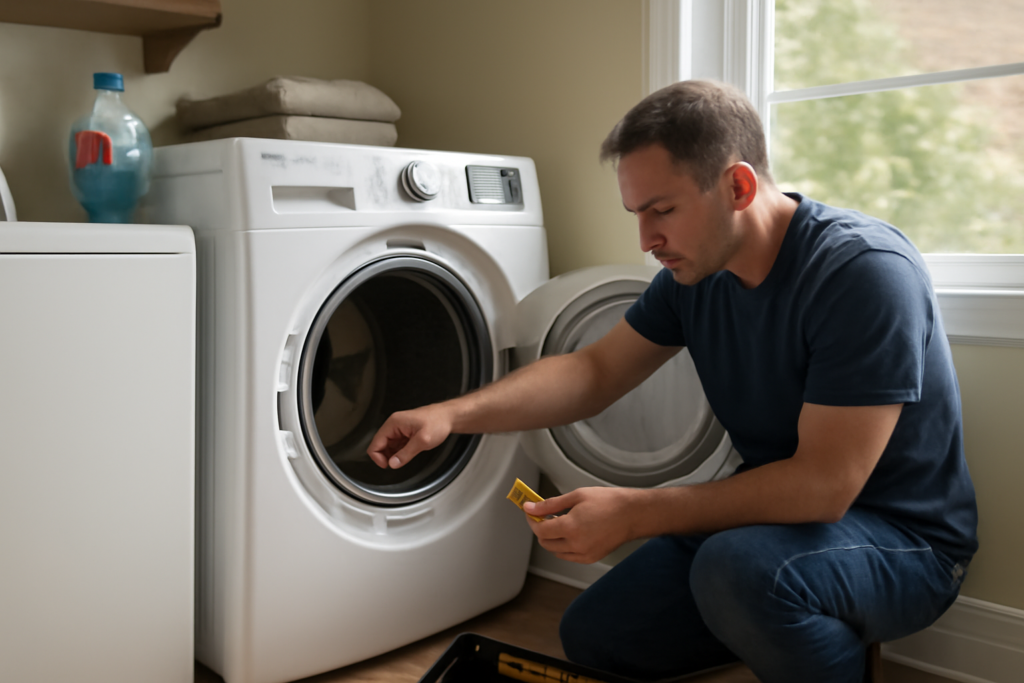
A Maytag dryer not heating is one of the most common calls I get, and the good news is that it is usually a cheap part, not a dead machine. When your Maytag tumbles clothes but leaves them cold and damp, the drum motor is fine — the heat circuit has failed somewhere. This guide walks the exact order a tech checks a Maytag dryer not heating, from the free stuff to the parts that need a wrench.
- Electric vs. Gas — Know Which You Have
- Safety First — Kill the Power
- 1. Check the Simple Stuff First
- 2. The Thermal Fuse (The Usual Culprit)
- 3. Electric Dryers: The Heating Element
- 4. Gas Dryers: Igniter and Gas Valve
- 5. Thermostats and the High-Limit Switch
- Airflow: The Quiet Killer of Heat
- Diagnostic Order in One Glance
- The Vent Is Usually the Real Story
- When to Call a Pro
Electric vs. Gas — Know Which You Have
Before anything, identify your dryer type, because the heat source is completely different. An electric Maytag runs on a 240-volt circuit and makes heat with a coiled resistance element. A gas Maytag burns natural gas or propane, uses an igniter and a gas valve to make heat, and plugs into a standard 120-volt outlet. Both share the same airflow, thermostats, and thermal fuse, so much of the diagnosis overlaps — but the heat-generating part you end up replacing depends entirely on which one sits in your laundry room.
Safety First — Kill the Power
Every check below starts the same way: unplug the dryer, or shut off its breaker if it is hardwired. For a gas model, also close the gas shutoff valve behind the machine before you open a panel. An electric dryer’s terminal block carries 240 volts that will hurt or kill you, and a gas line is nothing to probe blind. If you are not comfortable pulling a panel and using a multimeter, this is a reasonable place to call a pro.
1. Check the Simple Stuff First
Do not open the machine yet. Rule out these free causes:
- Air Fluff / No Heat setting: the most common false alarm. Confirm the cycle is set to a heated option, not the air-only mode.
- Tripped half-breaker: a 240V dryer uses a double breaker. One half can trip while the other still runs the motor — so the drum spins with no heat. Flip the breaker fully off, then on.
- Clogged vent: a blocked exhaust makes the dryer overheat and shut its heat down for protection. A vent that has not been cleaned in a year is a leading cause of weak or lost heat.
2. The Thermal Fuse (The Usual Culprit)
On most Maytag dryers a thermal fuse mounts on the blower housing or exhaust duct. It is a one-time safety device: if the dryer overheats, usually from that clogged vent, the fuse blows open permanently and cuts the heat circuit while still letting the drum turn. That exact symptom — motor runs, no heat — points straight here.
Test it with a multimeter set to continuity. A good fuse reads near zero ohms; a blown one reads open with no continuity. The part costs $8 to $20. Critical point: a blown thermal fuse is a symptom, not the disease. If you replace it without cleaning the vent, the new one will blow again within weeks. Clean the full duct run first.
3. Electric Dryers: The Heating Element
If you have an electric Maytag, the heating element is the next suspect. It is a coiled nichrome wire inside a housing, and over time a coil sags and touches the housing or simply breaks. A broken coil means no heat at all.
Pull the element and check continuity across its terminals — a working element shows a low resistance reading, typically in the range of 10 to 50 ohms; an open reading means it is dead. Replacement elements run $30 to $70 and swap out with a nut driver and a bit of patience threading it back into the airflow housing.
4. Gas Dryers: Igniter and Gas Valve
A gas Maytag makes heat through a small igniter that glows orange, then two gas-valve coils that open to release gas onto that igniter. The common failure is an igniter that no longer glows — it reads open on a meter and costs $20 to $50. If the igniter glows but shuts off without lighting the burner, the valve coils are the likely fault.
Here is the important boundary: testing the igniter is fair game, but any repair involving the gas valve, the burner assembly, or the supply line should go to a licensed technician. A wrong move there risks a gas leak or fire. If you smell gas at any point, stop, leave the house, and call the utility from outside. There is no shame in handing the gas side of the machine to a pro.
5. Thermostats and the High-Limit Switch
Maytag dryers carry several thermostats: a cycling thermostat that regulates normal drum temperature and a high-limit thermostat that cuts heat if things run too hot. Either can fail open and kill the heat. They test the same way — continuity at room temperature should read closed. A failed thermostat runs $10 to $30. Like the thermal fuse, a tripped high-limit almost always traces back to restricted airflow, so treat a bad vent as the root cause.
Airflow: The Quiet Killer of Heat
A dryer needs to move air as much as it needs to make heat. Restricted airflow is the root cause behind most blown fuses and tripped high-limit switches, so it is worth understanding the whole path. Air enters the drum, passes the heat source, carries moisture through the lint screen, and exits the blower into the exhaust duct. A clog anywhere in that chain makes the machine overheat and self-protect by cutting the heat.
Do a quick airflow test: run the dryer on a heat cycle and hold your hand at the outside vent cap. Strong, warm airflow means the path is clear; a weak trickle means a restriction upstream. Also pull the lint screen and hold it up to the light — if a film of fabric-softener residue blocks the mesh, wash it with a brush and warm soapy water. That film alone can choke airflow enough to trip a thermostat.
Diagnostic Order in One Glance
- Free checks: cycle setting, tripped half-breaker, clogged vent.
- $8 to $20: thermal fuse — test continuity, replace, and clean the vent that blew it.
- $10 to $30: cycling or high-limit thermostat.
- $20 to $50: gas igniter (gas models).
- $30 to $70: heating element (electric models).
Work that list top to bottom and you will solve the vast majority of no-heat calls without guessing or throwing parts at the machine. Buy a $15 multimeter before you buy any part — a two-minute continuity test tells you exactly which component is dead instead of you replacing parts on a hunch.
The Vent Is Usually the Real Story
Nine times out of ten, when I fix a Maytag dryer not heating, the underlying problem is a lint-choked vent that cooked a fuse or thermostat. Pull the exhaust hose, vacuum the lint trap housing, and clear the duct all the way to the wall cap. Beyond restoring heat, this matters for safety — lint is highly flammable and clogged dryer vents cause thousands of house fires a year. Clean the full run at least annually.
When to Call a Pro
- You are not comfortable using a multimeter or handling a 240V terminal block.
- The fault is on the gas valve, burner, or supply line of a gas dryer.
- You replaced the obvious part and the dryer still runs cold — the control board or wiring harness may be involved.
Most no-heat repairs come down to a thermal fuse, a heating element, or an igniter — parts under $70 and an hour of work. Start with the vent and the breaker, move to the thermal fuse, and only then open the heat source. Kill the power first, every time, and hand the gas valve to someone licensed. Follow that order and a Maytag dryer not heating usually turns back into a working machine the same afternoon.