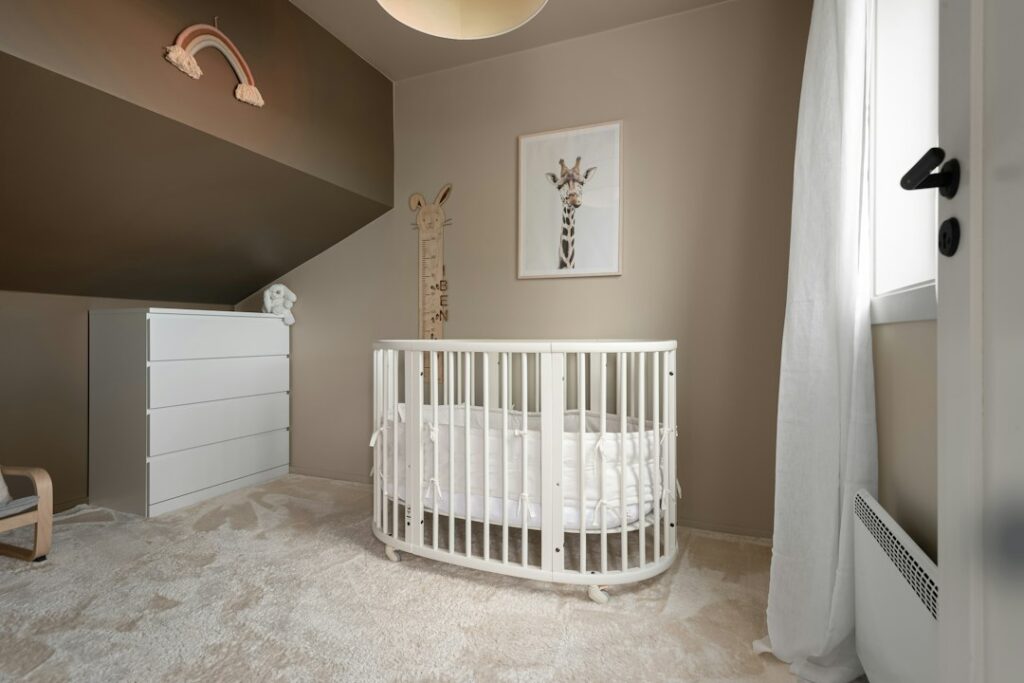
Parents often assume any crib mattress will fit any crib, and that assumption causes real safety problems. Typical mini crib dimensions run about 26 to 28 inches wide and 40 to 42 inches long on the outside, with a mattress of roughly 24 by 38 inches. A standard full-size crib, by comparison, takes a mattress close to 28 by 52 inches and has a frame around 30 by 54 inches.
That difference of a foot or more in length is why mini cribs fit spaces a standard crib never could: a corner of the parents’ room, a walk-in closet nook or a shared bedroom with an older sibling. It also means mini crib mattresses are not interchangeable with standard ones, and not always with each other.
- Mini Crib Dimensions Compared to Standard Cribs
- Mini Crib Mattress Measurements and Why They Are Not Interchangeable
- Which Rooms and Spaces Mini Cribs Suit
- Safe Placement Checklist
- Measuring Your Space for a Mini Crib
- Troubleshooting Common Mini Crib Issues
- Typical Costs
- When to Call a Pro
- Frequently Asked Questions
Mini cribs are usually outgrown sooner than full-size cribs, often between 18 months and 2 years depending on the child’s height and climbing skills, so the space savings come with a shorter lifespan.
Mini Crib Dimensions Compared to Standard Cribs
Full-size cribs sold in the US must meet federal standards that specify interior dimensions within a narrow range. Mini cribs, sometimes called non-full-size cribs, fall under a separate set of requirements that allow more variation in size. That flexibility is why mini crib measurements vary more from model to model.
| Measurement | Mini crib | Standard crib |
|---|---|---|
| Exterior footprint | About 26 to 28 x 39 to 42 in | About 29 to 31 x 53 to 57 in |
| Mattress size | About 24 x 38 in (varies) | About 27.25 x 51.6 in minimum |
| Mattress thickness | Typically 3 to 5 in | Up to 6 in |
| Typical use | Birth to about 18 to 24 months | Birth to about 3 years |
Mini crib length is the dimension that matters most for small rooms. Saving 12 to 15 inches of length often decides whether a crib fits along a wall between a door and a window. Width savings are smaller, usually 2 to 4 inches, but still useful in tight closets.
Height and Mattress Positions
Most mini cribs stand roughly 36 to 40 inches tall and offer two to four mattress height settings. The highest position makes it easier to lift a newborn; lower it before your baby can push up on hands and knees or pull to standing. Once the top rail sits less than about three-quarters of the child’s height above the mattress at its lowest setting, it is time to move to a larger bed.
Mini Crib Mattress Measurements and Why They Are Not Interchangeable
The most common mini crib mattress measurements are about 24 by 38 inches, but some models use 23.5 by 37.5, 24.5 by 38.5 or other close sizes. Those half-inch differences sound minor, yet they directly affect safety.
A mattress that is too small leaves gaps along the sides or ends where a baby’s head, arm or body can become trapped. A mattress that is too large bows up in the center or pushes the frame sides outward, creating an uneven sleep surface. For these reasons, many manufacturers include a mattress with the mini crib or specify an exact replacement size.
- Never use a standard crib mattress in a mini crib. It simply will not fit, and trimming foam is unsafe.
- Do not stack mattresses or add extra padding to raise the sleep surface or fill gaps.
- Match thickness to the crib’s limit. Many mini cribs specify a maximum mattress thickness of 3 to 5 inches so the rail height stays safe.
- Use fitted sheets made for the mattress size. Standard crib sheets are too loose on a small crib mattress and can bunch.
The Two-Finger Fit Test
Push the mattress firmly into one corner of the crib. Then check the gap on the opposite side and end. If you can fit more than two fingers between the mattress edge and the frame, the mattress is too small. Repeat on all sides. A properly sized small crib mattress fits snugly with no visible gaps and lies flat without bulging.
Which Rooms and Spaces Mini Cribs Suit
The compact size of a mini crib opens up options that would not work with a full-size model. Here is how the footprint fits common layouts.
Parents’ Bedroom
Health guidance encourages room-sharing (not bed-sharing) for at least the first several months. A mini crib at about 40 inches long fits beside a bed or at the foot of it in many primary bedrooms where a standard crib would block the walkway. Leave at least 24 to 30 inches of walking space around the crib so you can reach the baby at night without squeezing past furniture.
Shared Sibling Rooms
In a 10 by 10 bedroom with a twin bed (about 39 by 75 inches) and a dresser, a mini crib can often fit along the remaining wall where a standard crib would not. Keep the crib away from the older child’s bed edge so toys and blankets cannot be passed in, and out of reach of climbing furniture.
Closet Nooks and Alcoves
Walk-in closets and alcoves are popular spots for small-space nurseries. Make sure there is good airflow, a working smoke alarm nearby and comfortable temperature control. Avoid tight spaces that trap heat, and never place a crib in a closet with the door closed.
Condos, Apartments and Grandparents’ Homes
Many mini cribs fold or roll on locking casters, making them practical for apartments and as a second crib at a relative’s house. Folding models usually collapse to about 6 to 8 inches deep for storage in a closet or under a bed.
Safe Placement Checklist
- Keep the crib away from windows, blinds and curtain cords, which pose strangulation hazards. Cordless window coverings are the safest choice.
- Keep it clear of heat sources such as radiators, baseboard heaters and space heaters, and out of direct sun.
- Anchor nearby furniture. Secure dressers, bookcases and TVs to the wall so a curious toddler cannot tip them.
- Keep cords out of reach. Baby monitors and night lights should be mounted at least 3 feet from the crib with cords secured along the wall.
- Use the crib bare. A fitted sheet on a firm mattress is all a baby needs; no pillows, bumpers, quilts or stuffed toys.
- Lock casters on rolling models every time the crib is in use.
Measuring Your Space for a Mini Crib
Start by measuring the length and width of the floor area available. Add at least 6 inches on each side beyond the crib’s exterior footprint so you can tuck sheets and reach in comfortably. Check the path from the door to the crib: you should be able to walk in while holding a baby without turning sideways.
Consider flooring too. Hardwood, laminate and vinyl plank are easy to clean but cold underfoot; a low-pile area rug with a non-slip pad and flat edges warms the space and reduces trip risk during night feedings. Rolling cribs move easily on hard floors, so locking casters matter even more there.
Troubleshooting Common Mini Crib Issues
Can’t find a replacement mattress. Measure the interior of the frame precisely at mattress level. Look for a replacement listed for that exact size, then do the two-finger test.
Sheets keep coming loose. Buy sheets labeled for the mini crib size, not standard crib sheets. Elastic all the way around holds best.
Baby is outgrowing it. If your child is close to 35 inches tall, can climb or the top rail is low relative to their height, move them to a full-size crib or toddler bed.
The crib wobbles. Tighten all hardware. Check regularly for loose bolts, missing parts or cracked slats, and stop using any crib with damage. Check for recalls before using a secondhand crib.
Typical Costs
Basic mini cribs often range from about $100 to $250, while convertible and solid wood models commonly cost $200 to $500. Replacement mini crib mattresses usually run $40 to $150 depending on materials. Fitted sheets for small crib mattresses are generally inexpensive, and having three or more on hand makes nighttime changes easier.
When to Call a Pro
Most mini cribs assemble with basic hand tools in under an hour. Call a handyman if you need furniture anchored into masonry or plaster walls, or if you are converting a closet into a nursery nook with new shelving. Bring in a licensed electrician for any new outlets, hardwired lighting or ceiling fan work in the nursery. Before replacing a switch or fixture, turn off the breaker and confirm power is off with a non-contact voltage tester.
Frequently Asked Questions
What are standard mini crib dimensions?
Most mini cribs measure about 26 to 28 inches wide and 39 to 42 inches long on the outside, with a mattress around 24 by 38 inches. Exact sizes vary by model.
What size is a mini crib mattress?
The common size is about 24 by 38 inches and 3 to 5 inches thick. Always check your crib’s specified mattress dimensions, since sizes differ slightly between brands.
Can I use a standard crib mattress in a mini crib?
No. A standard crib mattress is roughly 28 by 52 inches and will not fit. Use only a mattress sized for your specific mini crib, with no gaps larger than two fingers.
How long can a baby sleep in a mini crib?
Most children outgrow a mini crib between 18 months and 2 years, or sooner if they start climbing or reach the manufacturer’s height or weight limit.
Will a mini crib fit in a small bedroom?
Usually, yes. A mini crib needs only about 3.5 feet of wall length plus clearance, making it a good fit for shared rooms, parents’ bedrooms and nursery nooks.