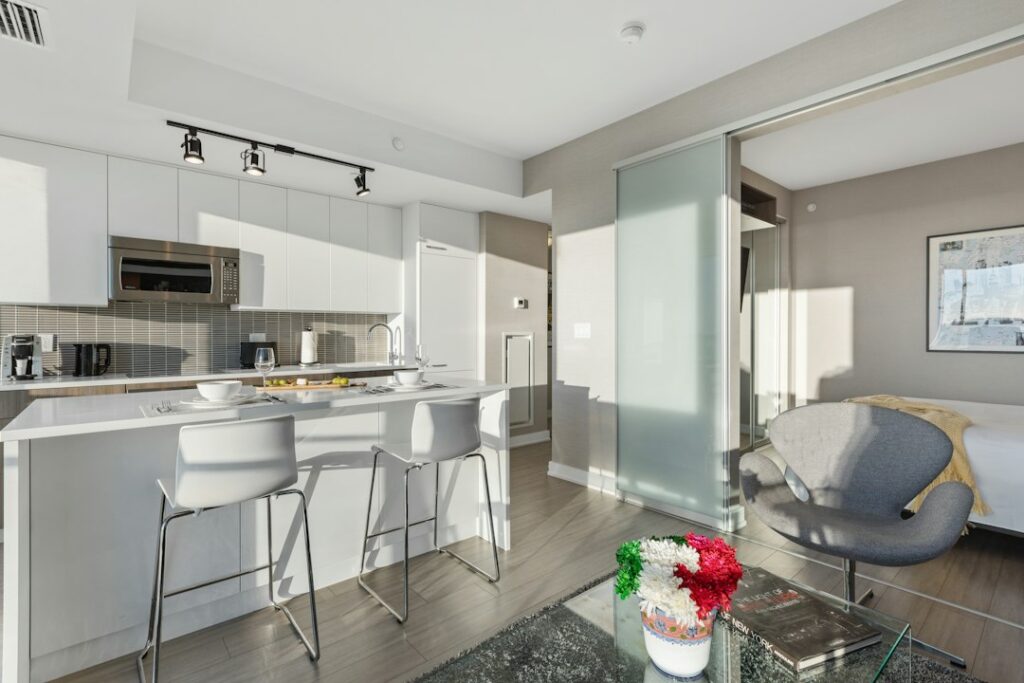
Most people still picture track lighting as the chunky chrome cans that hung over 1980s kitchen islands. Modern track lighting looks nothing like that. Today’s slim rails, tiny cylinder heads and suspended pendants can wash a gallery wall, light a reading corner and set a calm bedroom mood from a single ceiling box, with no new holes cut into drywall.
The short answer for most homes: choose a low-profile track in black or white that matches your ceiling or trim, use narrow-beam heads for art and wide-beam heads for general light, and add a pendant or two on the same rail where you want a focal point. Pair it with a dimmer, warm color temperature (2700K to 3000K in living spaces), and you have flexible lighting that adapts as furniture moves.
- Why Modern Track Lighting Suits Open Floor Plans
- Types of Track Systems: Rail, Monorail, Cable and Pendant
- Living Room Track Lighting Ideas
- Bedroom Track Lighting Ideas
- Hallways, Kitchens and Art Walls
- Choosing Heads, Beam Angles and Color Temperature
- Line Voltage vs Low Voltage Track
- How Modern Track Lighting Is Installed
- Troubleshooting Common Track Problems
- Cost of Modern Track Lighting
- When to Call a Licensed Electrician
- Frequently Asked Questions
Ideas for each room follow, along with how the different track systems work, what to buy, how installation goes and when an electrician should handle the job.
Why Modern Track Lighting Suits Open Floor Plans
Open floor plans and rental-friendly upgrades have pushed track systems back into the spotlight. A single junction box can feed 6 to 12 feet of rail, and each head can be aimed independently. That means one fixture can light a sofa, a bookshelf and a painting at the same time, something a flush-mount dome simply cannot do.
Modern track lighting also solves the problem of ceilings you would rather not cut. Concrete lofts, plaster ceilings in older houses and rooms with joists running the wrong direction all make recessed lights expensive. A surface rail sidesteps that work entirely. When you rearrange the room, you slide the heads along the track rather than patching holes.
Another reason the look has changed is LED. Integrated LED heads run cool, sip power (often 7 to 15 watts each) and come in sizes as small as 2 inches across. Smaller heads mean the fixture reads as architecture rather than hardware.
Types of Track Systems: Rail, Monorail, Cable and Pendant
Straight rail track
The most common style is a rigid straight rail, usually sold in 4 foot or 8 foot sections that join with straight, L, T or X connectors. Minimalist track lighting in this style uses a rail about 1 inch wide, often recessed-looking when painted to match the ceiling. Straight rails suit hallways, galley kitchens and long living room walls.
Monorail track
Monorail systems use a single bendable rail that you can curve by hand into gentle S shapes or arcs. These curves look sculptural over a round dining table or along a curved sectional. Most monorail systems run on low voltage through a remote or canopy transformer, which is why the rail can be thin and flexible.
Cable or wire systems
Two tensioned cables carry low voltage current, and small heads clip anywhere along them. Cable systems span long distances with almost no visual weight, which works well on high or vaulted ceilings. They do need solid anchor points at both ends.
Track lighting pendants
Many contemporary track lighting lines offer pendant adapters that drop a glass or metal shade from the rail on a cord. Track lighting pendants let you mix ambient spots and a decorative hanging light on a single circuit. Over a kitchen peninsula or a bedside table, one pendant on a rail of spots feels intentional rather than utilitarian.
Living Room Track Lighting Ideas
Track lighting for living room spaces works best when you think in layers. Use the rail for accent and task light, then let lamps and daylight handle the rest.
- Art wall wash: Run a straight rail 2 to 3 feet out from a gallery wall. Aim narrow 15 to 25 degree heads at each piece so light lands on the art rather than spilling across the ceiling.
- Bookshelf grazing: Place heads close to built-ins and tilt them steeply. Grazing light picks out texture on book spines and wood.
- Floating sofa zone: When the sofa sits in the middle of the room, an L shaped track can outline the seating area, with a couple of wide flood heads for conversation light.
- Fireplace focus: A pair of heads aimed at a stone or brick surround creates drama at night without a separate fixture.
- Black track on a white ceiling: A thin black rail draws a graphic line that suits industrial and Scandinavian rooms. Choose it on purpose, because it will be noticed.
- White track lighting on a white ceiling: Matching the ceiling color makes the rail nearly vanish, so only the light itself shows.
Keep heads at least 2 feet apart so beams overlap softly, and avoid aiming them directly at seating, where they create glare in people’s eyes.
Bedroom Track Lighting Ideas
Bedroom track lighting should be gentle. The goal is a warm, dimmable glow and a few targeted beams, not office brightness.
- Bedside pendants on track: Drop two small pendants from a rail that runs parallel to the headboard. You free up nightstand space and get reading light exactly where you need it.
- Headboard wash: Aim two or three heads at the wall behind the bed. A textured wall, wood slats or wallpaper look rich when grazed with light.
- Closet and dresser task light: A short track section over a dresser or open closet makes it easier to pick clothes and judge colors.
- Warm color temperature: Choose 2700K heads, or tunable heads that drop to 2200K at night for a candlelike feel.
Put bedroom tracks on a dimmer that matches the LED driver type. A cheap mismatched dimmer is the main cause of flicker and buzzing in LED track systems.
Hallways, Kitchens and Art Walls
Long hallways are a natural fit for a straight rail centered on the ceiling. Space heads every 3 to 4 feet and aim them alternately at each wall so the corridor feels wider. If the hall doubles as a family photo gallery, aim every head at the frames.
In kitchens, modern track light fixtures can replace a single center box light. Position the rail about 2 feet in from the upper cabinet faces so beams land on the counter instead of behind your shoulders. Over an island, swap two spots for pendants on the same rail.
Art walls in stairwells and entries benefit from adjustable heads with snoots or louvers, which cut glare when people look up the stairs.
Choosing Heads, Beam Angles and Color Temperature
Heads make or break the look of modern track lighting. Here is what to compare:
| Feature | Good choice | Why it matters |
|---|---|---|
| Beam angle | 15 to 25 degrees for art, 36 to 60 for general light | Controls spot versus wash |
| Color temperature | 2700K to 3000K | Warm, residential feel |
| CRI | 90 or higher | Accurate skin tones and art colors |
| Dimming | Compatible with your dimmer type | Prevents flicker and buzz |
Also confirm the track type. Rails and heads come in a few incompatible connector standards, often labeled by letter or as single circuit versus multi circuit. Buy heads made for your specific track, or buy a complete modern LED track lighting kit where the rail, connectors and heads are already matched. Kits are the easiest path for a first install.
Line Voltage vs Low Voltage Track
Line voltage track runs on standard household 120 volt power straight from the ceiling box. It is simple, supports long runs and accepts many head styles.
Low voltage track (usually 12 or 24 volts) uses a transformer or driver to step power down. It allows thinner rails, bendable monorails and cable systems. The transformer must be sized to the total wattage of all heads with some headroom, typically keeping the load at or below about 80 percent of its rating. Low voltage runs also lose brightness over long distances, so follow the maker’s maximum run length.
How Modern Track Lighting Is Installed
Most systems mount to an existing ceiling junction box with a canopy called a live end or feed connector. If you are comfortable with basic fixture swaps, the process usually looks like this:
- Kill the power. Turn off the breaker for the circuit and confirm power is off at the fixture wires with a non-contact voltage tester. Never work on or test energized wires.
- Remove the old fixture and check that the box is securely fastened to framing and rated for the fixture’s weight.
- Attach the mounting plate supplied with the track to the box.
- Connect the wires per the instructions, typically black to black, white to white and the ground to the green screw or bare copper.
- Mount the rail to the ceiling with the supplied clips, driving screws into joists or using appropriate ceiling anchors at the spacing the maker specifies.
- Add connectors and end caps, then twist or snap the heads into place.
- Restore power at the breaker, test, and aim each head.
Where there is no ceiling box at all, some kits offer a plug-in cord kit that runs to a wall outlet. Plug it directly into the wall receptacle and route the cord neatly; do not run it under rugs or through doorways.
Troubleshooting Common Track Problems
- One head won’t light: Rotate it out and reseat it; the contacts may not be engaged. Try the head in another spot on the rail.
- Whole section is dead past a connector: With power off, check that the connector is fully seated and oriented correctly, since many have a polarity marking.
- Flicker when dimmed: Swap to a dimmer listed as compatible with the LED heads or driver.
- Buzzing transformer: Check that the load is not too close to the transformer’s maximum and that the dimmer type suits it.
- Glare: Rotate heads away from seating, add snoots or honeycomb louvers, or switch to narrower beams.
Cost of Modern Track Lighting
Basic kits with a 4 foot rail and three or four heads often run in the low hundreds of dollars or less at home centers. Designer monorail and cable systems, or rails with many high-CRI heads, can climb to several hundred or more. Electrician labor for swapping an existing box fixture is typically a modest charge, while adding a new ceiling box, switch or circuit costs more and depends on access above the ceiling.
When to Call a Licensed Electrician
Swapping an existing fixture for a track is within reach of many careful DIYers, but call a licensed electrician if you need a new ceiling box, a new switch leg, a new circuit or outlet, or if your house has aluminum wiring, cloth-insulated wiring or no ground. Electricians also handle low voltage transformers that must be hidden in a ceiling or wall, since those need accessible, code-compliant locations. Permits may apply for new wiring in your area.
Frequently Asked Questions
Is track lighting outdated?
Older bulky chrome systems can look dated, but modern track lighting with slim rails, small LED heads and pendants is widely used in current interiors, especially lofts, galleries and open floor plans.
How far apart should track heads be?
About 2 to 4 feet apart is a good starting point. Closer spacing suits art walls and shelves, while wider spacing works for general room light.
Can I put track lighting in a bedroom?
Yes. Use warm 2700K heads, a compatible dimmer and aim beams at walls or a headboard rather than straight down at the bed to avoid glare.
Can I mix pendants and spotlights on one track?
Many systems sell pendant adapters for the same rail. Check that the pendant is made for your track type and that the total wattage stays within the system’s limit.
Do I need an electrician to install track lighting?
If you are replacing an existing fixture and are comfortable turning off the breaker and confirming power is off with a non-contact voltage tester, it can be a DIY job. New boxes, switches or circuits should go to a licensed electrician.