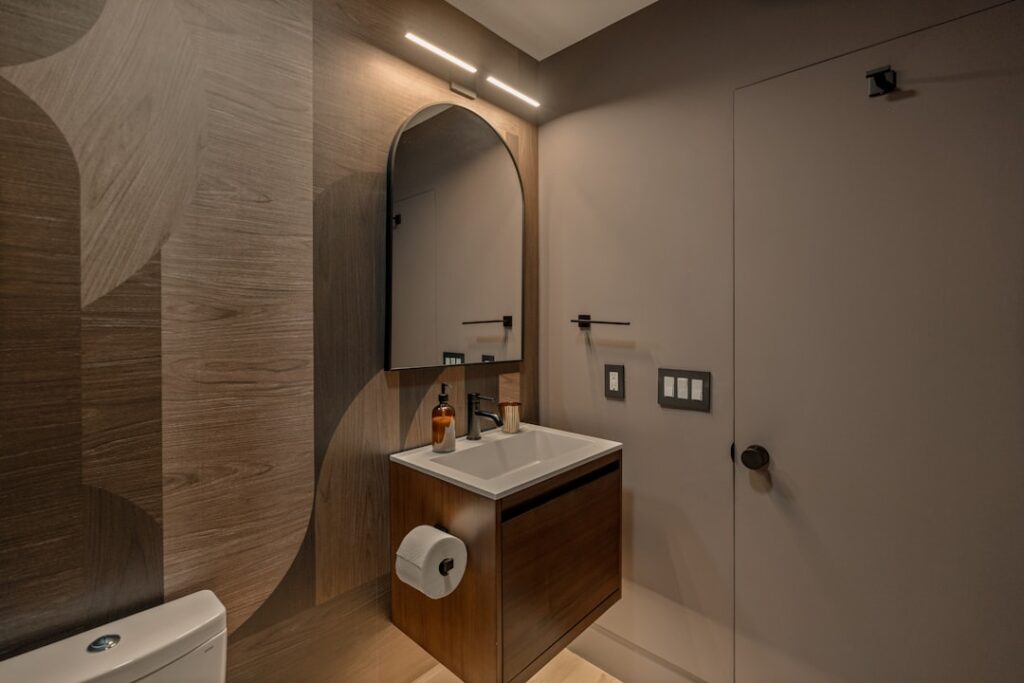
Good modern vanity lighting is the difference between a bathroom that feels like a hotel and one where you keep leaning toward the mirror trying to find decent light. Most bathrooms are lit by a single ceiling fixture, which throws shadows straight down onto your face and hides exactly what you are trying to see. Fixing that with the right fixtures, in the right spots, at the right color temperature, is one of the highest-impact upgrades in the whole room.
- Why Overhead Light Alone Fails
- Types of Modern Vanity Fixtures
- Color Temperature: The Number That Matters Most
- Exact Placement Heights and Spacing
- Brightness: How Many Lumens You Actually Need
- Finishes and Matching the Rest of the Room
- Wet-Location Ratings and Dimmers
- Putting It Together: Sample Layouts
- Final Thoughts
I have wired and specified vanity lighting for remodels of every size. This guide covers the fixture types, the color-temperature numbers that actually matter, exact placement heights, and how to avoid the shadow problem that plagues most bathrooms.
Why Overhead Light Alone Fails
A single fixture above the mirror or in the ceiling casts light downward, which means it drops shadows into your eye sockets, under your nose, and beneath your chin. For shaving, applying makeup, or any close mirror work, that is the worst possible angle. The goal of proper vanity lighting is to put light on your face from the front and the sides, at roughly eye level, so shadows fill in and you see an even, true image. Every good lighting layout is built around that principle.
Types of Modern Vanity Fixtures
Modern styles have moved well beyond the old row of Hollywood bulbs. Here are the main players.
LED Light Bars
A horizontal LED bar mounted above the mirror is the clean, contemporary default. Integrated LED bars from brands like Kichler, Progress Lighting, and WAC Lighting give a seamless glow, sip electricity, and last 25,000 to 50,000 hours. Frosted acrylic diffusers spread the light evenly instead of showing hot spots. Choose a bar close to the width of your mirror for balance.
Wall Sconces
A pair of sconces flanking the mirror is the gold standard for flattering, shadow-free light because they hit your face from both sides at eye level. This is how theater dressing rooms and upscale hotels light mirrors. Modern sconces come in minimalist tubes, cylinders, and frosted-glass globes.
Backlit and Lighted Mirrors
LED mirrors with light built into the edges or backlighting behind the glass are increasingly popular in modern baths. Many include anti-fog heating and a dimmer touch pad. They give a soft, even glow and eliminate the fixture entirely for a clean wall.
Vertical Light Bars
Tall vertical bars mounted on each side of the mirror combine the side-lighting benefit of sconces with a sleek modern form. A strong choice when you have wall space beside the mirror.
Color Temperature: The Number That Matters Most
Color temperature, measured in Kelvin, controls whether your light looks warm and yellow or cool and blue. This single spec changes how a bathroom feels and how accurately you see color in the mirror.
- 2700K: warm white, cozy and yellow-toned, like a traditional incandescent bulb. Relaxing but can make makeup look off.
- 3000K: soft white, still warm but a touch crisper. A popular, flattering choice for most modern bathrooms.
- 3500K to 4000K: neutral to cool white, the closest to natural daylight without going harsh. Best for makeup, shaving, and seeing true color.
For a bathroom, 3000K to 4000K is the sweet spot. Go toward 4000K if the space doubles as a serious grooming and makeup station; stay near 3000K for a softer, more spa-like feel. Just as important, buy bulbs or fixtures with a Color Rendering Index (CRI) of 90 or higher. High CRI means colors look true, which is exactly what you want when matching makeup or checking that your clothes actually go together.
Exact Placement Heights and Spacing
Fixtures fail when they are hung wrong, so here are the numbers pros work to.
Sconces Beside the Mirror
Mount side sconces at roughly 60 to 66 inches from the floor to the center of the fixture, which puts them at about eye level. Space them 28 to 40 inches apart, wide enough to straddle the mirror and light both sides of your face. Too close together and they behave like a single overhead source.
Light Bar Above the Mirror
Center a horizontal bar 75 to 80 inches from the floor, or about 3 to 6 inches above the top of the mirror. Center it left-to-right on the sink, not the mirror, if the two are not aligned.
Ceiling Height and General Fill
Keep a general ceiling light or recessed cans for overall room brightness, but never rely on them for the mirror. Layering the two, task lighting at the mirror plus ambient light from above, is what makes a bathroom read as finished and modern.
Brightness: How Many Lumens You Actually Need
Wattage stopped being useful the moment LEDs took over, so shop by lumens, the true measure of light output. For a vanity, aim for roughly 1,600 to 4,000 lumens total across all your mirror fixtures, depending on room size and how bright you like it. A small powder room is fine on the lower end; a large master bath where you do detailed grooming wants the upper end. Split that output between two side sconces or spread it across a wide bar rather than concentrating it in one blinding point.
Layered dimming lets one room cover both needs. Set the mirror lights bright and cool for grooming, then dim them warm for a relaxing bath. That flexibility is why I put nearly every vanity light on a dimmer, and it is a five-minute upgrade if the wiring is already there.
Finishes and Matching the Rest of the Room
The metal finish on your fixtures should tie into the faucets, cabinet hardware, and any shower trim for a pulled-together modern look. Matte black, brushed nickel, brushed brass, and chrome all read as current when used consistently. You do not have to match every finish perfectly, but pick one or two and repeat them; a black faucet with a black-framed mirror and black sconces looks intentional, while five random finishes look accidental. Frosted or opal glass diffusers soften the light and photograph better than exposed bulbs, though exposed vintage-style Edison bulbs remain a deliberate industrial-modern statement.
Wet-Location Ratings and Dimmers
Any fixture near a shower or tub must carry a damp or wet-location rating; check the label before you buy. Over the sink, damp-rated is standard. Put your vanity lights on a dimmer so you can crank them to full daylight for grooming and dial them down for a soft evening glow. Confirm the dimmer is rated for LED loads, because an old incandescent dimmer paired with LED fixtures causes flicker and buzz. A modern LED-compatible dimmer solves it. If you are adding fixtures where none existed, or moving a box to hit the right height, that is electrical work behind the wall and worth a licensed electrician in most homes. Swapping a fixture in an existing box for a same-size replacement, on the other hand, is a reasonable DIY job as long as you kill the breaker and confirm the power is off with a tester before touching a wire.
Putting It Together: Sample Layouts
For a single mirror in a standard bath, the easiest strong result is one wide LED bar above the mirror at 3000K to 3500K on a dimmer. For the best possible light, add or substitute a pair of sconces at eye level flanking the mirror. On a 60-inch double vanity, mount a sconce between and beside each mirror, or run two bars, one centered over each sink. A backlit LED mirror plus a pair of slim sconces gives a high-end, layered modern look that photographs beautifully and works even better in person.
Final Thoughts
Modern vanity lighting is less about the trendiest fixture and more about physics: get light onto your face from the front and sides at eye level, choose 3000K to 4000K with a CRI of 90 or better, and put it on an LED dimmer. Nail those fundamentals and even an inexpensive fixture will outperform a designer piece hung in the wrong place. Light the mirror right and the whole bathroom feels brighter, cleaner, and more expensive than it actually was.