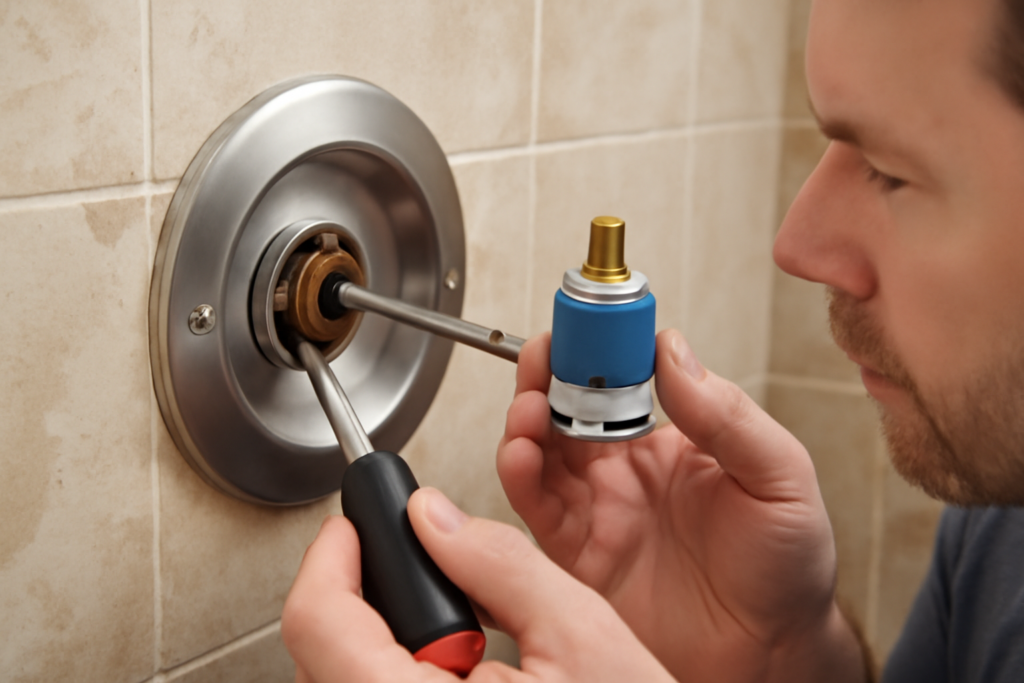
A shower that drips long after you shut it off, runs lukewarm, or squeals when you turn the handle almost always points to one culprit: a worn Moen shower valve cartridge. This cylindrical part is the heart of the valve, controlling how much hot and cold water mixes and how tightly the flow shuts off. The good news is that replacing it is one of the most satisfying and affordable plumbing repairs a homeowner can tackle, often under an hour and for the price of a single part.
Part of our Bathroom Remodeling & Flooring guide — explore the full guide →
What the Cartridge Actually Does
Inside your shower wall sits a valve body plumbed to the hot and cold supply lines. The cartridge slides into that body and, as you rotate the handle, its ports line up with the hot and cold inlets to blend water to your chosen temperature and volume. Over years of use, the rubber seals and internal surfaces wear, mineral deposits build up, and the cartridge can no longer seat tightly. That is when you get drips, temperature swings, or a handle that turns too easily or grinds. Replacing the cartridge restores a crisp shut-off and steady temperature without touching the pipes behind the wall.
Identifying Your Moen Cartridge
Moen uses several cartridge families, and installing the wrong one wastes a trip to the store. The most common models are:
- Moen 1222: Fits most single-handle Posi-Temp shower valves made from the mid-1990s onward. This is by far the most common residential cartridge, sold in a distinctive blue package.
- Moen 1225: An older single-handle cartridge for kitchen and some tub/shower valves, often gray.
- Moen 1200: A brass-body single-handle cartridge found in many pre-1990s installations.
- Moen 1224 and 4000/4570: Two-handle and Moentrol variants for specific valve bodies.
To identify yours, look for a model number stamped on the trim or in your home’s paperwork. If nothing is marked, remove the existing cartridge and match it at the store, or take a clear photo. Moen also offers a lifetime warranty on many cartridges, and you can request a free replacement by calling their customer line with your part in hand, an underused benefit that can save you $25 to $50.
Tools and Parts You Will Need
Gather everything before you start so you are not running to the hardware store with the water off:
- Replacement cartridge (a Moen 1222 for most modern showers)
- The Moen cartridge puller tool (part 104421), which is worth the $15 for stubborn cartridges
- Needle-nose pliers and standard pliers
- Phillips and Allen (hex) wrenches for the handle set screw
- A flathead screwdriver
- Plumber’s grease (silicone) for the O-rings
- White vinegar and an old toothbrush for cleaning mineral scale
- A towel and a small flashlight
Step-by-Step Replacement
Follow these steps carefully. The whole job typically takes 30 to 60 minutes.
- Shut off the water. Some Posi-Temp valves have integral stops you can close with a screwdriver; otherwise turn off the main supply. Open the shower to relieve pressure.
- Remove the handle. Pop off the decorative cap, loosen the set screw, and pull the handle straight off. Then unscrew the temperature limit stop and the trim escutcheon plate.
- Pull the retaining clip. A small brass or metal clip holds the cartridge in place at the top of the valve. Grip it with needle-nose pliers and pull it straight out. Do not lose it, and note its orientation.
- Extract the old cartridge. Grab the cartridge stem with pliers and twist it back and forth to break the mineral bond, then pull. For seized cartridges, the puller tool threads on and levers it out without straining the valve body.
- Clean the valve body. Scrub away scale with vinegar and the toothbrush so the new cartridge seats smoothly.
- Insert the new cartridge. Coat the O-rings with plumber’s grease. Note the flat side or notch that indicates hot/cold orientation; installing it backward reverses your hot and cold. Push it fully home.
- Reinstall the clip and trim. Seat the retaining clip, then reverse your steps to reattach the stop, escutcheon, and handle.
- Test. Turn the water back on slowly and check for leaks and correct temperature before you replace the handle cap.
Common Problems and Fixes
A few issues trip people up during this repair:
- Hot and cold reversed: The cartridge went in rotated 180 degrees. Pull it and flip it so the notch faces the correct way.
- Seized cartridge: Years of hard water can weld the cartridge to the brass body. Soak the area in vinegar, wiggle gently, and use the puller rather than yanking, which can crack the valve.
- Still dripping after replacement: Debris may be lodged in the valve, or the retaining clip is not fully seated, letting the cartridge shift. Recheck the clip.
- Water hammer or squeal: Usually resolves with a fresh cartridge, but a properly greased O-ring prevents recurrence.
Cost and Time
A genuine Moen 1222 cartridge runs about $18 to $35 at home centers and plumbing suppliers. The dedicated puller tool adds roughly $15 but pays for itself the first time you face a stuck cartridge. If you call in a plumber, expect $150 to $350 including the part and a one-hour service call, with the labor being the bulk of that. Because the repair is so contained and requires no soldering or pipe work, it sits comfortably within DIY reach for most homeowners with basic tools.
When to Call a Plumber
Handle this yourself if the valve body is intact and you can shut off the water. Call a professional if you discover a cracked valve body, if the cartridge is so corroded it will not budge even with the puller, or if there are no shut-offs and the main valve is unreliable. A damaged valve body means opening the wall and possibly soldering in a new Moen valve, a job that runs $400 to $800 and benefits from a pro. Homes with recurring cartridge failures every year or two may have aggressive water chemistry; a whole-house filter or softener can extend the life of every fixture.
Maintenance Tips
To keep your shower valve healthy, exercise the handle through its full range occasionally, and if you have hard water, consider replacing the cartridge proactively every five to seven years rather than waiting for a failure. A light coat of plumber’s grease on the O-rings each time keeps the action smooth and prevents squealing. Keep the old cartridge’s model number written inside your bathroom vanity door so the next repair is a five-minute parts run.
Frequently Asked Questions
How do I know if my Moen cartridge is bad? The classic signs are a shower that drips after you shut it off, water that runs lukewarm or swings between hot and cold, a handle that turns too loosely or grinds, or reduced flow. Any of these points to a worn or scaled cartridge that needs replacement.
Are Moen cartridges universal? No. Moen makes several families such as the 1222, 1225, 1200, and 1224, each designed for a specific valve body. Installing the wrong one will not seat correctly, so match the model number stamped on your trim or take the old cartridge to the store to compare.
Is the Moen cartridge really covered by a lifetime warranty? Many Moen cartridges carry a limited lifetime warranty. If yours fails, you can often call Moen customer service with the part in hand and receive a free replacement, saving the $18 to $35 the part costs at retail.
How long does a Moen cartridge last? In areas with soft water, a cartridge can last well over a decade. In hard-water regions, mineral scale can shorten that to five to seven years. A whole-house water softener extends the life of the cartridge and every other fixture in the home.
Replacing a Moen shower valve cartridge is one of those repairs that feels intimidating until you have done it once. With the right cartridge, a puller tool, and a patient approach to the retaining clip, you can silence a drip, banish temperature swings, and add years of reliable service to a shower you use every single day, all without opening a wall or calling for help.