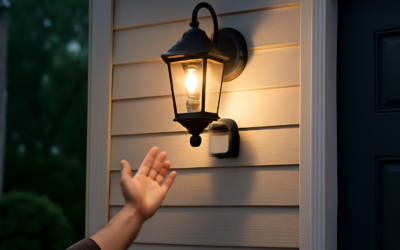
A porch that lights itself the moment someone approaches does two jobs at once: it deters prowlers and keeps you from fumbling for keys in the dark. A motion sensor light uses a small electronic eye to detect movement and switch on automatically, then shuts off after a set delay. These fixtures have gone from clunky floodlights to sleek, app-controlled devices, and a basic unit now costs less than $30. Understanding the technology helps you place them where they actually work instead of triggering every time a cat wanders by.
- How Motion Detection Works
- Common Types of Motion Sensor Lights
- Wiring a Hardwired Fixture
- Getting Placement Right
- Dialing In the Settings
- Solving False Triggers
- Smart and Connected Options
- Cost and Energy Savings
- Understanding the Detection Zone
- Indoor Applications Beyond Security
- Buying the Right Fixture
How Motion Detection Works
The vast majority of residential fixtures use passive infrared, or PIR, sensors. Rather than emitting a signal, PIR detects the heat a person or vehicle gives off against the cooler background. When a warm body moves across the sensor’s segmented field of view, the change in infrared energy trips the switch. That is why a warm car engine sets off your driveway light but a slow temperature drift at dusk does not.
Some higher-end and commercial units add microwave or dual-technology sensing. Microwave sensors bounce radio waves and measure the reflection, giving longer range and the ability to see through thin materials. Dual-tech fixtures require both PIR and microwave to agree before triggering, which slashes false alarms in busy areas.
Common Types of Motion Sensor Lights
The category covers a wide range of products, so match the type to the job. Overbuying a 4,000-lumen floodlight for a small back step just wastes money and annoys the neighbors.
- Floodlights: The classic dual-head or LED panel fixtures that throw 1,500 to 4,000 lumens across a driveway or backyard. Best for security coverage of wide areas.
- Path and step lights: Low-output fixtures around 100 to 300 lumens that light walkways without glare.
- Smart bulbs: Screw-in LEDs with built-in sensors that turn any existing fixture motion-activated for about $15 apiece.
- Battery and solar models: No wiring needed, ideal for sheds, fences, and spots far from a circuit. Solar units recharge daily and run all night.
- Ceiling and closet lights: Compact indoor fixtures that switch on when you enter a pantry, garage, or laundry room.
Wiring a Hardwired Fixture
Replacing an existing porch light with a motion version is one of the more approachable electrical projects, usually 45 minutes of work. Safety first: switch off the breaker and confirm the wires are dead with a non-contact voltage tester before touching anything.
Remove the old fixture and you will find three wires: black (hot), white (neutral), and bare copper or green (ground). Connect the new light’s matching leads with wire nuts, black to black and white to white, then wrap the connections and tuck them into the box. Ground goes to the green screw or ground wire. Mount the fixture, restore power, and set the sensor. If you are adding a fixture where none existed, running new cable and adding a box is where most people should call a licensed electrician.
Getting Placement Right
Placement determines whether a sensor light is genuinely useful or a nightly nuisance. PIR works best when movement crosses the beam sideways rather than walking straight at it, so aim the sensor across a path, not down it.
Mount floodlights 6 to 10 feet high for the widest coverage without creating blind spots directly below. Keep the sensor pointed away from heat sources that swing on windy days, like HVAC exhaust, dryer vents, and reflective pool surfaces. Angle the detection zone toward the ground so passing car headlights and streetlamps do not confuse it.
Dialing In the Settings
Nearly every fixture offers three adjustment dials, and tuning them makes the difference between a reliable light and a maddening one. Take a few minutes after dark to test each setting with a walk-through.
- Sensitivity or range: Controls how far away motion registers. Turn it down if the light catches sidewalk traffic beyond your property.
- Time delay: Sets how long the light stays on after the last movement, typically 1 to 20 minutes. A 3-to-5-minute delay suits most porches.
- Lux or dusk threshold: Determines the ambient darkness required before the sensor activates, so the light ignores motion during daylight.
Solving False Triggers
A light that flicks on at random is the top complaint, and the cause is almost always environmental. Start by narrowing the sensitivity and re-aiming the head away from streets and neighboring yards. Trim back branches and tall grass that sway within the detection field, since a wind-blown shrub reads as a warm-edged moving object at dusk.
Small animals are the other frequent culprit. Raising the mounting height and tilting the sensor slightly upward pushes the detection zone above cat and raccoon level. If a fixture keeps misbehaving despite adjustments, a dual-technology model that requires two sensors to agree will end the problem for good.
Smart and Connected Options
Wi-Fi and Zigbee models add features that plain sensors cannot match. Through an app you can set schedules, adjust brightness, receive a phone alert when motion is detected, and integrate the light with cameras or a full smart-home routine. Some floodlight-camera combos record a clip every time they trigger, turning a security light into a doorbell-style guardian.
The trade-off is dependence on your home network and, in some cases, a subscription for cloud video storage. If you only want automatic lighting, a standalone PIR fixture is simpler and never goes offline. Reserve the smart features for spots where remote monitoring genuinely adds value, like a detached garage or a vacation property.
Cost and Energy Savings
Motion lighting pays you back in a couple of ways. A modern LED motion fixture draws roughly 15 to 30 watts only when active, versus a dusk-to-dawn light that burns all night. Over a year, switching a 12-hour porch light to motion activation can trim several dollars off your electric bill per fixture and stretch bulb life dramatically since the LED runs a fraction of the hours.
- Basic PIR floodlight: $20 to $50.
- Solar motion light: $25 to $70.
- Smart floodlight with camera: $80 to $250.
- Electrician installation, if needed: $100 to $250 per fixture.
Understanding the Detection Zone
Every PIR sensor sees the world through a segmented lens that carves its field of view into zones, like invisible pie slices radiating outward. Motion registers when a warm object crosses from one zone into the next, which is why walking across the beam triggers a light instantly while walking straight toward it can go unnoticed until you are close. Picture the coverage as a fan spreading from the fixture, widest at the sides and shorter straight ahead.
Manufacturers rate coverage by degrees and distance, commonly 180 degrees across a 40-foot span for a security floodlight. When you aim a fixture, think about where a person would actually approach and orient the lens so their path cuts across those zones. A light guarding a driveway should face the length of the drive, not stare down it, so an approaching car sweeps sideways through the beam.
Indoor Applications Beyond Security
Motion sensing is not just for the exterior. Inside the home it eliminates the fumble for a switch when your hands are full and quietly trims energy waste in rooms people forget to light down. A pantry or closet light that switches on as the door opens is one of the small luxuries that feels obvious once you have it.
- Laundry rooms and garages, where you often walk in carrying a basket or bags.
- Hallways and stairwells, for safe nighttime navigation without hunting for switches.
- Bathrooms, where a dim night-mode setting guides late trips without a jarring bright light.
- Under-cabinet and toe-kick lighting that responds as you enter the kitchen.
For these spots, a plug-in or screw-in motion bulb is often all you need, converting an ordinary fixture in seconds with no wiring at all.
Buying the Right Fixture
When you shop, weigh a few specs beyond price. Look for an adjustable detection range of at least 30 feet for security use, a weatherproof rating of IP65 or higher for exposed locations, and a color temperature around 5000K, which reads as crisp daylight-white and shows detail better than warm yellow tones for security purposes. A quality motion sensor light should carry at least a two-year warranty and let you swap between manual-on and fully automatic modes. Get those basics right and you gain a fixture that quietly does its job for years, lighting your way home and putting would-be intruders on notice.