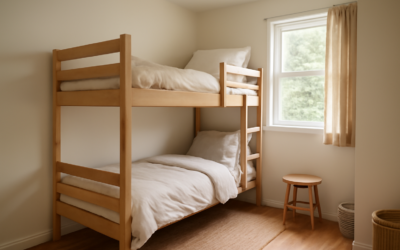
The appeal of murphy bunk beds is obvious: two sleeping spots that vanish into a wall cabinet or turn back into a sofa by morning. The catch is that a stacked fold-down bed puts far more leverage on the wall than a single murphy bed, and a poorly anchored cabinet can tip when the upper bunk swings down. Getting the anchoring, clearance and rails right is what separates a handy guest-room upgrade from a real hazard.
Here is the short answer. Wall-mounted fold-down bunks need a cabinet bolted into at least two or three wall studs (or into a floor-and-wall mounting system), about 7 feet of clear floor in front of the cabinet when the beds are open, a ceiling of 8 feet or more, and guardrails on the upper bunk. Sofa-to-bunk systems are freestanding, heavier and easier to install, but they still need clearance, careful locking and weight limits that match who will sleep on them.
If you are comparing a single fold-down bed, that is a different project with lighter loads. The focus here is the stacked and convertible versions.
Types of Murphy Bunk Beds and Convertible Systems
Fold-down bunk systems come in two main families, and they install very differently.
Wall-Cabinet Fold-Down Bunks
These look like a tall wardrobe or bookcase when closed. Two twin beds are stacked inside, usually in a horizontal (side-tilt) orientation, and fold down on piston or spring lift mechanisms. The cabinet must be fastened to wall framing because the open beds shift the center of gravity well forward. Some systems also bolt to the floor.
Sofa Bunk Beds
A sofa bunk bed, sometimes called a bunk bed couch, is a steel or wood frame that functions as a sofa during the day. You rotate the backrest upward and lock it into position to form the upper bunk, while the seat becomes the lower bed. These do not usually mount to the wall, but the best ones include optional anti-tip straps. They are popular in dens, basements and vacation homes.
Loft and Futon Combos
Related options include a twin over futon bunk bed, where a futon sits beneath a fixed upper twin, and a loft bed with futon underneath or a loft bed with couch. These are not true murphy systems because the upper bed never folds, but they solve the same problem of combining seating and sleeping. A twin over futon setup is usually the most affordable, and a loft bed with sofa works well for teens who want a lounge area under the bed.
Anchoring Murphy Bunk Beds Into Wall Studs
Stud anchoring is the single most important part of installing wall-cabinet murphy bunk beds. When the upper bunk is lowered, its weight plus the sleeper’s weight acts like a lever pulling the cabinet top away from the wall. Drywall anchors alone will not hold that.
Tools and materials:
- Stud finder and a small finish nail to confirm stud edges
- 4-foot level and tape measure
- Drill/driver and impact driver
- Structural wood screws or lag screws, usually 3 to 4 inches long, as specified by the kit
- Shims for leveling on uneven floors
- At least one helper; cabinets often weigh 250 to 400 pounds assembled
Installation principles:
- Locate at least two studs within the cabinet width, ideally three. Mark their centers from floor to top of cabinet height.
- Check for hidden utilities. Avoid drilling where wires or pipes run, usually straight up and down from outlets and switches. If an outlet sits behind the cabinet footprint, turn off the breaker and confirm power is off with a non-contact voltage tester before working near it, and have a licensed electrician relocate it if needed.
- Level the base first. Shim the cabinet base so the box is plumb. An out-of-plumb cabinet makes the beds bind and can stress the lift mechanism.
- Fasten the mounting rail or brackets into studs at the height specified by the manufacturer, using the full number of fasteners.
- Add floor anchors if the system includes them, especially on concrete or when the wall framing is metal.
- Test before first use by lowering each bed slowly with no weight on it, then again with a helper applying moderate pressure.
Steel studs, plaster and masonry all need specific fasteners. If you cannot find framing where the cabinet must go, a carpenter can open the wall and add horizontal blocking between studs.
Fold-Out Clearance and Room Layout
Clearance is where many murphy bunk bed projects go wrong. A closed cabinet may be only 16 to 20 inches deep, but the open beds project roughly 40 inches for a twin in a side-tilt design, or about 80 inches for vertical designs. Add walking space and you need about 7 feet from the wall for vertical units, and at least 5 feet for side-tilt twin units.
Plan the room around these points:
- Keep the fold-down path free of ceiling fans, pendant lights and window treatments.
- Allow at least 24 inches beside the open lower bed for walking.
- Keep the upper bunk clear of windows so a child cannot climb out.
- Check that baseboards, heat registers and outlets do not interfere with the cabinet sitting tight to the wall.
- Measure ceiling height: cabinet tops often reach 7 to 8 feet, and you need headroom above the lowered upper bunk, ideally 30 inches or more.
For sofa bunk beds, the backrest rotates up and out, so leave 18 to 24 inches behind the sofa or confirm the model converts with the back against the wall.
Top-Bunk Rails, Ladders and Weight Limits
Every upper bunk needs a guardrail on the open side. Many murphy systems use a removable or flip-up rail. Make sure it locks in place and extends at least 5 inches above the mattress surface. Rail openings should be small enough to prevent head entrapment, generally 3.5 inches or less.
Mattress thickness matters for the same reason. Fold-down beds usually limit mattresses to 6 to 8 inches, both to keep the rail effective and so the bed can close. A thicker mattress can overload the lift mechanism or stop the cabinet from latching.
Weight limits vary widely. Upper bunks on wall systems are often rated around 200 to 250 pounds, while heavy-duty sofa bunk frames may be rated higher. Treat the rating as the sleeper plus bedding, and never let kids jump on or hang from an open upper bunk. Children under 6 should not sleep on any upper bunk.
Ladders should hook securely and not slide. If the ladder stores inside the cabinet, make sure it is easy to reach so it actually gets used.
Daily Use and Maintenance
Good habits keep a fold-down system working for years:
- Lower and raise the beds with a steady, two-handed motion rather than letting them drop.
- Strap bedding in with the included elastic bands so it does not bunch when the bed closes.
- Check fasteners and pivot hardware every few months and retighten.
- Inspect gas pistons or springs yearly; replace them if the bed drifts or drops faster than normal.
- For sofa bunks, confirm the locking pins or levers engage fully every time.
Troubleshooting Common Problems
The bed drops too fast. The lift springs or pistons may be undersized for your mattress weight, or worn out. Check the manufacturer’s tension adjustment and piston rating.
The bed will not stay closed. The mattress may be too thick, or the cabinet may be out of plumb. Recheck level and compare the mattress to the size limit.
The cabinet moves when the bed opens. Stop using it immediately. The wall fasteners may have missed studs or pulled loose. Reinstall into solid framing.
The sofa bunk rattles. Tighten frame bolts and add nylon washers at metal joints. Felt pads under the feet reduce floor noise and protect hardwood or vinyl.
Cost Ranges and Hiring a Pro
Sofa bunk beds and twin over futon frames typically range from a few hundred dollars for basic metal models to over a thousand for heavy-duty versions. Wall-cabinet murphy bunk beds usually cost from roughly one to several thousand dollars for the kit, with custom cabinetry costing more. Professional installation often adds several hundred dollars, depending on wall construction and whether blocking is needed.
Hire a carpenter or installer when the wall has no accessible studs, when the cabinet mounts to masonry or plaster, when you need an outlet moved (that requires a licensed electrician), or when the system is heavy enough that two people cannot safely hold it in position. A pro can also verify that the unit is plumb and that the lift mechanism is set for your mattress weight.
Frequently Asked Questions
Do murphy bunk beds have to be attached to the wall?
Wall-cabinet units must be fastened into wall studs, and some also bolt to the floor. Freestanding sofa bunk beds do not require wall mounting, though anti-tip straps add security.
How much space do murphy bunk beds need when open?
Side-tilt twin units need about 5 feet of clear floor from the wall, and vertical units need about 7 feet. Add at least 24 inches beside the open bed for walking.
What mattress works in a murphy bunk bed?
Most systems limit mattresses to 6 to 8 inches thick. A thicker mattress can reduce guardrail height, overload the lift mechanism and stop the cabinet from closing.
Is a sofa bunk bed safe for adults?
Some heavy-duty sofa bunk frames are rated for adults. Check the upper-bunk weight limit, make sure the backrest locks fully, and use the guardrail every time.
What is the difference between a twin over futon and a murphy bunk bed?
A twin over futon has a fixed upper bed above a futon couch. A murphy bunk bed folds both beds into a cabinet or converts from a sofa, freeing more floor space.