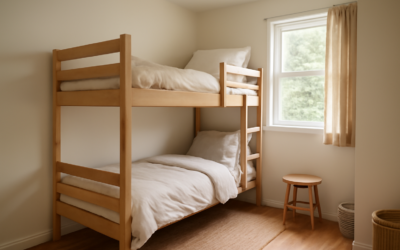
Kids grow, siblings move into separate rooms, and families relocate. That is why stackable twin beds are one of the smartest furniture buys for a growing household: they work as a bunk bed today and as two standalone twin beds later, with no extra purchase. The trick is understanding how the two frames lock together and how to separate and re-stack them without weakening the joints.
In short, a detachable bunk bed is two complete twin frames. The upper frame sits on the lower one and is held in place by connector pins, dowels or bolted brackets at each corner post. Remove the ladder, guardrail and pins, lift the top frame off with two adults, add the provided footboards or caps, and you have a pair of matching twins. Re-stacking reverses the process, but only after checking every pin and post for wear.
- How Stackable Twin Beds Connect
- What Makes a Bed Fully Detachable
- When to Split a Bunk Into Twins
- Step by Step: Separating a Bunk Bed
- Is It Safe to Re-Stack?
- Structural and Anchoring Safety
- Montessori and Low Options for Younger Kids
- Typical Cost Ranges
- Troubleshooting
- When to Call a Pro
- Frequently Asked Questions
Here is how the connection systems differ, when splitting makes sense, how to re-stack safely, and low-profile options for toddlers and younger kids.
How Stackable Twin Beds Connect
All stackable twin beds rely on the same basic idea: the top bed’s legs must be locked to the bottom bed’s posts so the frame cannot shift or lift apart. Manufacturers use a few different methods.
Wood or Metal Dowel Pins
The most common design. A short steel or hardwood pin, usually 3 to 4 inches long, slides into matching holes drilled in the top of the lower post and the bottom of the upper leg. Pins keep the frames aligned but do not resist upward pull, so they work together with the ladder and guardrail to hold everything tight.
Bolted Connector Brackets
Some bunk beds that come apart use steel plates or corner brackets bolted through both posts. This style resists lifting and racking better than pins alone, and it is common on metal frames.
Stacking Sleeves
Metal frames often use a narrower tube on the upper leg that slides into the lower post, secured with a through bolt or spring clip. Check that clips are present and fully seated every time you inspect the bed.
What Makes a Bed Fully Detachable
Not every bunk marketed as convertible separates into two good-looking twins. Before buying, confirm:
- Both frames stand alone: each bed has its own full set of four legs and side rails.
- Caps or finials are included: after separating, the pin holes on top of the posts should be covered with wooden caps so no one gets scratched and the beds look finished.
- Headboards are the right height: some top bunks have tall posts that look odd as a floor-level twin; others ship with shorter legs for conversion.
- Guardrails can be removed: as standalone twins, most kids no longer need a full-length rail.
- Replacement parts are available: pins, bolts and caps get lost during moves.
Stackable bunk beds with a solid wood frame and bolted rails usually handle repeated splitting better than those with cam locks and particleboard, which can strip after a few assembly cycles.
When to Split a Bunk Into Twins
There is no single right age, but these situations usually signal it is time to separate:
- Siblings move into separate bedrooms.
- The top-bunk child passes the bed’s weight limit, often 175 to 250 pounds for kids frames.
- A child starts sleepwalking, has a medical condition, or is recovering from an injury.
- The upper sleeper is now too close to the ceiling to sit up comfortably.
- You move to a home with lower ceilings, ceiling fans in the wrong spot or no suitable wall for anchoring.
- Kids simply want their own bed at floor level, which is common in the tween years.
Separated twins also make a flexible guest room setup: push them together with a bridge cushion for a king-width sleeping surface, or place them apart for two guests.
Step by Step: Separating a Bunk Bed
- Clear both beds and remove the mattresses. Mattresses make lifting unsafe.
- Remove the ladder and the upper guardrails, keeping all bolts in labeled bags.
- Remove connectors: unbolt brackets or pull out retaining clips. Dowel pins usually stay in the lower posts until the frame is lifted.
- Lift the top frame straight up with two adults, one at each end, and set it on the floor. Keep it level so pins do not bend or snap.
- Pull out the pins and store them with the hardware.
- Install post caps or finials on both beds.
- Check slats and rails on the former top bunk; some upper frames use a thin slat system that benefits from a bunkie board or center support at floor level.
Set each twin on a level spot and retighten every bolt. Felt pads under the legs protect hardwood, laminate and vinyl plank floors.
Is It Safe to Re-Stack?
Yes, if the parts are in good condition and you follow the maker’s instructions. Repeated stacking can wear pin holes, crack posts or strip threads, so inspect before every re-stack:
- Look for cracks or splits around pin holes and bolt holes.
- Make sure pins are straight and fit snugly with no wobble.
- Replace any stripped bolts or threaded inserts.
- Confirm all slats are present, unbroken and properly spaced.
- Check that the guardrail and ladder mount tightly with no play.
Never improvise by stacking two beds that were not designed to stack, and never use dowels, screws or zip ties as a substitute for the correct connector parts. Order replacement hardware from the manufacturer if anything is missing.
Structural and Anchoring Safety
Once stacked, a twin-over-twin frame stands 60 to 70 inches tall and carries two sleepers, so it needs to be stable. Place it against a wall, ideally in a corner, and fasten the upper frame to at least two wall studs with brackets and structural screws. Drywall anchors alone will not resist the side-to-side forces of kids climbing and playing. Avoid drilling directly above or below outlets and switches, where wiring usually runs.
Follow general bunk safety rules too: upper bunks for children 6 and older, guardrails on both long sides that rise at least 5 inches above the mattress, rail gaps of about 3.5 inches or less to prevent head entrapment, and the correct mattress thickness listed by the manufacturer. Keep the top bunk away from ceiling fans, windows and blind cords.
Montessori and Low Options for Younger Kids
For toddlers and preschoolers, a full-height bunk is not appropriate, but you can still plan ahead. A Montessori bunk bed or floor-level bunk keeps the lower bed a few inches off the floor and the upper bed at a modest height, often 40 inches or less, which reduces fall risk and lets kids climb in and out independently.
- Floor beds: a twin frame just a few inches high, often with a house-shaped canopy, that later becomes the bottom half of a stackable set.
- Low bunks: short bunk frames suited to kids around 4 to 7, with the upper sleeper only used by older siblings.
- Modular systems: some designs start as a floor bed, then add legs and an upper frame as the child grows.
A low stackable twin bed setup is a good middle ground when kids are too old for cribs but too young for a standard upper bunk.
Typical Cost Ranges
As general ranges, basic metal detachable bunk beds sit at the lower end of the market. Solid wood twin-over-twin sets that separate into two finished beds usually cost more, in the mid hundreds. Designs with drawer stairs, trundles or Montessori features often run higher. Remember to budget for two mattresses sized to the frame, post caps if they are sold separately, and wall anchoring hardware.
Troubleshooting
- Top bunk shifts when kids climb: check that all pins are seated and add wall brackets into studs.
- Pins will not line up: the frames may be out of square; loosen rail bolts slightly, align, then retighten.
- Squeaks after re-stacking: tighten all bolts and add a drop of wax to wood-on-wood contact points.
- Missing post caps: order replacements; do not leave exposed pin holes on standalone beds.
- Slats sagging on the former top bunk: add a center support or bunkie board.
When to Call a Pro
Most families can separate and re-stack beds themselves with two adults. Call a handyman if connector hardware is damaged, if you cannot find studs for anchoring, or if walls are plaster or masonry. A carpenter can also repair cracked posts or build custom caps, and a licensed contractor should handle any built-in bunk that attaches to wall or ceiling framing.
Frequently Asked Questions
Can all bunk beds be separated into twin beds?
No. Only detachable designs with two complete frames can be split. Many loft and fixed bunk beds share posts and cannot stand alone as two beds.
How do stackable twin beds stay together?
Connector pins, bolted brackets or stacking sleeves lock the top frame’s legs onto the lower posts. The ladder and guardrails add extra stiffness once installed.
Is it safe to re-stack a bunk bed after separating it?
Yes, as long as you use the original connectors, inspect posts and pins for cracks or wear, replace damaged parts, and anchor the stacked bed to wall studs.
What age is right for a detachable bunk bed?
The lower bed works for most kids who have moved out of a crib, but the upper bunk is generally recommended for children 6 and older.
Are Montessori bunk beds safer for toddlers?
They are lower to the ground, which reduces fall height. Toddlers should still use only the lower bed, with older siblings on top.