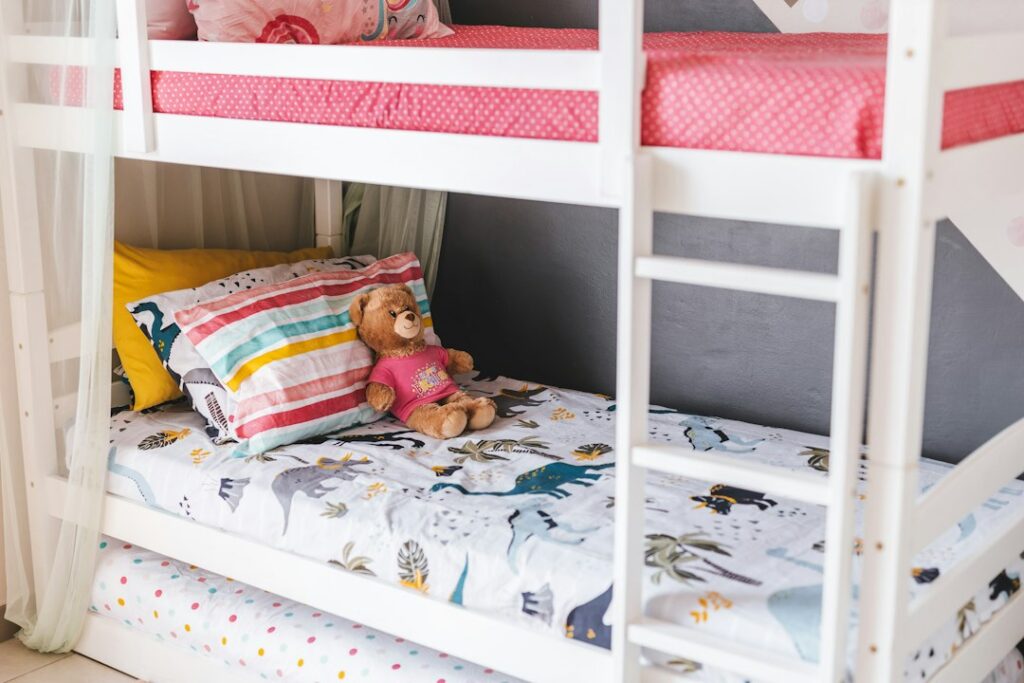
A twin bunk bed with trundle sleeps three kids in the floor space of one bed, but only if the trundle can actually roll out. The most common complaint is not the frame at all: it is a trundle that snags on a rug, hits a dresser, or will not close because the mattress is too thick. Plan the clearance and the mattress before you buy, and the extra bed becomes a real asset for sleepovers and siblings.
The quick answer: a twin trundle needs about 40 inches of clear floor in front of the bunk to pull out fully, plus a little extra so someone can step around it. Trundle mattresses usually must be 5 to 6 inches thick (sometimes up to 7), and the trundle should roll on a hard floor or a low-pile rug that extends past its full travel. Upper-bunk mattresses also have thickness limits so the guardrail stays effective.
- How a Twin Bunk Bed With Trundle Works
- Pull-Out Clearance and Room Layout
- Trundle Mattress Thickness and Sizing
- Twin, Full and Triple Trundle Combos
- Rugs, Flooring and Trundle Rolling
- Assembly, Anchoring and Safety
- Troubleshooting Trundle Problems
- Cost Ranges and When to Get Help
- Frequently Asked Questions
How a Twin Bunk Bed With Trundle Works
A trundle is a low bed frame on casters that stores under the lower bunk. Some are simple platforms on wheels, others sit inside a drawer box with a front panel that matches the bed. When you need it, you roll it out, and it sits 8 to 12 inches off the floor.
There are two main trundle styles:
- Standard (rolling) trundle: stays low when extended. Simple and durable, it creates a separate low bed.
- Pop-up trundle: uses spring-loaded legs to raise the trundle to near the height of the lower bunk, making a king-size sleeping surface when pushed together. These are more common on daybeds than bunk beds, but some bunk designs support them.
Some beds offer storage drawers instead of a trundle, or a choice between the two. If you ever expect sleepovers, the trundle is usually the more flexible option.
Pull-Out Clearance and Room Layout
Measure the trundle’s full extended depth, not just the mattress width. A twin trundle mattress is about 38 inches wide, and the frame adds a few inches, so full extension often runs 40 to 42 inches from the front edge of the bunk. Add 18 to 24 inches of walkway beyond that, and you need roughly 5 to 5.5 feet of clear floor in front of the bed.
Layout tips that avoid daily frustration:
- Keep dressers, toy bins and nightstands out of the trundle’s roll path.
- Check that the room door can open with the trundle extended, or plan to use the trundle only at night.
- Avoid placing the trundle over heating vents, which can blow directly on the sleeper and restrict airflow.
- Leave 1 to 2 inches between the bed and the wall so baseboards do not push the frame forward.
Tape the extended outline on the floor with painter’s tape before assembly. It shows immediately whether the layout works.
Trundle Mattress Thickness and Sizing
Mattress thickness is the detail most people get wrong. Trundles store under a lower bunk with limited clearance, typically 8 to 11 inches between the floor and the lower bunk’s slats. After subtracting the trundle frame and casters, there is only room for a 5 to 6 inch mattress in most designs.
Guidelines for choosing a mattress:
- Check the manufacturer’s maximum trundle mattress thickness and treat it as a firm limit.
- Choose foam or low-profile hybrid mattresses, since innerspring models are rarely made in 5 to 6 inch thicknesses.
- Match the width. A twin trundle takes a twin mattress (38 by 75 inches). Some trundles need a slightly shorter mattress, so confirm length.
- Respect upper-bunk limits too. Most upper bunks allow a 6 to 8 inch mattress so the guardrail stays at least 5 inches above the sleeping surface.
If you choose a trundle bed mattress that is too thick, the trundle will not close, the casters will drag, and the lower bunk slats can get pushed up. A thin mattress topper can add comfort for older kids without forcing the frame.
Twin, Full and Triple Trundle Combos
Bunk-and-trundle combinations come in several sizes. The right one depends on the ages of the kids and whether adults ever use the beds.
- Twin over twin bunk bed with trundle: the most common and compact option, sleeping three in about a 42 by 80 inch footprint. Also called a twin bunk with trundle.
- Twin over full with trundle: a twin on top, a full below and usually a twin trundle. Good when an older child or parent uses the lower bed.
- Full bunk bed with trundle: full over full with trundle designs sleep more comfortably but need a bigger room, about 58 by 80 inches for the frame alone. A full over full trundle bed often uses a twin trundle because full trundles need extra depth.
- Full bed with full trundle: not a bunk, but a single full bed with a matching full-size trundle, useful in guest rooms with low ceilings.
- Triple trundle bed: a bunk with a trundle, or a triple bunk with a trundle for four sleepers. These need high ceilings and careful anchoring.
A bunk bed with trundle and stairs replaces the ladder with storage steps. Stairs are easier for younger children and add drawer space, but they extend the footprint by 18 to 24 inches on one end.
Rugs, Flooring and Trundle Rolling
Floor surface decides how smoothly the trundle rolls. On hardwood, luxury vinyl, laminate and tile, the casters roll easily but can scratch or dent the floor, especially with grit trapped under the wheels. On carpet, thick pile can stop the trundle cold.
Follow these rug placement rules:
- Size the rug so the trundle rolls on it the whole way. The rug should extend at least 45 to 48 inches in front of the bed and slide partly under the frame. A rug edge in the middle of the roll path causes the trundle to catch and bump.
- Choose low-pile or flatweave rugs, ideally under 0.5 inches thick.
- Use a thin, non-slip rug pad so the rug does not bunch as the trundle moves.
- On hard floors without a rug, upgrade to soft rubber or polyurethane casters, and keep them clean.
Wall-to-wall carpet can work if it is low-pile. With plush carpet, a trundle on runners or a hard floor protector board under the roll path helps.
Assembly, Anchoring and Safety
Tools usually needed: hex keys, a drill/driver, a rubber mallet, a level, a stud finder and 2.5 to 3 inch wood screws for the wall bracket.
- Assemble the bunk frame following the manufacturer’s sequence and snug all bolts.
- Square the frame by comparing diagonal measurements.
- Fasten the included wall bracket or anti-tip strap into a wall stud.
- Install slats and confirm center supports touch the floor where included.
- Assemble the trundle, attach casters and test roll it before adding the mattress.
- Tighten all hardware fully and recheck after two weeks.
Safety basics apply to every bunk: guardrails on both sides of the upper bunk, no children under 6 on the top, and the ladder secured. Keep the trundle from rolling under a sleeper’s feet at night by pushing it in or locking the casters if available.
Troubleshooting Trundle Problems
The trundle will not roll in. The mattress is probably too thick, or a caster has picked up a sock or rug fringe. Check both.
It scrapes the floor. A caster may have loosened or broken. Replace it with one of the same height, and add felt to the drawer front bottom if it drags.
The lower bunk sags into the trundle. Add a center support leg or replace thin slats with thicker ones, keeping clearance for the trundle.
Cost Ranges and When to Get Help
A basic twin bunk bed with trundle in pine or metal often costs a few hundred dollars, while solid hardwood versions with stairs or drawers can run from several hundred to over a thousand. Trundle mattresses usually cost from under a hundred to a few hundred dollars. Professional assembly typically costs a flat fee in the low hundreds. Hire help for heavy frames, plaster or masonry walls, or if you are unsure the wall anchor is secure.
Frequently Asked Questions
How much space does a twin bunk bed with trundle need?
The frame is about 42 by 80 inches, and the trundle needs 40 to 42 inches to extend. Plan for 5 to 5.5 feet of clear floor in front of the bed.
How thick can a trundle mattress be?
Most trundles accept a 5 to 6 inch mattress, with some allowing 7 inches. Check the manufacturer’s limit so the trundle can roll under the bed.
Can a full over full bunk bed have a trundle?
Yes. Full over full with trundle designs usually include a twin trundle, though some offer a full trundle for wider rooms.
Will a trundle roll on carpet?
Trundles roll well on low-pile carpet and flatweave rugs. Thick plush carpet can block them, so use a low rug or a floor protector under the roll path.
Does a bunk bed with trundle need to be anchored?
Yes. Fasten the included wall bracket or anti-tip strap into a wall stud to prevent tipping, especially when kids climb the ladder.