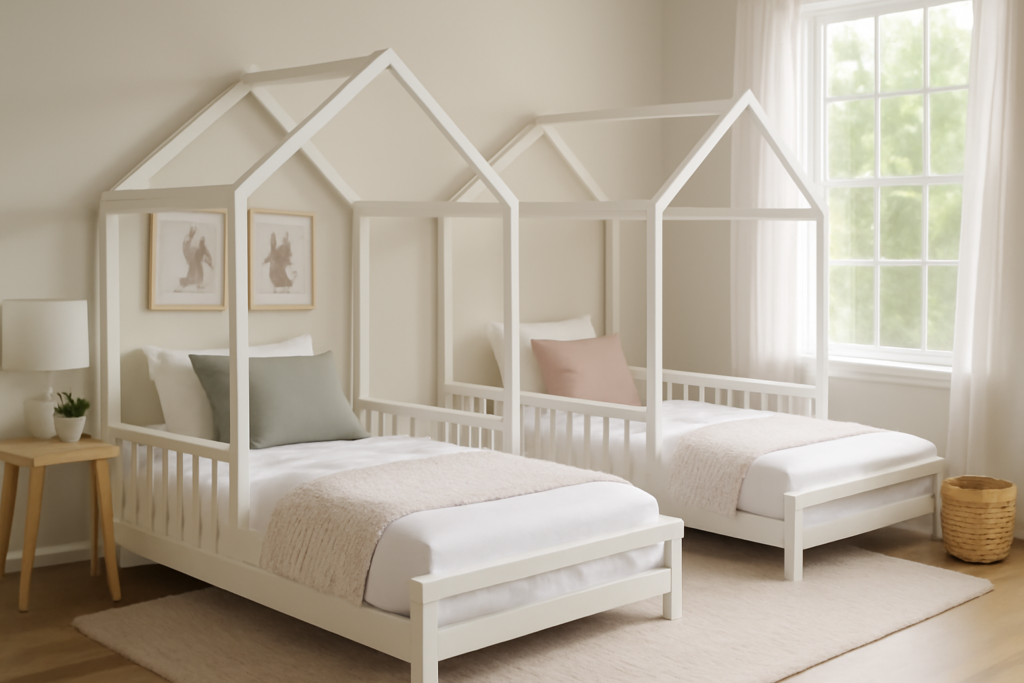
A twin house bed looks like a playful wooden frame shaped like a little cottage, but the real value sits at floor level: a child can climb in and out without a ladder or a long drop. Most house beds hold a standard twin mattress (about 38 by 75 inches) on a low platform or directly on a slatted base, and many come with short side rails that stop a sleeping toddler from rolling onto the floor. The safety details that matter most are not the roof or the chimney cutout. They are the gap between the mattress and the frame, the rail height, and what is on the floor around the bed.
Parents usually start shopping for one when a toddler begins climbing out of the crib, often somewhere between 18 months and 3 years. A low house bed or a floor bed with rails is a sensible next step because a fall from 6 to 10 inches is far less of a concern than a fall from a crib rail. Adult floor bed pages rarely cover the kid side of the question, so the sections that follow focus on fit, rails, flooring and setup for a young child.
- What a Twin House Bed Is and Who It Suits
- Mattress Fit: The Gap That Matters Most
- Rail Height and Placement for a Floor Bed With Rails
- Tools and Materials for Assembly
- Step by Step: Setting Up the Bed Safely
- Flooring Under a Low Kids Bed
- Troubleshooting Common Problems
- General Cost Ranges
- When to Get Help
- Frequently Asked Questions
If you want the short answer: choose a frame that fits your mattress snugly, pick rails that rise at least 5 inches above the top of the mattress, anchor any tall roof frame to the wall, and put a flat, non-slip rug beside the bed. Everything else is style.
What a Twin House Bed Is and Who It Suits
A house bed is a bed frame built from posts and beams in the outline of a small house. The “roof” is usually open, so it is decorative rather than enclosing. Some versions sit directly on the floor with the mattress inside a rectangular border; others lift the mattress 4 to 8 inches on slats for airflow. The twin size is the most common because a child can use it from toddlerhood well into the grade school years.
Montessori-style floor beds follow the same idea without the house shape. The point is independence: the child can get into bed alone, get up in the morning, and reach a low shelf of books. A twin floor bed with rails keeps that independence while adding a little guard against rolling out, which is helpful for restless sleepers.
- Best fit: toddlers moving out of a crib, kids who climb, and families who want one frame that lasts several years.
- Less ideal: infants under 12 months, since pediatric safe sleep guidance calls for a firm crib or bassinet surface with nothing soft around the baby.
- Room size: a twin frame with a roof takes roughly 42 by 80 inches of floor space, plus clearance for a play area.
Mattress Fit: The Gap That Matters Most
The most important measurement on any kids bed is the space between the mattress edge and the inside of the frame. A small child can slip into a wide gap and get wedged. As a practical rule, aim for no more than about 1 inch of gap on any side once the mattress is pushed to one corner. If you can fit two adult fingers between the mattress and the frame, the fit is too loose.
Twin mattresses are not all identical. Some foam models measure 37.5 inches wide; some innerspring models run close to 39. Measure the inside of the frame before you order, and measure the mattress after it has fully expanded if it arrived compressed in a box (that can take 24 to 72 hours).
Mattress thickness
Thickness affects how well the rails work. A 5 to 6 inch mattress is common for house beds because it keeps the sleeping surface low and leaves plenty of rail above it. A thick 10 to 12 inch mattress can raise your child almost to the top of the rail, which defeats the purpose. Firm is better than plush for young children, and a waterproof, breathable protector is worth adding during the potty training years.
Rail Height and Placement for a Floor Bed With Rails
Guard rails on a twin house bed exist to stop rolling, not to trap a child inside. Look for rails that extend at least 5 inches above the top of the mattress. Many frames offer rails on one long side, both long sides, or all the way around with an entry opening.
- Entry opening: leave a gap of about 15 to 20 inches so the child can climb in and out easily. Wider openings reduce the rolling protection.
- Rail spacing: openings between rail slats should be small enough that a child’s head cannot pass through. Solid panels or slats under about 3.5 inches apart are the usual target.
- No gaps at the ends: check where rails meet the corner posts. There should be no spaces that could catch a head, arm, or clothing.
- Against the wall: if the bed sits in a corner, push it tight to the wall or add a rail on the wall side. A few inches of gap between bed and wall is a known entrapment risk.
Some parents take the rails off once the child sleeps reliably in one spot, usually around age 4 or 5. Keep the hardware so you can reinstall rails if a younger sibling inherits the bed.
Tools and Materials for Assembly
Most house beds arrive flat packed. Assembly takes one to two hours for two adults. Gather these before you start:
- The included hex key plus a ratcheting screwdriver or a drill with a clutch set low
- A rubber mallet for dowels
- A tape measure and a level
- Felt pads or rubber bumpers for the feet and base rails
- Two wall anchoring straps or L brackets rated for furniture, plus screws long enough to reach a stud
- A stud finder
- A low, flat, non-slip rug or play mat for the entry side
If you are shopping, a solid wood montessori house bed frame with rounded edges and a non-toxic finish is a practical choice. Avoid frames with sharp roof corners at a child’s head height.
Step by Step: Setting Up the Bed Safely
- Pick the spot. Keep the bed away from windows, blind cords, heaters and wall outlets with anything plugged in. Two to three feet of clearance from a window is a reasonable minimum.
- Prepare the floor. Vacuum or sweep the area. On hardwood, laminate or vinyl plank, stick felt pads under every point that touches the floor so the frame does not scratch the finish as your child climbs and wiggles.
- Assemble the base first. Build the rectangular frame and slat support on the floor, checking the diagonals with a tape measure. Equal diagonals mean the frame is square.
- Add the house posts and roof. Tighten all bolts snugly but do not strip them. Recheck after 24 hours, since wood compresses slightly.
- Anchor tall frames. A roof frame can reach 5 to 6 feet. If the roof is attached, secure it to a wall stud with a furniture strap so it cannot tip if a child climbs or hangs from the beams.
- Install the rails. Attach rails on the open sides and confirm there are no gaps at the joints.
- Place the mattress and test the fit. Push it to one corner and check the opposite gaps. Press the edges with your palm to make sure the mattress does not ride up over the rail.
- Lay the rug. Place a flat rug or thin mat at the entry opening. Use a non-slip pad cut slightly smaller than the rug and make sure the edges lie flat.
Flooring Under a Low Kids Bed
Because a floor bed sits close to the ground, the flooring matters more than it does under a standard frame. Airflow is the first issue. A mattress resting directly on a solid floor can trap moisture from breathing and sweat, and mildew can form on the underside within weeks in humid climates. A slatted base, or even a thin slatted platform, solves most of this. Lift and air the mattress once a month if it sits on a solid surface.
Hard floors like hardwood, luxury vinyl plank and laminate are easy to clean after spills and accidents, but they can be slippery for small feet. A low-pile rug with a grippy pad beside the bed helps. Wall-to-wall carpet is soft to land on but harder to clean and can hold dust mites; if you have carpet, vacuum under and around the bed weekly.
Keep rug edges flat and taped or tucked so a sleepy toddler does not trip at night. Round rugs with curled edges and layered rugs are common trip hazards. A plug-in night light at floor level helps kids see their path to the door or bathroom.
Troubleshooting Common Problems
The mattress slides or leaves a gap
Add a thin non-slip mattress gripper under the mattress, or choose a frame with a lip. If the gap is more than about an inch, the mattress is the wrong size for the frame. Replace it rather than stuffing pillows or blankets into the gap.
The frame squeaks or wobbles
Retighten every bolt and check that the slats are seated. Rubbing slats can be quieted with strips of felt. A wobbly roof usually means the top beams were installed before the posts were fully tightened.
My child keeps rolling out
Add rails on both long sides and narrow the entry opening. You can also move the bed into a corner with the wall acting as a barrier, as long as the bed is pushed tight to the wall.
Scratches on the floor
Felt pads wear out. Replace them every few months, and use larger furniture glides under the base rails where the frame gets pushed around during play.
General Cost Ranges
Prices vary widely by material and finish. As a general guide, a basic pine twin house bed frame without rails often falls in the low hundreds of dollars. Solid hardwood frames with rails, slats and a durable non-toxic finish run higher, sometimes several hundred dollars more. A twin mattress for a child ranges from budget foam options to mid-priced hybrid models. Add a modest amount for a mattress protector, felt pads, furniture straps and a non-slip rug pad. Handy parents can build a simple frame from lumber, but store-bought frames usually include tested rail spacing, which is hard to match with a DIY build.
When to Get Help
Most families assemble a house bed without help. Consider a handyperson if your walls are plaster or masonry and you are unsure how to anchor a tall frame securely, or if the frame arrived with damaged parts. Talk with your pediatrician before moving a child under about 18 months out of a crib, and follow safe sleep guidance for babies. If you notice cracked slats, loose rails, or split posts at any point, stop using the bed until the part is replaced.
Frequently Asked Questions
What age is right for a twin house bed?
Most children move to a house bed between 18 months and 3 years, usually when they start climbing out of the crib. Babies under 12 months should stay in a crib or bassinet with a firm, bare sleep surface.
How high should rails be on a twin floor bed with rails?
Aim for rails that rise at least 5 inches above the top of the mattress. Choose a thinner mattress (5 to 6 inches) so the rails stay effective.
Can I put the mattress directly on the floor inside the frame?
You can, but air it out regularly. A slatted base is better because it lets moisture escape and helps prevent mildew under the mattress.
Do I need to anchor a house bed to the wall?
If the frame has a tall roof or posts that a child could climb or pull on, yes. Use a furniture strap screwed into a wall stud so the frame cannot tip.
What rug works best beside a kids floor bed?
A low-pile rug with a non-slip pad and flat edges. Avoid thick shag or rugs with curled corners, which can trip a child walking at night.