
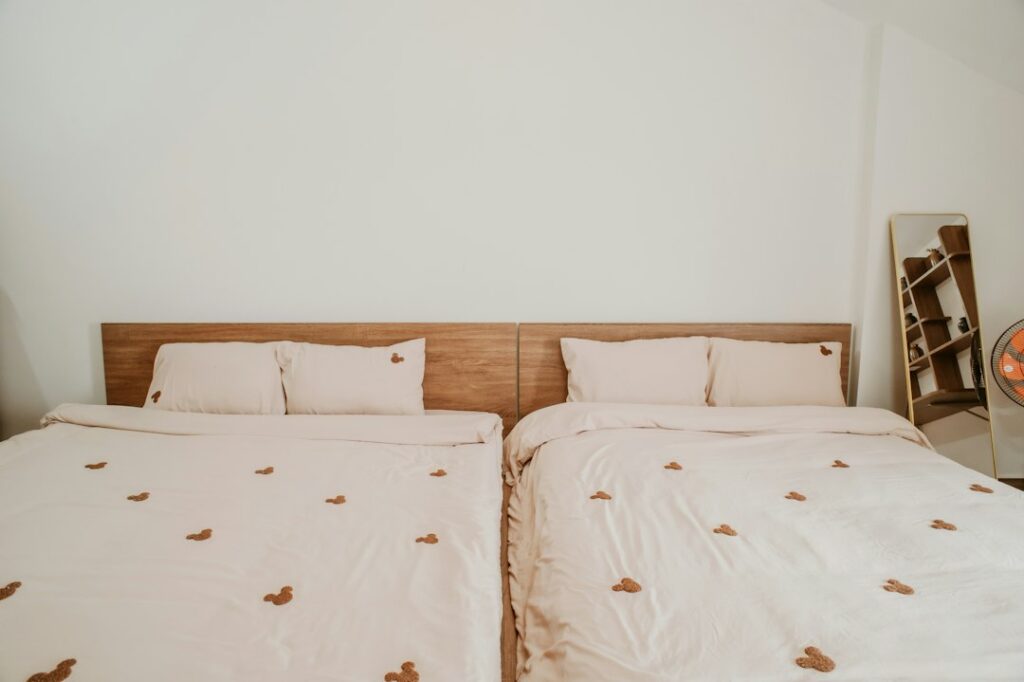
Most people plan a kids room around the mattress and forget the frame, and that is how a bed that “should fit” ends up blocking a closet door. Standard twin bed dimensions are 38 inches wide by 75 inches long for the mattress alone, which works out to roughly 96.5 by 190.5 centimeters. Once a frame, headboard and bedding are added, the real footprint usually grows to about 40 to 42 inches wide and 78 to 82 inches long.
A twin is the smallest standard adult mattress sold in the US, and it is the default choice for toddlers moving out of a crib, kids rooms, bunk beds, guest daybeds and trundles. It sleeps one person comfortably up to about 5 feet 10 inches tall. Taller teens and adults often find their feet hanging off the end, which is where the twin XL (38 by 80 inches) or a full (54 by 75 inches) comes in.
- Standard Twin Bed Dimensions in Inches and Centimeters
- Twin Size Bed Frame Dimensions by Style
- How Much Floor Space a Twin Bed Really Needs
- How Many Twin Beds Fit in a Shared Room
- Picking the Right Twin Frame and Mattress
- Flooring and Rug Tips Around a Twin Bed
- When to Size Up From a Twin
- Cost Ranges for Twin Beds and Mattresses
- Frequently Asked Questions
The sections that follow cover exact measurements in inches and centimeters, typical frame sizes by style, how much floor space you actually need around the bed, how many twins fit in a shared room, and the signs that it is time to size up.
Standard Twin Bed Dimensions in Inches and Centimeters
Mattress makers in the US build to a common standard, so a twin from one store will fit a frame from another in nearly every case. Small variations of half an inch to an inch are normal, especially with foam mattresses that compress during shipping and expand once unboxed.
| Measurement | Inches | Centimeters |
|---|---|---|
| Mattress width | 38 in | 96.5 cm |
| Mattress length | 75 in | 190.5 cm |
| Mattress surface area | about 19.8 sq ft | about 1.84 sq m |
| Common mattress depth | 6 to 14 in | 15 to 36 cm |
Depth is the number that varies the most. Bunk bed and trundle mattresses usually run 6 to 8 inches thick so the guardrail stays effective and the trundle slides under the main bed. A standard twin for a kids room tends to be 8 to 10 inches, and pillow-top or hybrid models can reach 12 to 14 inches. Thicker mattresses look plush, but they raise the sleeping surface and can make a low-profile frame feel tall for a small child.
If you shop internationally or read European product listings, note that a “single” in the UK measures about 90 by 190 centimeters, a little narrower than a US twin. Fitted sheets labeled for one market may be snug or loose on the other.
Twin Size Bed Frame Dimensions by Style
The frame is what actually takes up floor space. Twin bed frame dimensions depend heavily on style, and the gap between a minimal metal frame and a storage captain’s bed can be close to a foot in length.
- Basic metal frame: about 39 by 75 to 76 inches. It barely extends past the mattress and is the most space-efficient option.
- Platform bed frame: about 40 to 42 inches wide by 77 to 80 inches long. A low twin platform bed frame needs no box spring and suits small rooms and young kids who climb in and out on their own.
- Panel bed with headboard and footboard: about 41 to 44 inches wide by 80 to 84 inches long. Thick wood posts add length at both ends.
- Captain’s or storage bed: about 41 to 43 by 78 to 81 inches, with drawers that need roughly 18 to 22 inches of clear space to open.
- Daybed: about 40 to 42 inches deep by 79 to 82 inches wide, since it sits sideways against a wall like a sofa.
- Bunk bed: about 42 to 44 by 79 to 82 inches, with a total height of 60 to 72 inches.
When you compare twin size bed frame dimensions online, look for the “overall” or “assembled” measurement rather than the mattress size the frame accepts. Product pages often lead with “fits twin mattress” and bury the real footprint further down the specifications.
How Much Floor Space a Twin Bed Really Needs
Designers generally recommend at least 24 inches of clear walkway on any side of a bed you need to access, and 30 to 36 inches is more comfortable. In a kids room, the side against the wall needs no clearance, which is one reason twins are so often pushed into a corner.
Here is a practical way to estimate the space a twin occupies with circulation:
- Start with the frame footprint, about 41 by 80 inches for a typical platform or panel bed.
- Add 24 to 30 inches along the open long side for getting in and out and making the bed.
- Add 24 inches at the foot if anyone walks past it, or if a dresser faces it.
- Add 18 to 22 inches anywhere storage drawers must open.
Using those numbers, a corner-placed twin needs a zone of roughly 65 by 104 inches, or about 5.5 by 8.7 feet. A room of 9 by 10 feet holds one twin, a dresser and a small desk without feeling cramped. A 10 by 10 foot room can also handle a reading chair or a play area.
Do not forget doors, windows and heat registers. Keep beds from covering floor vents, leave room for a swinging closet door, and avoid placing a bunk or loft under a ceiling fan. Measure from the finished wall surface, not from baseboard to baseboard, and account for the baseboard thickness pushing the frame out about half an inch.
How Many Twin Beds Fit in a Shared Room
Siblings sharing a room is the most common reason families ask about twin size dimensions. The answer depends on layout as much as square footage.
Two twins side by side
Two frames at about 41 inches each plus a 24 to 30 inch aisle between them need roughly 106 to 112 inches of wall width, a little over 9 feet. Add a nightstand of 18 to 20 inches in the middle and you are closer to 10.5 feet. The room should also be at least 10 to 11 feet deep to leave a walkway at the foot of the beds.
Two twins in an L shape
Placing one bed along each wall in a corner saves the most open floor. One bed occupies about 80 inches along one wall and the other about 80 inches along the adjacent wall, with the head of one tucked near the foot of the other. A room around 10 by 10 feet usually works.
Bunk beds and trundles
A bunk bed puts two sleepers in a single 42 by 80 inch footprint, which frees up an entire wall. Ceiling height matters: plan for at least 30 to 36 inches between the top mattress and the ceiling, so 8-foot ceilings are the practical minimum for standard bunks. A trundle tucks a second twin underneath and rolls out at night, requiring about 80 inches of clear floor in front of the bed when open.
Three twins in one room is possible in rooms of about 12 by 14 feet or larger, usually with a bunk plus one single, or a bunk with a trundle.
Picking the Right Twin Frame and Mattress
Matching the frame to the child and the room makes a bigger difference than most buyers expect. A few guidelines help:
- Toddlers and young kids: choose a low platform with a mattress top no higher than about 16 to 20 inches off the floor, and add a side rail for the first year out of the crib.
- School-age kids: a captain’s bed or platform with drawers trades closet clutter for under-bed storage.
- Guest rooms and offices: a daybed with a trundle reads as seating during the day and sleeps two.
- Bunks and lofts: stick to the mattress thickness the manufacturer specifies so the guardrail stays at least 5 inches above the mattress surface.
Slat spacing also matters for foam and hybrid mattresses. Most mattress warranties call for slats no more than about 2.5 to 3 inches apart. Wider gaps can let foam sag and may void coverage, so check before you buy an older or secondhand frame.
Flooring and Rug Tips Around a Twin Bed
Once twin bed dimensions and the layout are settled, turn to the floor. Kids rooms take a beating, so the flooring under and around the bed deserves some thought. Luxury vinyl plank and laminate handle spills, toy cars and frequent furniture moves well. Carpet or a large area rug adds warmth and softens falls, which matters most near bunk ladders and low beds.
For a twin bed on a hard floor, a 5 by 8 foot rug placed perpendicular under the lower two-thirds of the bed leaves soft landing space on both sides. In a corner layout, a 4 by 6 rug along the open side is often enough. Use a non-slip rug pad sized slightly smaller than the rug so the edges lie flat and do not become a tripping edge. Felt pads under the frame legs protect hardwood and vinyl when the bed gets dragged for cleaning.
When to Size Up From a Twin
A twin can carry a child from toddler years through middle school, but several signs suggest it is time for something larger:
- Feet reach the end of the mattress, generally once someone passes about 5 feet 8 inches to 5 feet 10 inches.
- A growing teen sleeps diagonally or curls up to stay on the bed.
- The room will become a guest room where couples might stay.
- A pet regularly shares the bed.
The twin XL adds 5 inches of length on the same width and fits the same rooms, so it is the simplest upgrade for tall teens. A full adds 16 inches of width but keeps the 75-inch length, which helps restless sleepers more than tall ones. A queen at 60 by 80 inches needs a room of at least 10 by 12 feet to leave reasonable walkways.
Cost Ranges for Twin Beds and Mattresses
Prices vary widely by material and region, but general ranges help with budgeting. Basic metal twin frames are typically among the least expensive options, often under the cost of a single mattress. Wood platform frames land in a low-to-mid range, while captain’s beds with drawers, bunk beds and daybeds with trundles cost noticeably more because of the added hardware and material. Twin mattresses run from budget foam models to premium hybrids that can cost several times as much. Bedding for a twin is the cheapest standard size and the easiest to find.
Assembly is usually a DIY job with basic hand tools and a second person for an hour or two. Bunk and loft beds take longer and must be anchored and assembled exactly as the instructions specify, including every guardrail and cross brace.
Frequently Asked Questions
What are standard twin bed dimensions in inches?
A standard twin mattress measures 38 inches wide by 75 inches long. With a frame, the overall footprint usually measures about 40 to 42 inches wide and 77 to 82 inches long depending on the headboard and footboard.
How big is a twin bed in centimeters?
A US twin mattress is about 96.5 centimeters wide by 190.5 centimeters long. That is slightly wider than a UK single, which is roughly 90 by 190 centimeters.
What size room do you need for a twin bed?
A room of about 7 by 9 feet fits a twin with a walkway, but 9 by 10 feet or larger leaves comfortable space for a dresser and desk. Allow 24 to 30 inches of clear floor along the open side of the bed.
Can two twin beds fit in a 10 by 10 room?
Yes. An L-shaped corner layout works well in a 10 by 10 room. Side by side placement also fits, though with a narrower aisle and little room for a nightstand between the beds.
Is a twin bed big enough for an adult?
A twin works for an adult up to about 5 feet 10 inches tall who sleeps alone. Taller adults are usually more comfortable on a twin XL, which adds 5 inches of length.
Do twin sheets fit a twin XL mattress?
Standard twin fitted sheets are usually too short for a twin XL. Flat sheets and comforters often work, but buy fitted sheets labeled twin XL for the longer mattress.


