
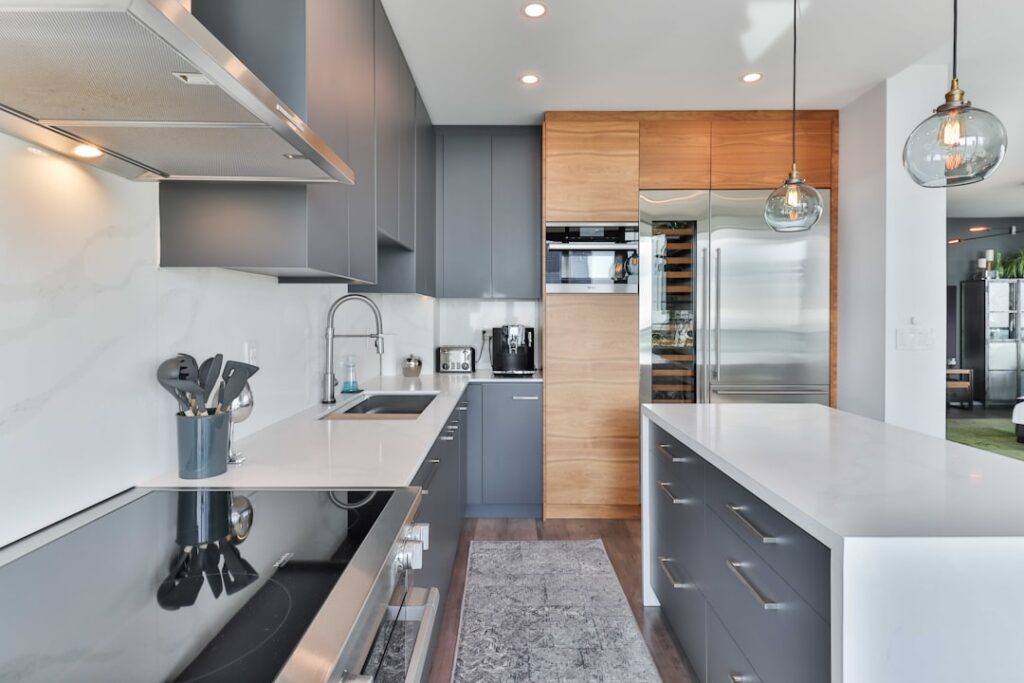
That awkward 12-inch gap between your refrigerator and the wall is not wasted space. A properly sized narrow pantry cabinet turns it into three linear feet of canned-goods storage or a pull-out spice rack. These cabinets come in widths from 9 to 18 inches, heights from counter-tall to full ceiling, and configurations that include pull-out towers, tip-out drawers, and rolling carts. The key is matching the width precisely and choosing pull-out hardware that actually holds the weight of full cans. This guide covers what sizes exist, which brands are worth the money, and how to install one without rebuilding your cabinets.
Part of our Kitchen Remodeling guide — explore the full guide →
- Standard Narrow Pantry Cabinet Widths
- Pull-Out vs. Fixed-Shelf Configurations
- Tall Pantry Towers vs. Counter-Height Cabinets
- Rolling Pantry Carts for Rentals
- Best Brands for Built-In Narrow Pantry Cabinets
- Hardware That Actually Lasts
- Installing a Narrow Pantry Cabinet
- Maximizing Storage Inside a Narrow Cabinet
- Final Recommendation
Standard Narrow Pantry Cabinet Widths
Factory cabinets come in 3-inch width increments: 9, 12, 15, and 18 inches. Anything narrower than 9 inches is typically a custom build because the shelves cannot hold standard pantry items. Here is what fits in each width:
- 9-inch wide: Spice jars, bottles, narrow cereal boxes stacked vertically.
- 12-inch wide: Canned goods, standard cereal boxes, soup cans two-deep.
- 15-inch wide: Most pantry staples, small appliances like stand mixers turned sideways.
- 18-inch wide: Large boxes, baking sheets on end, small countertop appliances.
Measure the gap in your kitchen at the floor, the middle of the wall, and near the ceiling. Old homes often have walls that bow 1/2 inch or more, and a cabinet that fits the floor may bind at the top.
Pull-Out vs. Fixed-Shelf Configurations
Narrow cabinets essentially come in two internal layouts. Fixed-shelf models are simpler and cheaper, typically $200 to $500. They work fine for items you use weekly where you can see everything on the front of each shelf. The problem is that anything behind the front row disappears; a 12-inch deep shelf wastes the back half if you cannot reach it.
Pull-out models, where every shelf slides out on full-extension drawer glides, run $500 to $1,400 but dramatically improve access. The entire cabinet is effectively front-row storage because you pull each shelf out to see the back. Rev-A-Shelf and Hafele both make retrofit pull-out kits ($150 to $300 per shelf) that convert existing fixed-shelf cabinets.
Tall Pantry Towers vs. Counter-Height Cabinets
A tall pantry tower runs 84 to 96 inches high, matching the height of your upper cabinets plus the counter stretch below. This maximizes vertical storage and looks built-in. Expect $800 to $2,500 installed.
Counter-height narrow cabinets (36 inches tall, matching your base cabinets) make sense when upper cabinets are already installed or when you want a countertop surface above. These work especially well beside the refrigerator where you might set a coffee maker or toaster on top.
Rolling Pantry Carts for Rentals
Renters or homeowners who do not want to commit to a built-in cabinet can buy rolling pantry carts. These freestanding units are 10 to 15 inches wide, 60 to 72 inches tall, and roll on four casters. They slide between the fridge and wall and pull out when you need access.
Top picks under $250:
- HOMEFORT Slim Storage Cart: 10.4 inches wide, 4 tiers, $89 on Amazon. Best for cans and bottles.
- Simple Houseware 5-Tier Slim Kitchen Cart: 6.7 inches wide, $59. Only for very narrow gaps.
- SpaceAid Rolling Storage Cart: 14.6 inches wide with drawers, $139. Highest capacity.
The tradeoff is that rolling carts hold less weight per shelf (typically 20 to 30 pounds) versus a built-in pull-out (75 to 100 pounds per shelf). Do not overload them with canned goods or they bend.
Best Brands for Built-In Narrow Pantry Cabinets
Quality varies wildly at the same price point. Brands worth considering:
- KraftMaid: Mid-range semi-custom, $600-$1,400 for a 12-inch pull-out tower. Good pull-out hardware.
- Diamond Cabinetry: Budget Lowe’s line, $400-$900. Decent for secondary kitchens or utility pantries.
- Cardell Cabinetry: Menards house brand, $350-$750. Acceptable if your expectations are measured.
- IKEA Sektion: $300-$600 for a Maximera pull-out configuration. Surprisingly good hardware given the price.
- Rev-A-Shelf retrofits: $150-$400 to convert an existing cabinet. Best value if you already have a narrow cabinet with fixed shelves.
Custom shops charge $1,500 to $3,500 for a narrow pull-out pantry tower with soft-close hardware and solid wood face frames. Worth it for a forever home, overkill for a flip or rental.
Hardware That Actually Lasts
Pull-out pantry cabinets live or die by their drawer slides. Specify these:
- Full-extension ball-bearing slides: Let you pull the shelf all the way out, not just three-quarters. Blum Tandembox and Accuride 3832 are the industry standards.
- 100-pound rating minimum: Cans of tomatoes are heavier than you think; 10 cans equals about 12 pounds.
- Soft-close mechanism: Prevents slamming when someone shoves a shelf closed. Adds about $40 per shelf.
Cheap epoxy-coated slides (common in cabinets under $300) seize up within two years of daily use. The extra $50 to $100 for metal ball-bearing slides pays back in the first five years.
Installing a Narrow Pantry Cabinet
Basic installation of a tall narrow pantry tower next to a refrigerator takes two to four hours. Steps:
- Remove any baseboard in the installation area.
- Locate wall studs with a stud finder and mark them.
- Level the cabinet from floor to ceiling using shims under the toe kick.
- Secure with at least two 3-inch cabinet screws into studs through the back rail.
- If adjacent to other cabinets, clamp face frames together and secure with 2.5-inch screws.
- Scribe the filler panel if one side meets an uneven wall; trim with a jigsaw.
- Reinstall baseboard, caulk any gaps, and attach toe-kick molding.
For rental situations or spaces you may remodel later, skip the screws into studs and use a freestanding pantry with anti-tip brackets mounted to one stud at the top.
Maximizing Storage Inside a Narrow Cabinet
A few accessories turn a narrow cabinet into a high-density storage unit:
- Door-mounted spice racks: Add 8 to 12 spice-jar slots per door.
- Tiered shelf risers: Double the visible storage on fixed shelves.
- Clear acrylic bins: Group like items so the shelf does not turn into a jumble.
- Lazy-Susan turntables: Not just for corners; 9-inch turntables fit 12-inch pantry shelves.
- Under-shelf baskets: Use the 3 to 4 inches of dead space above each shelf for flat items like tea boxes.
Final Recommendation
For most homeowners with a 12-inch gap beside the fridge, buy a KraftMaid or IKEA Sektion pull-out pantry tower with full-extension slides. Budget $700 to $1,000 including hardware. If you are renting, grab a HOMEFORT or SpaceAid rolling cart for under $150 and add dividers to keep contents from sliding. Either approach turns dead space into some of the most-used storage in the kitchen.


