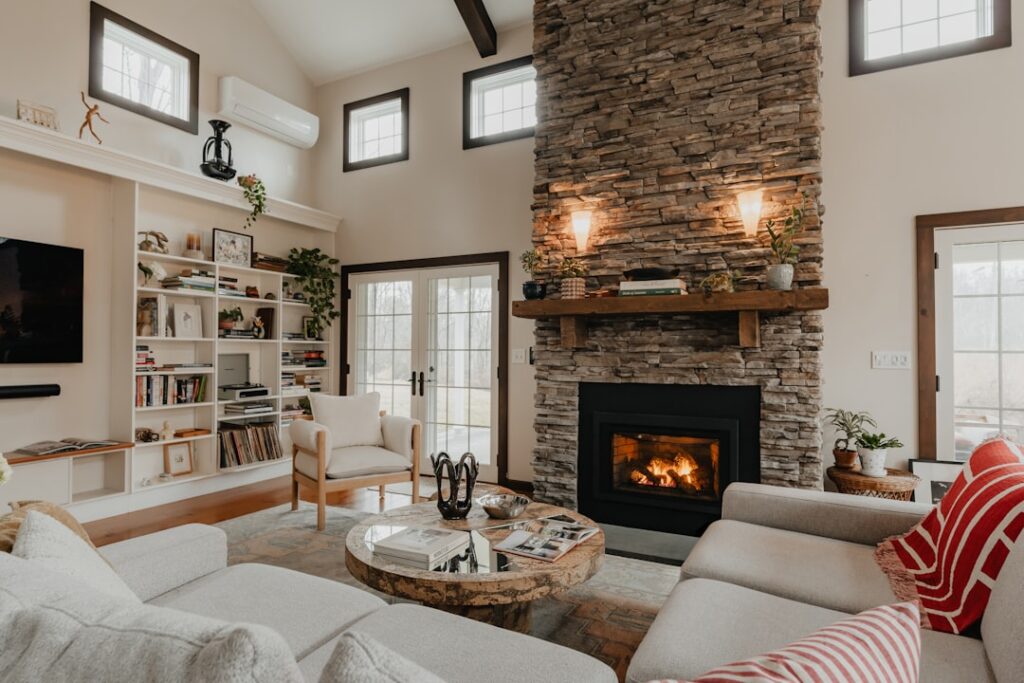
A natural gas fireplace gives you the look and warmth of a fire with the flip of a switch, no logs to haul, no ash to shovel, and no dying embers to babysit. For many homeowners it is the practical middle ground between a decorative electric unit and a full wood-burning hearth. This guide covers the types, venting, sizing, cost, and the safety and service you cannot skip with a live gas appliance.
Because it burns real gas and produces combustion byproducts, a gas fireplace is not a plug-and-play purchase. Installation involves a gas line, proper venting, and, in most jurisdictions, a permit and inspection. Understanding the categories first will save you from an expensive mismatch.
Three Types of Gas Fireplaces
- Gas fireplace insert: A sealed firebox that slides into an existing masonry or factory-built wood fireplace, converting it to gas. This is the most common retrofit and typically vents through the existing chimney with a new liner.
- Built-in gas fireplace: A complete unit framed into a wall where no fireplace existed, ideal for new construction or a remodel. It needs its own vent path to the outside.
- Gas log set: A burner and ceramic logs placed into an existing open fireplace. Cheaper, but far less efficient because much of the heat goes up the chimney.
Inserts and built-ins deliver real heat and efficiency. Log sets are mostly about ambiance. Decide which job you want the fireplace to do before you shop.
Vented vs. Ventless
Venting is the single most important technical choice. There are three approaches.
Direct-vent is the modern standard and the safest option. A sealed glass front separates the firebox from your room, and a coaxial pipe pulls combustion air from outside and pushes exhaust back out. No indoor air is consumed, and no combustion byproducts enter the home. Efficiency runs 70 to 85 percent.
B-vent (natural vent) pulls combustion air from the room and exhausts up a vertical flue. It is older technology, less efficient, and loses heated room air up the chimney.
Ventless (vent-free) units burn without any flue and release all combustion products, including water vapor and small amounts of carbon monoxide, into the room. They are efficient on paper but are banned in some states and by many local codes, and they can add unwanted humidity and require a room oxygen-depletion sensor. If you value indoor air quality, choose direct-vent.
Sizing by BTU
Gas fireplaces are rated in BTU per hour, typically 20,000 to 40,000 BTU. Oversizing makes a room uncomfortably hot and wastes gas; undersizing leaves it chilly. A rough rule for a reasonably insulated home is 20 BTU per square foot of the space you want to heat, adjusted up in cold climates and down in mild ones.
A 300-square-foot living room, for example, wants roughly 6,000 to 9,000 BTU of steady output, so a 20,000 to 25,000 BTU unit turned down suits it well. If you intend to zone-heat a large great room, step up accordingly. Ask about the turndown range, since a fireplace that modulates lets you dial comfort instead of running full-blast.
Installation and Cost
Total installed cost for a natural gas fireplace generally runs $3,000 to $8,000, and complex jobs go higher. The breakdown looks like this:
- The unit itself: $1,200 to $4,500 for a quality direct-vent insert or built-in.
- Gas line run and hookup: $300 to $1,000 depending on distance to the meter.
- Venting and chimney liner: $500 to $2,000.
- Framing, surround, mantel and finish work: $500 to $3,000.
- Permit and inspection: $100 to $400.
This is not a DIY installation. Running or extending a gas line and terminating a vent through a roof or wall must be done by a licensed gas fitter or fireplace installer, and code requires a permit and inspection in nearly every jurisdiction. An improperly sealed vent or a gas leak is a life-safety problem, not a cosmetic one.
Efficiency and Operating Cost
A direct-vent unit at 75 percent efficiency running 25,000 BTU per hour uses about a quarter of a therm each hour. At a typical residential rate near $1.50 per therm, that is roughly 40 cents an hour, or a few dollars an evening, cheaper than most electric space heating and far cheaper than heating the whole house to warm one room. Look for the fireplace efficiency (FE) rating rather than the input BTU alone when you compare models.
Safety and Annual Service
A gas fireplace is safe when installed and maintained correctly, but it demands respect. Follow these rules:
- Schedule annual service with a qualified technician. They clean the burner and glass, check the gas pressure, test the thermocouple and safety shutoffs, and inspect the vent for blockage or corrosion.
- Install carbon monoxide detectors on every level and near sleeping areas, and test them monthly. This is non-negotiable with any gas appliance.
- Respect clearances to combustibles. Keep furniture, drapes and decorations away from the unit per the manufacturer’s spec, and never hang stockings or greenery too close.
- Mind the hot glass. Direct-vent glass fronts reach 400 degrees or more and stay hot after shutdown. Use the provided safety screen if you have children or pets.
- Know the smell of gas. If you smell rotten eggs, do not flip switches; leave and call the gas utility from outside.
Is It Right for You?
A natural gas fireplace makes sense if you have gas service, want reliable heat with minimal effort, and value clean operation. Choose a direct-vent insert or built-in for real efficiency, size it to the room by BTU, budget for professional installation, and commit to a CO detector and annual service. Do those things and you get decades of push-button warmth from one of the more sensible upgrades a home can have.
Ignition Systems: Standing Pilot vs. Electronic
How the fireplace lights matters more than most buyers realize. A standing pilot keeps a small flame burning continuously, so the fireplace lights instantly and works even during a power outage, a real advantage in winter. The tradeoff is that the always-on pilot burns a trickle of gas year-round and its thermocouple eventually wears out. An electronic ignition (intermittent pilot) lights the pilot only on demand with a spark, saving gas and eliminating the standing flame, but it needs electricity or a battery backup to work. If you buy a home for its fireplace’s outage resilience, ask which system it uses; many people want the standing pilot specifically so the fire works when the power is out.
Features Worth Paying For
- A variable-speed blower that pushes the fireplace’s radiant heat into the room and roughly doubles how much warmth you feel.
- A wall thermostat or remote that modulates the flame to hold a set temperature instead of running full-blast.
- A modulating (multi-stage) burner so you can dial the flame from a low glow to full output, tuning both heat and ambiance.
- A battery backup on electronic-ignition models so the fireplace still lights during an outage.
Converting an Existing Fireplace
If you already have a wood-burning masonry fireplace, converting it to gas is usually cheaper than building new, because the chimney and opening exist. A licensed installer runs a gas line to the firebox, drops in a direct-vent insert with a new flue liner, and finishes the surround. Expect $2,500 to $6,000 for a conversion depending on how far the gas line has to travel. The payoff is turning a drafty, inefficient hole in the wall, which loses most of its heat up the chimney, into a sealed 75-percent-efficient heater you light with a switch.
Whether you convert or build new, the fundamentals hold: choose direct-vent for clean, efficient operation, size the natural gas fireplace to the room by BTU, hire a licensed gas professional for the install, and back it all up with CO detectors and yearly service. Get those right and you’ll have push-button warmth and a beautiful flame for decades, safely.