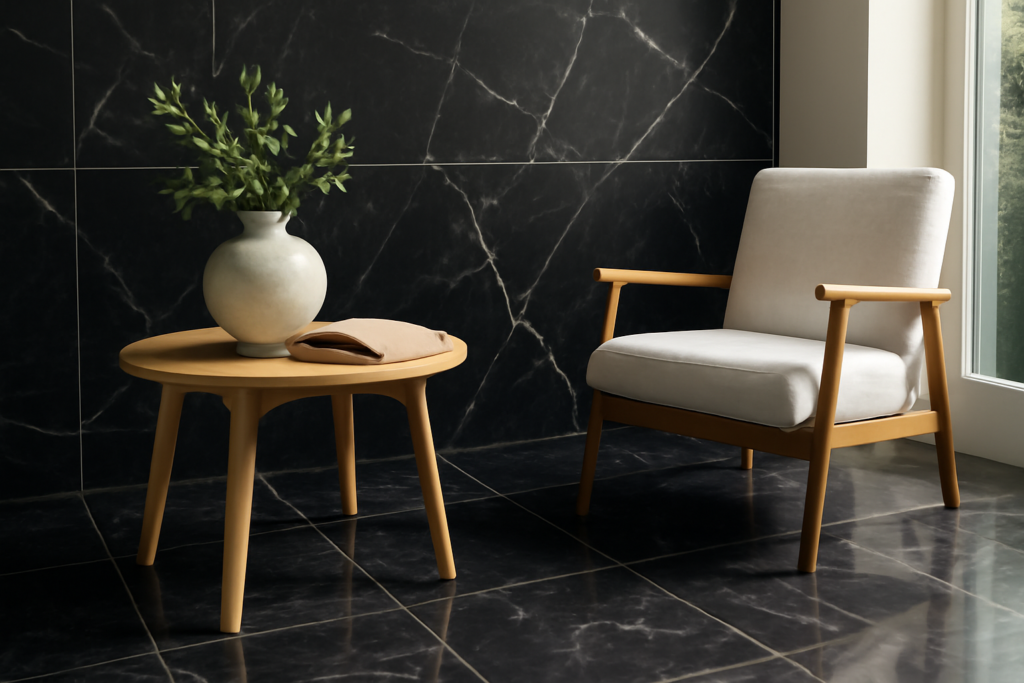
Few materials make a bolder statement than deep black marble laced with lightning-strike white veins, and that exact look has a name. Nero Marquina tile recreates the famous Spanish black marble quarried near Markina in the Basque Country, prized for centuries for its intense, near-black background and sharp, contrasting white veining. Whether you buy the real marble or a convincing porcelain lookalike, this tile turns a floor, backsplash, or shower into a high-drama focal point. But black marble comes with real care considerations, and the porcelain-versus-natural-stone decision changes everything. Here is how to use it well.
Part of our Tile & Grout guide — explore the full guide →
What Nero Marquina Is
The original Nero Marquina is a natural limestone-based black marble from Spain, distinguished by its dense, dark background and irregular white calcite veining. It has been used in luxury architecture and design for generations, from grand hotel lobbies to high-end bathrooms. Today, “Nero Marquina tile” refers to two things: the genuine marble cut into tile, and porcelain tiles printed to mimic that iconic look.
Both have their place. The natural marble offers unmatched depth and authenticity, while porcelain versions capture the appearance at a fraction of the maintenance and cost. Knowing which you are buying is essential, because they behave completely differently in a wet or high-traffic space.
Porcelain vs. Natural Marble
This is the decision that matters most, and it comes down to where the tile is going and how much upkeep you will tolerate.
- Natural marble: Authentic depth and unique veining, but porous, prone to etching from acids, and requires sealing. Softer and more easily scratched. Best for lower-traffic, dry-leaning areas or where a homeowner wants genuine stone.
- Porcelain: Non-porous, highly durable, stain- and scratch-resistant, and needs no sealing. Modern digital printing makes high-end porcelain nearly indistinguishable from real marble at arm’s length. Ideal for floors, showers, and busy kitchens.
For most homeowners, porcelain is the practical winner in wet and high-use areas. Reserve genuine Nero Marquina marble for feature walls, fireplace surrounds, or spaces where authenticity outweighs maintenance.
Finish Options and Their Effects
The finish dramatically changes both the look and the practicality of the tile. A polished finish delivers that mirror-like, glossy black that makes the white veins pop and reflects light around the room; it is stunning on walls and backsplashes but shows water spots and can be slippery underfoot.
A honed or matte finish gives a softer, contemporary look, hides water spots and fingerprints better, and provides more slip resistance, making it the safer pick for floors and shower pans. There are also textured and structured finishes for wet-area floors that need extra grip. For a bathroom floor, always lean matte or textured for safety.
Where Nero Marquina Tile Shines
The high contrast makes this tile a designer favorite for creating focal points. Popular applications include:
- Bathroom floors and walls for a moody, luxurious spa feel.
- Kitchen backsplashes, especially paired with white or light cabinetry for maximum contrast.
- Shower feature walls and niches as a dramatic accent.
- Fireplace surrounds and entryway floors where you want an immediate impression.
- Herringbone and hexagon patterns that play the white veining into a geometric layout.
Because the tile is so dominant, keep the surrounding palette restrained. It pairs beautifully with brass or gold fixtures, warm wood vanities, and crisp white grout that echoes the veining.
What It Costs
Price depends heavily on whether you choose porcelain or natural stone. Porcelain Nero Marquina-look tile runs roughly $4 to $15 per square foot for materials, with premium large-format and thick-body options at the top. Genuine Nero Marquina marble tile costs considerably more, typically $15 to $40-plus per square foot depending on grade, thickness, and finish.
Installation adds $8 to $20 per square foot, more for intricate patterns like herringbone or for natural stone, which requires careful handling and sealing during the install. A mid-size bathroom in porcelain commonly totals $1,500 to $4,000 installed; the same space in genuine marble can easily double that.
Care and Maintenance
Porcelain is refreshingly simple: sweep or vacuum, then damp-mop with a pH-neutral cleaner. No sealing, no special products. Natural marble is the opposite and demands respect. It must be sealed on installation and resealed periodically, and you must avoid all acidic cleaners, vinegar, and citrus, which etch dull marks into the polished surface almost instantly.
On real marble, wipe up spills immediately, use coasters and trivets, and clean only with a stone-specific pH-neutral product. The black background also shows dust, hard-water spots, and residue more readily than lighter tiles, so a microfiber and a quick buff keep polished surfaces looking sharp. Choose porcelain and you get the drama of Nero Marquina with almost none of the upkeep, which is why it has become the go-to for anyone who wants the look to survive real daily life.
Grout Color Makes or Breaks the Look
With a black tile, grout choice is not a minor detail; it defines the entire installation. A matching black or charcoal grout makes the tiles read as one continuous, seamless field of dark stone, which is the most dramatic, high-end effect and hides everyday grime well. This is the go-to for a moody shower or a statement floor where you want the surface to feel monolithic.
A crisp white or light-gray grout does the opposite, framing each tile and turning the layout into a bold graphic grid, which suits a subway or herringbone pattern where you want the geometry to show. Be warned that white grout against black tile shows every speck of dirt and needs diligent sealing and cleaning. For most homeowners, a mid-gray grout strikes the practical balance, defining the tile without the maintenance burden of stark white.
Design Pairings That Elevate the Space
Because Nero Marquina is so visually powerful, the materials around it determine whether the room feels luxurious or heavy. Metallic accents are its best friend: brushed brass, polished gold, and champagne bronze fixtures pop against the black background and echo classic black-and-gold design pairings. Matte black hardware creates a sleek, monochromatic modern look, while chrome keeps things crisp and contemporary.
Balance the darkness with light around it. White or cream cabinetry, pale oak vanities, and plenty of natural light keep a Nero Marquina space from feeling like a cave. In a small powder room, a full wall of the tile reads as jewel-box drama; in a larger bathroom, use it as a feature wall or shower accent rather than wrapping every surface. Warm wood tones and brass together with the black marble create the timeless, elegant contrast that keeps this look in demand decade after decade.
If you are nervous about committing to so much black, start small. A single feature strip behind a vanity, a shower niche lined in the tile, or a border framing a plainer field lets you test the drama before wrapping an entire wall. You can always add more later, but scaling back a room that reads too dark means tearing out tile, so it pays to ease into the look rather than over-commit on day one.
Prefer to explore on your own?
See how new flooring looks in your actual room in seconds — free, no signup.
Try the free Floor Studio →