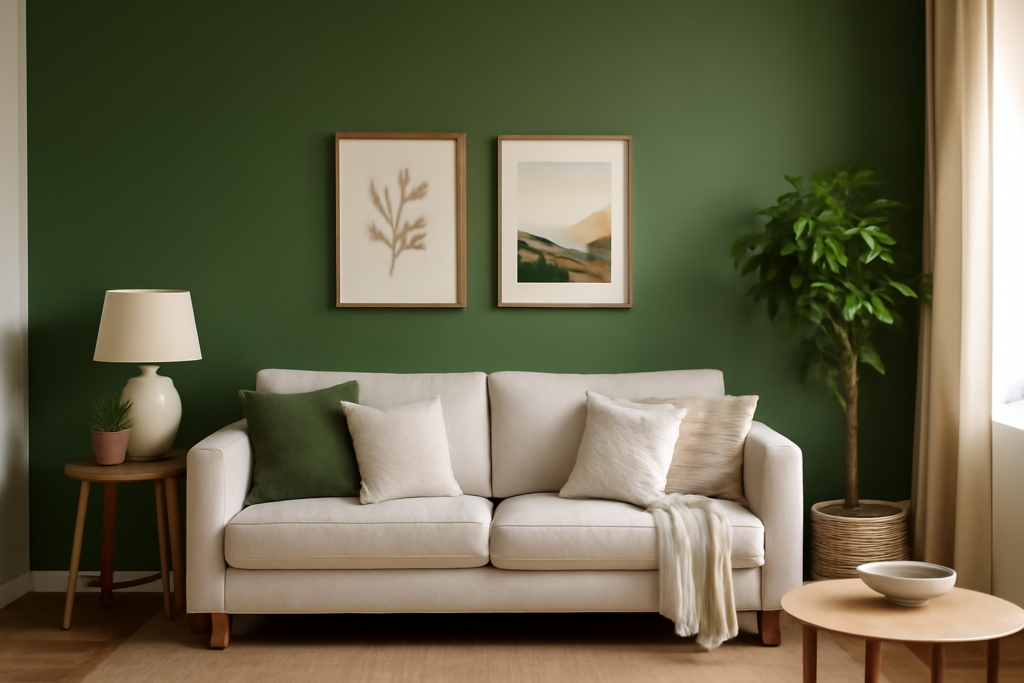
Gray had its decade, and homeowners are moving on to something warmer with more personality. An olive green accent wall hits the sweet spot: it feels organic and grounded, borrows the sophistication of a deep neutral, and still reads as color rather than beige. Olive works because it contains both green and a touch of brown-yellow, which makes it flatter skin tones, pair with almost any wood, and glow under warm light. The catch is that olive is undertone-sensitive, so choosing the shade and the wall carefully makes the difference between rich and murky.
- Why Olive Green Works as an Accent
- Choosing the Right Olive Paint
- Which Wall Should You Paint?
- Decorating Around Olive Green
- Finish and Sheen
- Step-by-Step: Painting Your Accent Wall
- Common Mistakes to Avoid
- Olive Green in Different Rooms
- How Olive Changes Through the Day
- Caring for Your Olive Accent Wall
- Is an Olive Green Accent Wall Worth It?
Why Olive Green Works as an Accent
Olive is a muted, earthy green, and muted colors are forgiving. Unlike a saturated emerald or a cool sage, olive carries warmth that keeps a room from feeling cold or clinical. It behaves like a neutral you can build an entire palette around, sitting comfortably next to cream, camel, rust, black, and brass. On a single accent wall, that warmth adds depth without demanding you repaint the whole room or replace your furniture.
There is also a timelessness to olive. It nods to nature, mid-century design, and old-world libraries all at once, so it rarely feels like a trend you will regret. As an accent, it lets you test the color commitment-free before deciding whether to take it further.
Choosing the Right Olive Paint
Not every green labeled olive behaves the same. Some lean gray, some lean brown, and some tip toward chartreuse under bright light. These proven picks give you a reliable starting point:
- Sherwin-Williams Ripe Olive: a deep, dramatic olive that reads almost brown-green in low light, ideal for a bold statement wall.
- Farrow & Ball Bancha: a rich, earthy olive with real depth, gorgeous in living rooms and studies.
- Benjamin Moore Dark Olive: a classic warm olive that pairs beautifully with wood and brass.
- Sherwin-Williams Olive Grove: a softer, lighter olive for those who want warmth without heaviness.
- Behr Mother Nature: a mid-tone olive that photographs true and works in most light.
Buy sample pots and paint large swatches, because olive shifts more than most colors as light changes. What looks like a handsome forest-olive at noon can turn muddy brown after dark, and that surprise is best discovered on a test patch, not a finished wall.
Which Wall Should You Paint?
The best accent wall is the one your eye lands on first when you enter the room. In a living room, that is usually the wall behind the sofa or the one framing a fireplace or television. In a bedroom, the headboard wall is the natural choice. Pick a wall with an architectural feature or a focal furniture piece so the color has something to frame.
Avoid choosing a wall broken up by too many windows and doors, since the paint gets chopped into thin strips and loses impact. A solid, mostly uninterrupted wall gives olive room to do its work. Consider light too: a wall that catches warm afternoon light will make olive glow, while one in permanent shadow can make it read flat.
Decorating Around Olive Green
Olive is a team player, and the pairings you choose set the whole mood. For a warm, cozy library feel, layer in walnut furniture, brass lamps, and cream textiles. For something more modern, contrast the olive with matte black frames, white trim, and a few crisp geometric pieces. Rust, terracotta, and mustard accents lean into olive’s earthiness, while blush pink and dusty blue soften it.
Metals matter. Brass and aged gold are olive’s best friends, adding a glow that cool chrome cannot match. Bring in living plants and natural textures like jute, linen, and rattan to reinforce the organic feeling. A few well-chosen accessories in complementary tones make an accent wall feel intentional rather than random.
Finish and Sheen
For an accent wall, a matte or eggshell finish flatters olive best, giving it a soft, velvety depth that hides minor wall imperfections. Matte in particular makes deep olive look expensive and enveloping. If the wall sees hands or lives in a kitchen or hallway, step up to a scrubbable eggshell so you can wipe it clean. Save satin and semi-gloss for trim and doors, where the slight contrast in sheen frames the accent nicely.
Step-by-Step: Painting Your Accent Wall
- Prep the wall. Fill nail holes, sand smooth, wipe off dust, and let it dry fully.
- Tape the edges. Run painter’s tape along the ceiling, adjacent walls, and trim for crisp lines.
- Prime if needed. Over a light wall, a coat of tinted primer helps deep olive cover in two coats instead of three.
- Cut in. Use an angled brush to paint the edges and corners first.
- Roll the field. Work in overlapping W patterns with a 3/8-inch nap roller, keeping a wet edge.
- Apply the second coat. Let the first coat dry the full 4 hours, then recoat for even, saturated color.
- Pull the tape. Remove painter’s tape while the final coat is still slightly wet to avoid peeling.
Plan on about one quart to one gallon of paint for a single accent wall depending on its size, and expect two coats for the deeper olives.
Common Mistakes to Avoid
The biggest error is skipping the sample stage and committing to a shade that goes brown or chartreuse in your specific light. The second is choosing a busy, window-filled wall that fragments the color. The third is pairing olive with cool grays and chrome, which fights its inherent warmth and leaves the room feeling confused. Lean into warm woods, brass, and creamy whites instead.
Olive Green in Different Rooms
Where you place an olive accent wall shapes the mood it creates. In a living room, olive behind the sofa or framing the fireplace turns a gathering space cozy and grounded, especially paired with warm wood furniture and soft lighting. In a bedroom, an olive headboard wall promotes rest, reading as calm and enveloping without the coldness of gray. Home offices benefit enormously from olive, since the muted, natural tone supports focus and reads as sophisticated on video calls, a far better backdrop than stark white.
Dining rooms and powder rooms are where olive can go boldest. A deep olive in a small powder room, with the trim painted to match, creates a jewel-box effect that feels intentional and luxe. In a kitchen, olive works beautifully on a single wall or on lower cabinetry, pairing with brass hardware and butcher-block or white counters for a warm, current look. Even entryways gain character from an olive accent that greets guests with warmth.
How Olive Changes Through the Day
More than most colors, olive shifts dramatically with the light, and understanding that rhythm helps you place it well. In bright midday sun, olive reads greenest and most vivid, showing off its depth. As afternoon light warms and golds, olive glows richer and cozier, which is why west-facing rooms flatter it so well. After dark, under warm incandescent or LED bulbs, olive deepens toward brown-green and becomes moody and enveloping.
This day-to-night transformation is part of olive’s appeal, but it means your bulb choice matters. Warm-white bulbs around 2700K enhance olive’s richness, while cool daylight bulbs can flatten it or push it gray. Test your accent wall under the actual bulbs you use at night, not just in daylight, so you love it around the clock. That evening character is when an olive accent wall feels most special.
Caring for Your Olive Accent Wall
An accent wall sees less traffic than a hallway, but it still benefits from smart maintenance. Save a small labeled container of the leftover paint for touch-ups, because matching a deep olive after the fact is difficult and even the same color from a fresh can may vary slightly in batch. Clean gently with a barely damp cloth and mild soap, avoiding abrasive cleaners that can burnish a matte finish into a shiny patch. If your accent wall is behind a sofa where hands and heads rest, a scrubbable eggshell holds up better than dead-flat matte. With minimal care, a well-applied olive wall keeps its rich, velvety depth for years.
Is an Olive Green Accent Wall Worth It?
For a single afternoon of work and less than $50 in paint, an olive green accent wall transforms the character of a room. It brings warmth that gray never delivered, pairs with the furniture you already own, and feels current without chasing a trend that will date. Sample your shade, pick the wall your eye finds first, and surround it with brass and wood. The result is a space that feels considered, cozy, and unmistakably yours.