Most crawl space windows fail long before anyone notices, because nobody looks at them until water, mice, or a home inspector forces the issue. A proper crawl space window replacement is one of the cheapest fixes in home maintenance — often under $100 per opening in materials — yet a rusted-out or broken foundation window is a highway for rodents, a moisture leak into your framing, and an instant flag on a pre-sale inspection report. This guide covers how these windows are sized, whether you should vent or seal, and how to swap one out in an afternoon.
Part of our Windows & Doors guide — explore the full guide →
- What Counts as a Crawl Space Window
- Repair, Replace, or Seal It Permanently?
- Measuring the Opening Correctly
- Removing the Old Window
- Installing the New Window Step by Step
- What Crawl Space Window Replacement Costs
- Ventilation, Egress, and Code Notes
- Small Upgrades Worth Making While You’re There
- Common Questions About Foundation Windows
What Counts as a Crawl Space Window
Crawl space windows — also called foundation windows or basement utility windows — are the small units set into the concrete, block, or brick foundation wall between grade and the sill plate. Standard sizes cluster around 32 x 14 inches, 32 x 16 inches, and 32 x 24 inches for block foundations, because they’re built to fill the space of one or two courses of 8 x 16 concrete block. Older poured-concrete homes from the 1940s-70s often have steel-framed hopper windows with a single pane of glass and a cam latch, and those steel frames are almost always rusted at the bottom rail by now.
You’ll find three basic operating styles: hoppers that tilt inward from the top, sliders, and fixed (non-operating) panes. Hoppers dominate because they vent well and shed rain when open. Most replacement units sold at Home Depot, Lowe’s, and Menards are vinyl hoppers or sliders from brands like Duo-Corp, TAFCO, and Park Ridge, typically running $60-140 each.
Repair, Replace, or Seal It Permanently?
Before ordering a window, decide what you actually want the opening to do. You have three paths:
- Replace with an operable window if your crawl space relies on passive ventilation. Building codes for vented crawl spaces generally require 1 square foot of vent area per 150 square feet of crawl space floor, and windows can count toward that.
- Replace with a fixed or glass-block unit if you want daylight and security but never open the window anyway. Glass block mortared into the opening is nearly burglar-proof and maintenance-free; a 32 x 16 block panel runs $60-100 in materials.
- Seal the opening entirely if you’re converting to a sealed (encapsulated) crawl space with a vapor barrier and dehumidifier. In that system, open vents and windows are actively harmful, so openings get filled with foam-insulated vent covers, treated plywood, or mortared block.
Encapsulation has become the standard recommendation in humid Southeast climates because vented crawl spaces pull in muggy summer air that condenses on cool framing. If your crawl space already has a sealed liner, don’t install an operable window — install an airtight insulated panel instead.
Measuring the Opening Correctly
Measure the masonry opening, not the old window frame. Take width and height at three points each and record the smallest figures, then order a unit sized about 1/4 to 1/2 inch smaller in each dimension to leave room for shimming and sealant. With old steel windows set directly into poured concrete, you’ll usually remove the steel frame entirely, so measure the raw concrete pocket. If the steel frame is solidly embedded and rust is only surface-level, some homeowners install a vinyl insert within the old steel perimeter — acceptable, but you lose glass area and it traps moisture against the steel, so full removal is better practice.
Removing the Old Window
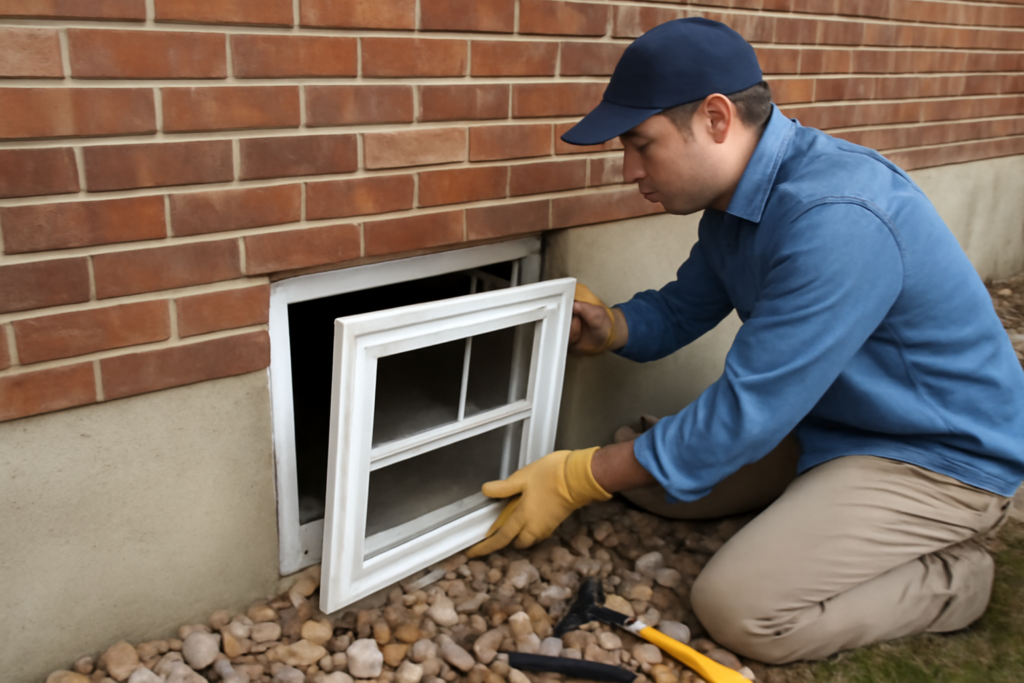
Steel-framed units come out with an angle grinder fitted with a metal cut-off wheel, a reciprocating saw with a bi-metal blade, or in stubborn cases a cold chisel and 3-pound sledge. Cut the frame at the bottom center and at both side jambs, then bend the sections inward with a pry bar until the anchoring fins tear free of the mortar. Wear safety glasses and gloves — 60-year-old steel shatters and tears unpredictably. Wood-framed bucks that have rotted get cut out with a reciprocating saw. Vacuum the pocket clean and knock off loose mortar with a chisel so you have sound, flat masonry on all four sides.
Installing the New Window Step by Step
- Dry-fit the unit. Set it in the opening and check the gap on all sides. Aim for an even 1/8 to 1/4 inch reveal.
- Build up the sill if needed. If the masonry sill is badly pitted, trowel a patch of hydraulic cement or mortar mix and let it cure so the window bears on a flat surface pitched slightly to the exterior for drainage.
- Bed the frame in sealant. Run a generous bead of polyurethane sealant (Loctite PL Window, Door & Siding or OSI Quad Max, about $8-10 a tube) along the sill and up the jambs, then press the window in place.
- Shim and fasten. Plumb and level the unit with plastic shims, then drive 1/4-inch masonry screws (Tapcons) through the frame’s pre-drilled holes into the concrete or block. Two per side is typical for these small units. Hammer-drill a 3/16-inch pilot hole for each Tapcon.
- Seal the perimeter. Caulk the exterior joint completely. On the interior, fill larger gaps with low-expansion window-and-door foam, trim flush after curing, and caulk over it.
- Check operation. Open and latch the sash a few times. A racked frame binds — back off the Tapcons, re-shim, and retighten.
Total working time is 1-2 hours per window once you’ve done the first one. The hammer drill and grinder are the only specialty tools; renting both for a half day costs about $40-60 if you don’t own them.
What Crawl Space Window Replacement Costs
DIY materials come in remarkably low: $60-140 for the window, $10-20 for sealant, foam, and Tapcons. Hiring it out changes the math. A handyman typically charges $150-350 labor per opening, so a three-window job lands around $600-1,200 all-in. Full-service window companies often won’t touch foundation utility windows, or will quote $400-700 each because small jobs carry minimum-charge overhead. Glass block installers charge $175-400 per opening installed. If the surrounding masonry needs rebuilding — spalled concrete, cracked block, a rotted wood buck in a brick foundation — add $100-400 per opening for the repair work.
Ventilation, Egress, and Code Notes
Crawl space windows are not egress windows and don’t need to meet the 5.7-square-foot clear-opening rule that applies to sleeping-room basement windows. What inspectors do check: vented crawl spaces need operable vent area within 3 feet of each corner in many jurisdictions, and any window within 18 inches of the crawl floor in a garage-adjacent wall may need specific fire-rated treatment. If you’re sealing openings as part of encapsulation, most codes require a mechanical drying method — a crawl space dehumidifier (Aprilaire E070 or Santa Fe Compact70, $1,100-1,600) or conditioned-air supply — before you eliminate the passive vents. Check with your local building department before permanently closing anything.
Small Upgrades Worth Making While You’re There
Since you’re already working at the foundation line, spend an extra hour on the details that keep the crawl space dry. Swap torn vent screens for 1/4-inch hardware cloth backed by insect mesh to stop mice and wasps. Regrade or add splash blocks under any downspout dumping near a window well. If a window sits below grade, install a plastic window well ($30-60) and gravel so soil doesn’t bury the frame. And take ten minutes with a flashlight to scan the rim joist above each window for water staining or insect damage — the area around failed foundation windows is exactly where rot starts, and catching it now is worth far more than the window itself.
Common Questions About Foundation Windows
Do crawl space windows need to open at all? Only if your crawl space ventilation plan counts on them. Most vented crawl spaces meet code through dedicated foundation vents, in which case a fixed pane or glass block is fine and more secure. Sealed, encapsulated crawl spaces should have no operable openings at all.
Should the glass be single or double pane? For a vented crawl space, single pane is genuinely adequate — the space is intentionally connected to outdoor air, so paying for insulated glass there is wasted money. For a sealed and conditioned crawl space, an insulated dual-pane unit or an insulated solid panel makes sense because the space is inside your thermal envelope.
What about window wells that keep filling with leaves and water? Add a clear polycarbonate well cover ($20-50) sloped to shed rain. If the well floods in storms, dig it out, add 6 inches of gravel at the base, and check that the adjacent downspout isn’t discharging beside it — most “leaky crawl space window” complaints are actually drainage problems that a $12 downspout extension solves.
Is this a permit job? Like-for-like window replacement in an existing opening rarely requires a permit, but enlarging an opening, cutting a new one, or permanently sealing required ventilation can. A five-minute call to the building department beats undoing mortared block during a future sale inspection.