Onyx Countertops: The Ultimate Guide to This Stunning Natural Stone
If you have ever walked into a high-end hotel lobby or upscale cocktail bar and been mesmerized by a glowing, translucent stone surface, you were likely looking at onyx countertops. Onyx is one of the most visually dramatic natural stones available for interior design, prized for its swirling veins, rich colors, and ability to transmit light. But before you fall head over heels for this gorgeous material, you need to understand what you are signing up for in terms of maintenance, durability, and cost.
- Onyx Countertops: The Ultimate Guide to This Stunning Natural Stone
- What Is Onyx Stone?
- Backlit Onyx Countertops
- Onyx Countertop Cost
- Durability and Maintenance
- Onyx vs Marble Countertops
- Pros and Cons of Onyx Countertops
- Best Uses for Onyx Countertops
- Onyx Countertop Installation Tips
- How Onyx Compares to Other Premium Stones
- Frequently Asked Questions About Onyx Countertops
In this comprehensive guide, we cover everything you need to know about onyx countertops, from pricing and installation to care requirements and how onyx stacks up against marble and other premium stones.
What Is Onyx Stone?
Onyx is a form of calcite, a translucent natural stone formed by dissolved limestone that is redeposited by springs and rivers. Unlike granite or quartzite, onyx has a crystalline structure that allows light to pass through it, creating an ethereal, glowing effect that no other countertop material can replicate.
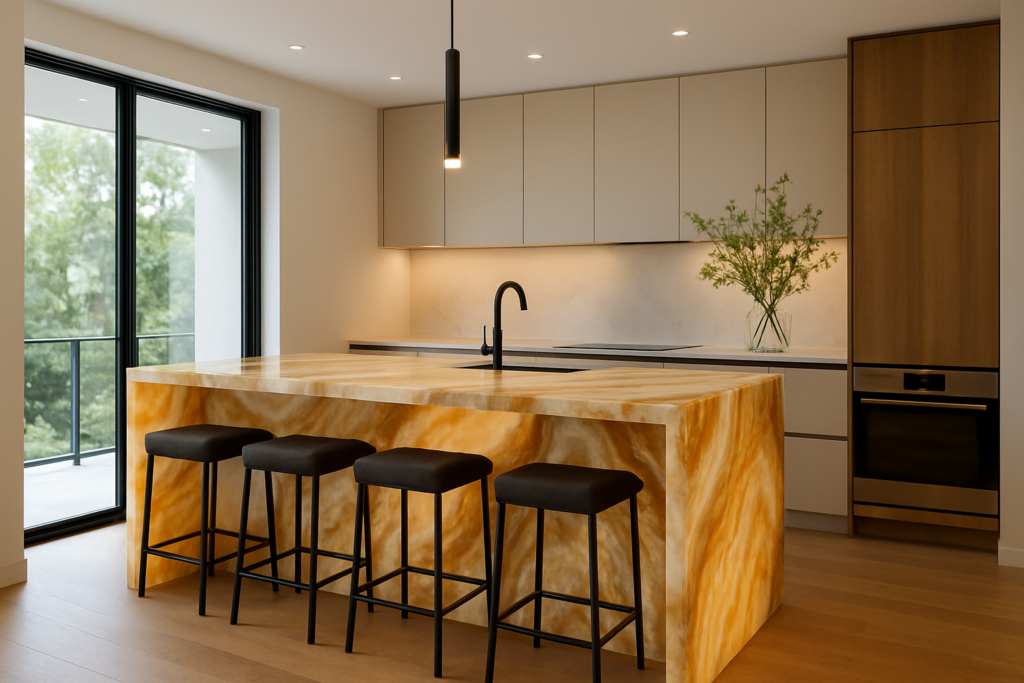
Onyx slabs come in a wide spectrum of colors, including honey gold, emerald green, white, blood red, and multicolored varieties with dramatic banding. Each slab is genuinely one-of-a-kind, making onyx a favorite among architects and designers who want a true statement piece.
Key Characteristics of Onyx
- Translucency: Light passes through the stone, enabling stunning backlit installations
- Mohs hardness: Only 3 out of 10, making it one of the softest countertop stones
- Composition: Calcium carbonate (calcite), similar to marble and travertine
- Formation: Created by mineral-rich water deposits over thousands of years
- Availability: Rare compared to granite or marble, which drives up pricing
Backlit Onyx Countertops
The single most spectacular application of onyx is backlit onyx countertops. By installing LED panels or light strips behind or beneath a thin onyx slab, the stone seems to glow from within, highlighting every vein and color variation in breathtaking detail.
Backlit onyx is commonly used in:
- Bar tops and reception desks
- Powder room vanities
- Accent walls and fireplace surrounds
- Kitchen islands as a focal point
- Hotel and restaurant design
For backlighting to work effectively, the onyx slab should be no thicker than 2 cm (about 3/4 inch). Thicker slabs reduce translucency. LED panels are the preferred light source because they produce even illumination, low heat, and long lifespans. Expect to add $20 to $50 per square foot to your project for professional backlighting installation.
Onyx Countertop Cost
Onyx is among the most expensive natural stones for countertops. Here is a breakdown of what you can expect to pay in 2026:
| Cost Component | Price Range | Notes |
|---|---|---|
| Onyx slab (material only) | $50 – $200/sq ft | Varies widely by color and rarity |
| Fabrication | $30 – $60/sq ft | Requires experienced fabricator |
| Installation | $15 – $35/sq ft | Fragile; extra care needed |
| Backlighting (optional) | $20 – $50/sq ft | LED panels and installation |
| Sealing | $5 – $15/sq ft | Required; reapply every 6-12 months |
| Total installed (no backlight) | $100 – $310/sq ft | |
| Total installed (backlit) | $120 – $360/sq ft |
For a 30-square-foot kitchen countertop, you could be looking at $3,000 to $9,300 or more. Common onyx varieties like honey onyx sit at the lower end, while rare colors such as blue onyx or multicolored Pakistani onyx command top dollar.
Durability and Maintenance
Here is where reality sets in. Onyx is extremely delicate. With a Mohs hardness rating of just 3, it is softer than a copper penny. For context, granite rates 6 to 7, and quartzite can reach 7 to 8. This means onyx scratches, chips, and etches with alarming ease.
Sealing Requirements
Onyx is highly porous and must be sealed before use and resealed every 6 to 12 months. Use an impregnating sealer designed for calcite-based stones. Even with proper sealing, acidic liquids like lemon juice, wine, and vinegar will etch the surface on contact.
Daily Care Tips
- Always use coasters, trivets, and cutting boards
- Wipe spills immediately, especially acidic liquids
- Clean with a pH-neutral stone cleaner only
- Never use bleach, ammonia, or abrasive cleaners
- Avoid placing hot pans directly on the surface
Onyx vs Marble Countertops
Onyx and marble are both calcite-based stones, but they differ significantly in practical terms. Here is how they compare:
| Feature | Onyx | Marble |
|---|---|---|
| Mohs Hardness | 3 | 3 – 5 |
| Translucency | Yes (can be backlit) | Minimal to none |
| Cost per sq ft | $50 – $200 | $40 – $100 |
| Color Range | Wide (golds, greens, reds, whites) | Primarily whites and grays |
| Etching Risk | Very high | High |
| Availability | Rare | Widely available |
| Best Use | Accent areas, low-use surfaces | Bathrooms, low-traffic kitchens |
| Maintenance Level | Very high | High |
If you love the look of onyx but need something more durable for everyday kitchen use, consider quartzite countertops, which offer similar veining with far superior hardness.
Pros and Cons of Onyx Countertops
Pros
- Unmatched beauty: No other countertop material offers the same visual drama
- Translucency: Backlighting creates a jaw-dropping focal point
- Unique slabs: Every piece is truly one of a kind
- Increases home value: A luxury feature that impresses buyers
- Versatile colors: From warm honeys to cool greens and whites
Cons
- Extremely soft: Scratches, chips, and etches easily
- High maintenance: Requires frequent sealing and careful daily use
- Expensive: Among the priciest countertop options available
- Not food-safe without sealing: Porous surface harbors bacteria if unsealed
- Limited fabricators: Not every stone shop has experience working with onyx
- Fragile during transport: Higher risk of breakage during delivery and installation
Best Uses for Onyx Countertops
Given its delicacy, onyx is best reserved for areas that see light use and where its beauty can be fully appreciated:
Powder Room Vanity
A powder room is the ideal location for an onyx countertop. Guest bathrooms see minimal daily use, reducing the risk of damage, while giving you a stunning focal point that wows visitors.
Bar Top
A backlit onyx bar top is a showstopper in any home. Because bar surfaces are typically smaller, the cost is more manageable, and the dramatic effect is maximized.
Accent Pieces
Consider onyx for a decorative shelf, side table, or small accent countertop rather than a full kitchen installation. This approach lets you enjoy the beauty of onyx without the stress of protecting a large work surface.
Fireplace Surrounds
An onyx fireplace surround with backlighting creates an unforgettable living room centerpiece. Since no food preparation happens here, maintenance concerns are minimal.
Onyx Countertop Installation Tips
If you have decided that onyx is right for your project, keep these installation tips in mind:
- Choose an experienced fabricator: Onyx requires specialized cutting and polishing equipment
- Inspect slabs in person: Photos cannot capture the true translucency and color variation
- Request fiberglass mesh backing: This reinforcement helps prevent cracking during transport and installation
- Plan for seams carefully: Onyx slabs are typically smaller than granite slabs, so seam placement matters
- Seal before installation: Apply the first coat of sealer before the countertop goes in
- Consider a plywood substrate: A solid, level substrate prevents stress cracks
How Onyx Compares to Other Premium Stones
For a broader perspective, see how onyx fits into the wider world of natural stone countertops. If you are drawn to natural stone but concerned about onyx’s fragility, marble offers a slightly more practical middle ground, while quartzite provides the best of both worlds with high durability and natural beauty.
Frequently Asked Questions About Onyx Countertops
Is onyx good for kitchen countertops?
Onyx is not recommended for busy kitchens due to its softness (Mohs 3) and susceptibility to etching, scratching, and staining. It is better suited for low-use areas like powder rooms, bar tops, and accent pieces where it will not be subjected to daily kitchen wear.
How much do onyx countertops cost?
Onyx countertops typically cost between $50 and $200 per square foot for the material alone. With fabrication and installation, expect to pay $100 to $310 per square foot. Adding backlighting can push the total to $120 to $360 per square foot.
Can you backlight any onyx slab?
Most onyx slabs have some degree of translucency, but thinner slabs (2 cm or less) produce the best backlighting results. Darker onyx varieties are less translucent than lighter ones. Always test translucency with a flashlight before purchasing a slab for backlighting.
How often do you need to seal onyx countertops?
Onyx should be sealed every 6 to 12 months with a high-quality impregnating stone sealer. In high-use areas, you may need to reseal more frequently. Perform a water drop test to check whether your sealant is still working.
Does onyx stain easily?
Yes, onyx is highly porous and stains easily if not properly sealed. Wine, coffee, citrus juice, and oil can all penetrate the surface quickly. Always wipe spills immediately and keep the stone sealed to minimize staining risk.
What is the difference between onyx and marble?
Both are calcite-based stones, but onyx is translucent while marble is opaque. Onyx typically has more dramatic veining and color variation and is softer and more expensive than marble. Marble is more widely available and slightly more practical for everyday use.
How long do onyx countertops last?
With meticulous care and regular sealing, onyx countertops can last decades. However, they will develop a patina of scratches and etching over time that some homeowners consider part of the stone’s character. Professional polishing can restore the finish periodically.