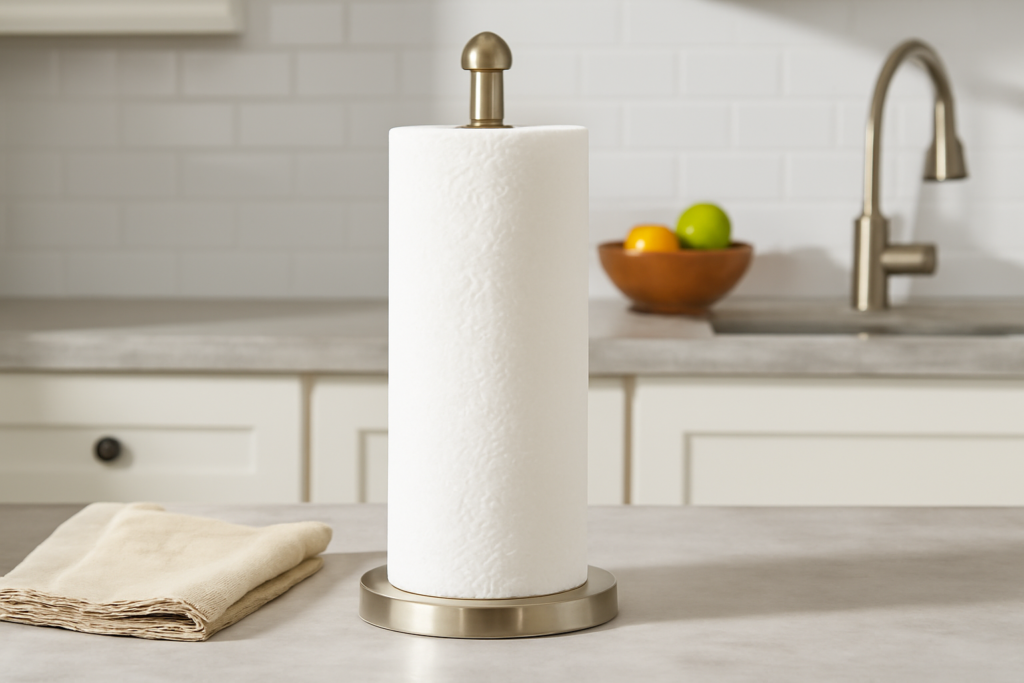
Tearing a single sheet only to have the whole roll unspool across the counter is a small daily annoyance that the right stand quietly eliminates. A good paper towel holder for countertop lets you tear one-handed, stays put when you pull, and looks intentional sitting next to the stove. It seems like a trivial purchase, but the difference between a wobbly $6 stand and a well-designed weighted one shows up every single day in the kitchen.
Part of our Countertops guide — explore the full guide →
Why the Right Holder Matters
A countertop holder has one job done in two motions: hold the roll steady and let you tear a sheet with one hand while the other is busy. Cheap holders fail at both. They tip when you grab, they let the roll spin freely so towels tumble off, and the post is too short or too tall for standard rolls. The features that fix these problems are worth understanding before you buy.
Key Features to Look For
- Weighted or wide base: a heavy cast base or a broad footprint keeps the holder from tipping when you tear. This is the single most important feature.
- One-handed tear mechanism: a spring-tension arm, a ratcheting post, or a suede-drag ring lets you rip a sheet without holding the roll with your other hand.
- Correct post height: it should accommodate standard and jumbo Select-A-Size rolls without the roll sliding off the top.
- Easy reloading: a lift-off or pivoting arm makes swapping rolls painless. Some tension designs require a firm push.
- Material and finish: should match your kitchen and resist rust near the sink.
Common Styles and Materials
Standing Vertical Post
The classic upright design with a weighted base and a simple post. Cheap, reliable, and easy to reload. Look for one with a top finial or a spring arm so towels don’t fly off. Stainless steel and cast iron versions run $10 to $25.
Tension-Arm One-Handed Holders
Brands like simplehuman make a spring-tension arm that grips the roll so you can tear single sheets one-handed with a satisfying snap. These are the premium choice, typically $25 to $40, and they genuinely work better than a bare post. simplehuman’s weighted stainless model is a longtime favorite for good reason.
Standing With Storage or Spray Bottle Ring
Some holders add a small caddy for a cleaning spray bottle or a shelf for sponges. Handy near a sink, though they take up more counter space. Usually $20 to $35.
Decorative and Material-Statement Holders
Marble, acacia wood, matte black metal, and copper finishes turn the holder into a design accent. Wood and stone bases are naturally heavy, which helps stability. Expect $20 to $50 for these style-forward pieces.
Materials Compared
- Stainless steel: the most versatile, rust-resistant, and easy to wipe clean. Fingerprints show on shiny finishes; brushed hides them.
- Cast iron: extremely stable thanks to its weight, often in a bronze or black finish, but can rust if the coating chips near water.
- Wood (acacia, bamboo): warm and heavy, though it needs occasional oiling and shouldn’t sit in standing water.
- Marble or stone: heavy and upscale, but pricier and can chip if knocked.
- Plastic: cheapest and lightest, which is exactly why it tips. Skip it unless the base is weighted.
What It Costs and Where to Buy
Countertop paper towel holders span a wide range. Budget upright posts start around $8 to $12, solid weighted stainless models run $15 to $25, and premium one-handed tension holders like simplehuman land at $25 to $40. Designer marble and wood pieces reach $50. You’ll find them everywhere: Amazon, Target, Walmart, Bed Bath & Beyond successors, Home Depot, and kitchen specialty shops. For most kitchens, a weighted stainless or a tension-arm model in the $20 to $35 range is the sweet spot of stability, looks, and one-handed convenience.
Placement Tips
Set the holder within arm’s reach of the stove and sink, the two spots where you grab towels most. Keep it a few inches back from the edge so it isn’t knocked off, and away from an open flame if it’s plastic or wood. If counter space is tight, consider whether an under-cabinet or wall-mount holder would serve you better, though those sacrifice the easy portability of a countertop stand.
Bottom Line
A paper towel holder for countertop is a small purchase that pays off in daily convenience when you choose well. Prioritize a weighted base and a one-handed tear mechanism above all else, then pick a material and finish that suits your kitchen. A simplehuman tension holder or a solid brushed-stainless post will outperform any lightweight plastic stand for years. Spend the extra ten dollars on stability; you’ll appreciate it every time your other hand is covered in flour.
Top Picks Worth the Counter Space
A few models consistently earn their spot next to the stove. Ranked by how they balance stability, one-handed tearing, and looks, these are the ones I’d point a homeowner toward first.
- simplehuman Tension Arm ($30-$40): the gold standard for one-handed use. The spring-loaded arm grips the roll so a single sheet tears clean without the roll spinning off. Heavy brushed-steel base won’t budge.
- OXO Good Grips SteadyTear ($20-$25): a weighted base with a small spring-tension top that snaps sheets one-handed for less money than the simplehuman.
- Umbra Tug ($15-$20): a modern flexible-post design that’s genuinely stable and hides fingerprints in its matte finish.
- Spectrum Diversified Euro ($10-$15): the budget upright pick, a simple weighted post that gets the basics right without the tear mechanism.
For a kitchen with a farmhouse or warm palette, an acacia-wood post in the $20 to $30 range hides fingerprints entirely and brings its own heft. Just keep it a few inches from the sink so it never sits in a puddle.
Setup and Keeping It Working
Countertop holders need no tools, but a couple of habits keep them performing. Break in a stiff tension arm by loading and tearing a full roll before you judge it; the spring loosens slightly with use. Wipe stainless models with a microfiber cloth and a drop of dish soap, then dry them to stop water spots, and buff brushed finishes in the direction of the grain, never across it.
- Load the roll so it feeds from the back, which lets the counter edge act as a natural tear bar.
- Re-oil wood bases every few months with mineral oil or a butcher-block conditioner to stop drying and cracking.
- Check felt or rubber base pads yearly; a worn pad lets the holder slide and scratch stone counters.
- For cast-iron holders, touch up any chips in the coating with appliance paint before rust sets in near the sink.
Countertop vs Wall-Mount vs Under-Cabinet
A freestanding holder isn’t the only option, and the right choice depends on your counter space. Countertop stands win on flexibility since you can move them wherever you’re working, but they eat a 5-to-7-inch footprint. Wall-mount and under-cabinet holders free the counter entirely, at the cost of a fixed location and a few screws.
- Countertop: most convenient, movable, no installation. Takes up counter real estate and can tip if cheap.
- Under-cabinet: frees the counter completely, keeps towels off the surface, but requires drilling into the cabinet bottom and puts the roll overhead.
- Wall-mount: great for tight galley kitchens, though you’re committed to the spot once it’s anchored.
Quick FAQ
Will one holder fit jumbo Select-A-Size rolls? Most standard posts handle them, but double-length “huge” rolls can exceed shorter posts. Check the post height against a roll’s diameter, usually around 5.5 inches for a jumbo.
Why does my holder tip when I tear? The base is too light or too narrow. A weighted base of at least a pound, or a tension arm that holds the roll, solves it instantly.
Are wood holders sanitary near the sink? Yes, if you keep them dry and oiled. Standing water is the only real enemy of a sealed acacia or bamboo base.