
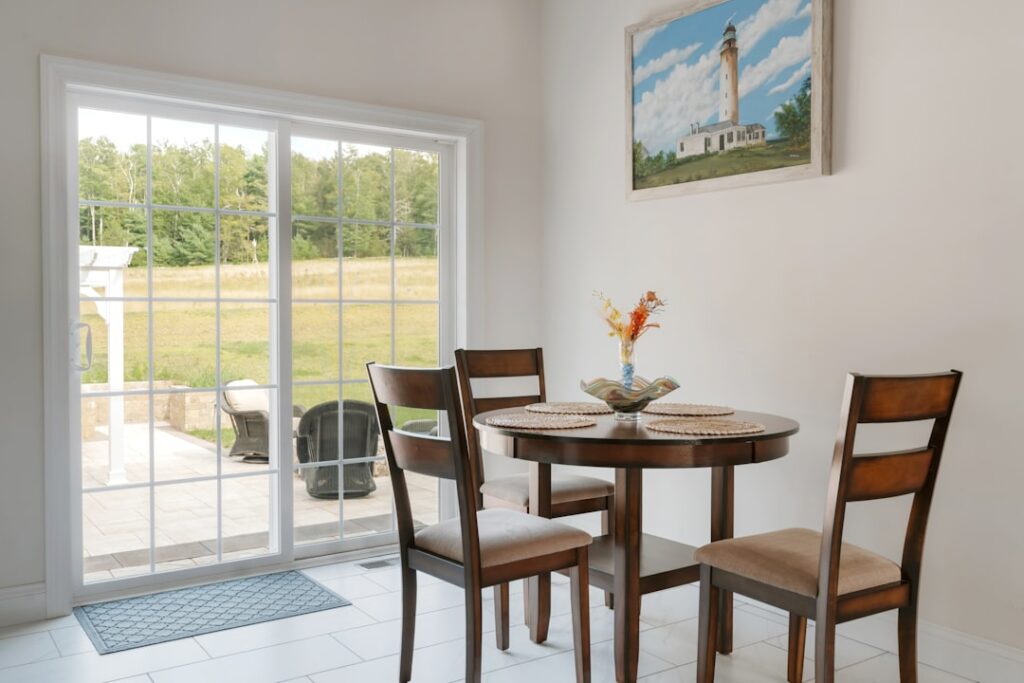
A sliding patio door that takes two hands and a grunt to open is not worn out — it is running on dead rollers, and rollers cost $15. Most patio glass door repair jobs fall into a short list of failures: rollers that have flat-spotted or seized, tracks packed with grit or peened over, locks that no longer catch, fogged glass that has lost its seal, and weatherstripping ground to felt. Every one of these is fixable for a fraction of the $1,500 to $4,000 a replacement door costs, and most are honest DIY territory. Here is the full repair playbook, starting with the fix that solves 70 percent of complaints.
Part of our Decks & Outdoor guide — explore the full guide →
- Roller Replacement: The Big One, Step by Step
- Track Cleaning and Repair
- Handles and Locks
- Fogged Glass: Replacing the IGU, Not the Door
- Screen Doors and Weatherstripping
- Repair or Replace: Drawing the Line
- Sourcing Parts by Brand
- Sliding Patio Door Repair Troubleshooting Flow, Plus Replacement Glass and Screen Door Options
Roller Replacement: The Big One, Step by Step
Rollers are the wear item nobody lubricates until the door already grinds. Replacing them takes about an hour, a helper, and these steps:
- Find the adjustment screws — two holes low on each edge (or face) of the sliding panel, sometimes under vinyl plugs. Turn both counterclockwise to retract the rollers fully; this drops the panel and takes tension off.
- Remove the panel. With a helper gripping each side, lift the door straight up into the head channel and swing the bottom out toward you. Panels weigh 50 to 100 pounds; suction-cup lifters ($20 a pair) save fingers and glass. If it will not clear, look for a head-stop strip screwed into the top track and remove it first.
- Lay the door on sawhorses over a blanket, bottom edge accessible. The roller assemblies sit in each bottom corner, held by one or two screws through the edge or bottom rail. Back out the screws and pry the old assembly from the rail — corrosion often means persuading it with a flat screwdriver.
- Match the replacement exactly. Take the old roller to compare: wheel diameter (1 to 1-1/2 inches typical), wheel material (steel with bearings outlasts nylon), single vs tandem wheels, and housing shape. Prime-Line and Slide-Co cover most doors for $10 to $30 per assembly; order both sides — the second one is as old as the first.
- Reinstall, rehang, and adjust. Seat the new assemblies, lift the panel back into the head channel, swing the bottom in, then turn the adjusters clockwise until the door glides and the gap along the jamb is even top to bottom. Even gap equals square panel equals a lock that lines up.
While the panel is out, this is the moment to clean the track and renew weatherstripping — the door is already off, and the marginal effort is ten minutes.
Track Cleaning and Repair
New rollers die young on a bad track. Vacuum the channel, then scrub with a nylon brush and degreaser; a screwdriver wrapped in a rag digs out the corners. Inspect the raised rail the wheels ride on: decades of load flatten and burr it, and a peened or gouged rail chatters forever. Light burrs dress off with a fine file. Genuinely worn aluminum rails get a stainless track repair cap — Prime-Line and others sell C-shaped covers ($20 to $40) that snap over the existing rail and give the rollers a fresh running surface; cut to length with a hacksaw and tap on with a rubber mallet. Lubricate with silicone spray or dry PTFE only. Never use WD-40 or grease on a patio door track — both turn airborne grit into grinding paste, and grease is how most tracks got ruined in the first place.
Handles and Locks
Patio door latches fail in the mechanism, not the hook. The internal mortise lock — a small steel cassette inside the door edge that the handle actuates — wears its spring or cam, and the hook stops throwing or retracting. Remove the two handle screws, pull both halves, then unscrew the faceplate on the door edge and slide out the mortise body. Match its length, hook style, and screw spacing at a hardware supplier; universal replacements run $15 to $35 and installation reverses the removal. Full handle sets (interior and exterior with keyed cylinder) run $30 to $80 — measure the vertical hole spacing (3-15/16 inches is the most common) before ordering. If the lock is fine but will not catch, the problem is alignment: adjust the roller screws to square the panel or reposition the keeper on the jamb. Add a security bar or a $25 track lock while you are in there; the factory hook alone is modest security.
Fogged Glass: Replacing the IGU, Not the Door
Permanent haze or moisture between the panes means the insulated glass unit’s edge seal has failed and the argon and desiccant are long gone. No product cures this from outside — drilled “defogging” services improve appearance temporarily but restore no insulation. The real fix is replacing the IGU itself, and it does not require a new door. A glass shop measures width, height, and thickness of the sealed unit (typically 5/8 to 1 inch overall), builds a matching tempered unit — patio doors are safety-glass by code, always tempered — and swaps it by removing the panel’s glazing stops. Cost runs $150 to $400 for standard sizes, $250 to $600 with low-E coating matched, versus thousands for a new door. On vinyl and aluminum panels this is a comfortable pro job and a feasible careful-DIY; on wood-clad doors (Andersen, Pella), factory glass through a dealer keeps the warranty and the fit honest. Take the panel dimensions and brand stamp (check the spacer bar between panes for etched maker and date) when you call.
Screen Doors and Weatherstripping
Screen door fixes are the same roller story in miniature: spring-loaded corner rollers ($8 to $15 a pair, Prime-Line again), adjusted by screws at each corner. If the frame itself is racked or the corners have cracked, a whole replacement screen panel runs $60 to $150 — measure the opening, not the old bent frame. Re-screening a sound frame costs $15 in fiberglass mesh and a $5 spline roller.
Weatherstripping on sliders takes two forms: fin or pile strips along the jambs and meeting stile, and a fuzzy pile in the head and sill channels. Pile weatherstrip slides out of a T-channel and new stock slides in — measure pile height (0.20 to 0.35 inch typical) and buy it by the foot. The meeting-stile interlock and jamb bumpers peel-and-stick or screw on. Total renewal costs under $40 and noticeably cuts drafts, bugs, and the whistle on windy nights. Check the sill weep holes while you are down there; blocked weeps are why water appears inside during storms.
Repair or Replace: Drawing the Line
Repair wins whenever the frame is sound. Rollers, track cap, lock, weatherstripping, even fresh glass — a door needing all of it comes in around $300 to $700, a fifth of replacement cost, and vinyl or aluminum sliders from the last 30 years have parts availability that makes repair straightforward. Replacement earns its price when the frame itself has failed: rotted wood at the sill or lower stiles, a racked or bowed frame that no adjustment squares (the door binds at one corner no matter what), corroded-out aluminum sills, or chronic leaks under the sill pan. Single-pane doors from the 1970s are also replacement candidates on energy grounds alone. For everything else, an afternoon and $50 in parts brings back the one-finger glide the door had on day one — do the rollers first, and half the other symptoms disappear with them.
Sourcing Parts by Brand
Identify the door before ordering anything: look for a brand stamp or sticker on the frame edges, the glass spacer bar, or the sill. Andersen, Pella, and Marvin sell OEM rollers, locks, and weatherstrip through their parts sites and dealers — pricier, but exact. For the vast fleet of builder-grade doors (Milgard, Ply Gem, MI, defunct regional brands), the aftermarket carries the load: Prime-Line and Slide-Co dominate hardware-store pegboards, and swisco.com and blainehardware.com let you match parts by photo and dimensions when no stamp survives. Order with the old part in hand, buy pairs, and keep the receipt — roller housings that look identical online can differ by an eighth of an inch that matters.
Sliding Patio Door Repair Troubleshooting Flow, Plus Replacement Glass and Screen Door Options
When a door misbehaves, it is tempting to buy rollers first. A two-minute check pinpoints the actual failure so your sliding patio door repair starts with the right part. Work through these checks in order; each one rules out a cause before you spend money on the next.
- Look at the gap. Close the door and check the gap along the latch jamb. Uneven top to bottom means the panel is out of square: adjust the roller screws before anything else.
- Clean the track and retest. If it now glides, the rollers were fine; stop here and lubricate with silicone or dry PTFE.
- Lift test. If it still drags, raise the panel with the adjustment screws. No change in height means the rollers are broken or seized; replace them.
- Run a finger along the rail. Burrs or a flattened rail call for filing or a track cap.
- Check the lock last. If the door glides and the gap is even but the latch will not catch, it is a keeper or mortise-lock problem.
Replacement Glass Screen Door and Panel Options
Searches for a replacement glass screen door usually mean one of three different parts, and it helps to know which you need before calling a supplier:
- Sliding screen panel: the removable mesh panel on the outside track. Replace the whole frame when it is bent or cracked; measure the opening height and width, not the damaged frame.
- Glass or insulated glass unit in the sliding panel: replaced through a glass shop, always as tempered safety glass, as described above.
- Storm or retractable screen add-on: a separate product for doors whose original screen track is missing or damaged; confirm fit with the frame depth before ordering.
Handling Tempered Glass Safely
Tempered glass is strong across its face but vulnerable at its edges and corners, and it cannot be cut or trimmed after manufacture. A chip on the edge can make it shatter completely later. Carry panels on edge, never flat, with a helper and suction-cup lifters. Wear cut-resistant gloves and eye protection, pad the sawhorses, and never set a panel down on a corner or on concrete. If a tempered pane breaks, it crumbles into many small pieces, some still sharp. Keep people and pets away, and wear gloves and closed-toe shoes while you vacuum and sweep, including inside the door frame channels. If a pane is cracked but still in place, cover it with packing tape on both sides and leave glass replacement to a glass shop.


