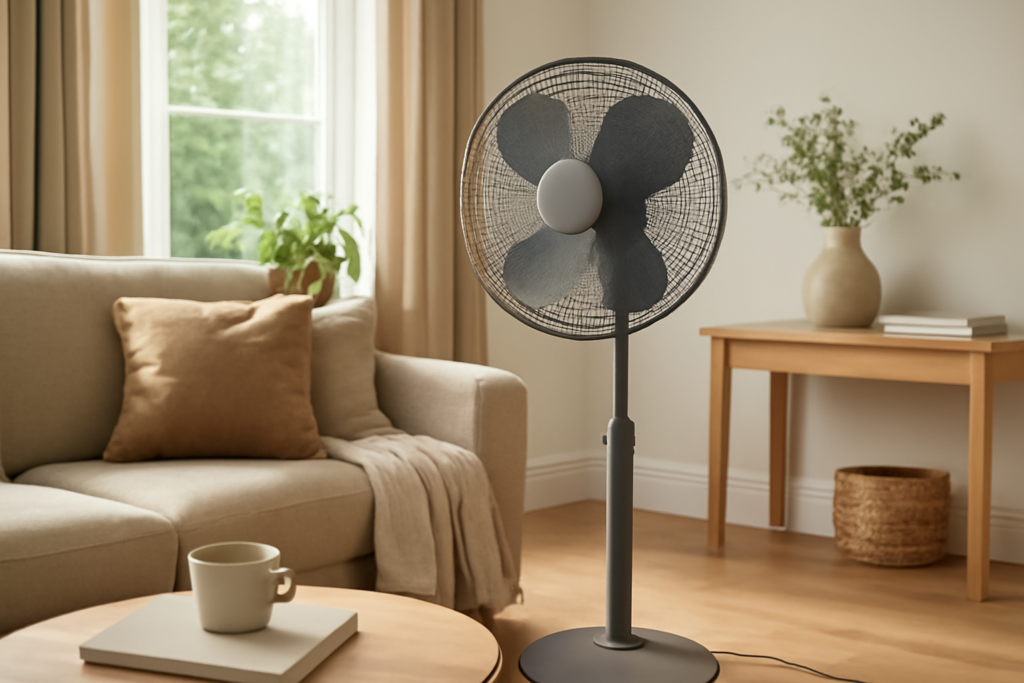
If you want to feel a breeze where you actually sit rather than down at ankle level, the height-adjustable design beats a flat box fan every time. A pedestal floor fan mounts its blades on an adjustable pole, lifting the airflow to chest or head height and adding oscillation that sweeps a whole room instead of blasting one spot. For the price of a couple of restaurant dinners, it can keep a bedroom, living room, or home office comfortable and let you push the thermostat up several degrees. The challenge is that pedestal fans vary wildly in airflow, noise, and build quality, and the cheapest ones disappoint fast.
How a Pedestal Fan Works and Why Height Matters
A pedestal fan sits on a weighted base, with a telescoping pole that raises the fan head anywhere from about 40 to 55 inches off the floor. That height is the whole point. Air aimed at your upper body and face feels far more cooling than air pushed across the floor, because most of your skin’s heat loss happens above the waist.
The adjustable pole lets you match the airflow to the situation, low for a seated desk setup, high to clear a standing kitchen, or tilted upward to circulate warm air in winter. Combined with oscillation, which rotates the head 60 to 90 degrees side to side, a single pedestal fan covers a far larger area than a stationary fan of the same size.
Reading the Airflow Numbers
Airflow is measured in cubic feet per minute, or CFM, and it is the spec that actually predicts how well a fan cools. A weak pedestal fan moves under 1,500 CFM and struggles in anything bigger than a small bedroom. A capable model pushes 2,000 to 3,500 CFM, enough for a living room. High-velocity pedestal fans can exceed 4,000 CFM for garages and large open spaces.
Blade size and motor strength drive these numbers. Common blade diameters run 16 to 18 inches for home models. Don’t assume a bigger fan automatically moves more air, since blade pitch and motor power matter just as much. When a listing hides the CFM, that usually means it is not worth bragging about.
Key Features to Compare
Pedestal fans pack more features than basic box fans, and the right ones make daily use far more pleasant.
- Oscillation — Nearly standard, it spreads air across the room. Look for the option to lock it in a fixed position too.
- Multiple speeds — Three speeds is the minimum; better fans offer five or more for fine control.
- Adjustable tilt and height — Lets you aim airflow precisely, up, down, or level.
- Remote control and timer — Handy for bedrooms, letting you change settings or auto-shutoff without getting up.
- Quiet DC motor — Premium models use DC motors that run quieter and use less power than standard AC motors.
A remote and a sleep timer feel like luxuries until you own them, then you wonder how you slept without them.
Noise: The Spec People Regret Ignoring
A pedestal fan often runs all night in a bedroom, so noise level deserves real attention. Sound is measured in decibels, and a quiet fan on its lowest setting stays under 45 decibels, roughly the hum of a soft refrigerator. Cheap fans with unbalanced blades or loose housings can rattle at 60 decibels or more, loud enough to disrupt sleep.
Fans with DC motors and well-engineered blades run noticeably quieter than budget AC models. If a fan is mainly for sleeping, prioritize a low minimum-speed decibel rating over raw maximum airflow. You can always run a quiet fan a notch higher, but you cannot quiet down a loud one.
Energy Use and Running Cost
Pedestal fans are cheap to run, which is their biggest advantage over air conditioning. A standard model draws 50 to 100 watts, while energy-efficient DC-motor versions sip as little as 20 to 35 watts. At typical U.S. electricity rates, running a pedestal fan for ten hours costs only a few cents.
Compare that with a central air system or window unit drawing hundreds of watts, and the savings are obvious. Because moving air makes you feel about 4°F cooler, you can raise the thermostat and let the fan do the rest, trimming your cooling bill noticeably across a hot summer. Just turn fans off when you leave the room, since they cool people, not empty spaces.
Stability, Assembly, and Build Quality
A tall fan with a poor base tips over easily, especially in homes with kids or pets. Look for a wide, heavy base, ideally a metal cross-base or a weighted round one, rather than a flimsy plastic foot. Metal blades and a sturdy housing last longer and run with less vibration than thin plastic parts.
Most pedestal fans ship partly disassembled and take 15 to 30 minutes to put together, attaching the base, pole, motor housing, blades, and grille. Read a few recent reviews for complaints about the head drooping over time, the oscillation gears stripping, or the height adjustment slipping under the fan’s own weight. These are the failure points that separate a fan that lasts five years from one that wobbles loose by the second summer.
Getting the Most From Your Fan
Placement turns a decent fan into a great one. For whole-room cooling, set the fan in a corner and aim it diagonally so air circulates and returns. To cool yourself directly, position it slightly to the side rather than blasting your face, which dries your eyes and feels harsh over time. Pair a pedestal fan with an open window in the evening to pull in cool air, and combine it with a ceiling fan for layered circulation on the hottest days.
Wipe the blades and grille every few weeks, since dust buildup cuts airflow and throws the blades out of balance, which creates noise. A clean, well-placed pedestal floor fan is one of the best cooling values in any home, delivering targeted comfort for pennies a day and years of reliable service when you buy a solid model.
Prefer to explore on your own?
See how new flooring looks in your actual room in seconds — free, no signup.
Try the free Floor Studio →