
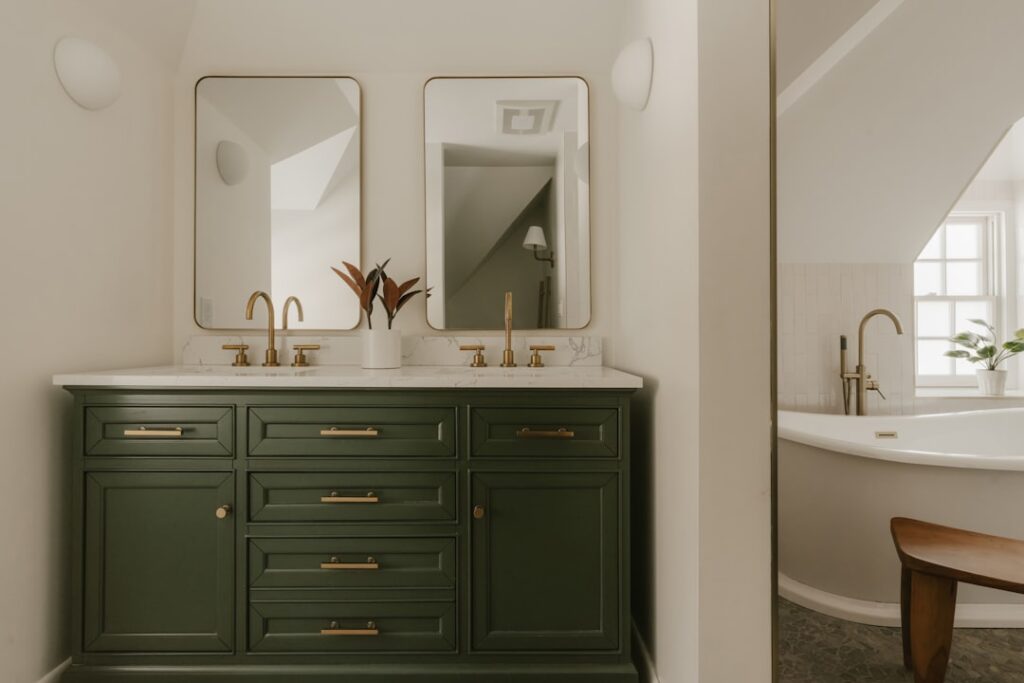
In a powder room barely big enough to turn around in, a bulky cabinet can make the whole space feel like a closet. A pedestal sink vanity solves that problem by putting the basin on a slender column, freeing up floor space and giving even the smallest bathroom an open, timeless look. It’s a fixture that has stayed in style for more than a century, and it remains one of the smartest choices for tight guest baths and vintage-inspired remodels.
Part of our Bathroom Remodeling & Flooring guide — explore the full guide →
The catch is storage, or the lack of it. Pedestal sinks suit Victorian rowhouses and modern condos alike, and the homeowners who love them plan for that tradeoff up front. This guide covers styles, real costs, the plumbing you need to hide, and the clever ways to reclaim the storage a pedestal gives up.
What a Pedestal Sink Vanity Actually Is
Strictly speaking, a pedestal sink is a two-piece fixture: a wall-mounted basin supported by a freestanding column, or pedestal, that conceals the drain plumbing and part of the supply lines. Unlike a traditional vanity, it has no cabinet or countertop. The “vanity” in the name refers to the sink assembly serving the same role a vanity would, minus the storage box.
The basin bears most of its weight through a bracket lagged into the wall framing, while the pedestal carries the rest to the floor and dresses up the pipes. This is why a pedestal sink needs solid blocking behind the wall; the column alone is not enough to keep the basin from wobbling under daily use.
Styles That Fit Different Bathrooms
Pedestal sinks come in enough variety to match nearly any decor, from ornate to minimalist.
- Traditional: Rounded basins with fluted columns and detailed edges, ideal for cottage and Victorian baths
- Transitional: Cleaner lines with a slight taper, a safe match for most homes
- Modern: Rectangular basins and straight square columns for a crisp, contemporary look
- Console-style: A basin on two front legs with a metal frame, offering a small shelf or towel bar
Console sinks are a middle ground worth knowing about. They keep the airy feel of a pedestal but add a slim ledge or bar for a hand towel, splitting the difference on storage. Most pedestal basins measure 18 to 26 inches wide and 20 to 24 inches tall to the rim, which sits comfortably for adults.
Cost Breakdown
Pedestal sinks are generally cheaper than a full vanity setup because you skip the cabinet and countertop. A basic ceramic model runs $80 to $250, while designer or cast-iron enameled pieces reach $400 to $900. Add a faucet at $60 to $250 and a P-trap and supply kit for another $30 to $60.
Installation labor typically runs $150 to $400 if the plumbing is already roughed in at the right height. If a plumber has to move supply lines or the drain to center them behind the pedestal, add $200 to $500. All in, a straightforward pedestal sink project lands around $350 to $1,200, comfortably below the $600 to $2,500 range for a comparable vanity and top.
The Plumbing You Have to Plan For
Here’s the detail people miss: a pedestal hides the plumbing only if the plumbing is centered to match the column. On a standard vanity, an off-center drain disappears inside the cabinet. With a pedestal, an angled or offset pipe pokes out and ruins the clean look.
Ideal rough-in puts the drain about 18 to 19 inches off the finished floor and centered on the basin, with hot and cold supply stubs flanking it a few inches to each side. If you’re replacing an old vanity with a pedestal, expect to relocate the drain and possibly the shutoff valves so everything tucks behind the column. Chrome or brushed-nickel supply lines and an exposed decorative P-trap look intentional if any plumbing shows below the pedestal.
Solving the Storage Problem
Losing the cabinet is the real cost of going pedestal. Plan replacement storage before you commit, or the bathroom becomes cluttered fast.
- Recessed medicine cabinet: Set into the wall between studs, it adds depth without eating floor space
- Wall shelves or floating ledges: Mounted above the toilet or beside the mirror for everyday items
- Over-the-toilet etagere: A tall, narrow rack that uses vertical space cheaply
- Under-basin storage: A small woven basket or pedestal-hugging cabinet designed to wrap the column
A recessed cabinet is the highest-value upgrade because it reclaims storage without shrinking the room. Framing one in during a remodel adds maybe $100 to $250 in labor and materials but transforms how usable a pedestal bath feels.
Installation Steps and Wall Blocking
The single most important step happens inside the wall. Before you close it up, install a horizontal 2×8 or 2×10 blocking board between the studs at basin-bracket height so the mounting lag screws bite into solid wood. Screwing a heavy ceramic basin into drywall alone is a guaranteed failure; the sink will pull loose within a year.
Set the pedestal in place, rest the basin on it, and mark the wall-bracket holes. Drill, anchor into the blocking, and hang the basin. Connect the faucet and drain before final tightening so you have room to work. Then caulk the seam where the basin meets the wall with a mildew-resistant silicone to keep water out. Level the basin front-to-back before the caulk sets.
Faucet and Material Options
The basin material affects both durability and price. Vitreous china is by far the most common, offering a glassy, stain-resistant surface that wipes clean and holds up for decades at a modest price. Fireclay and enameled cast iron cost more and add weight but resist chips and scratches far better, which matters on a fixture you’ll keep for 20 years. Solid-surface and stone-resin basins bring a modern, seamless look at a higher price point.
Faucet placement is dictated by the basin’s pre-drilled holes, so match the two when you buy. A single-hole basin takes a single-handle faucet; an 8-inch widespread basin takes a three-piece faucet with separate hot and cold handles; and a wall-mount faucet, which frees the basin deck entirely, requires the supply lines to be roughed into the wall behind the sink. Wall-mount faucets look striking over a pedestal but must be planned before the wall is closed, since retrofitting them means opening drywall. Whatever you choose, buy a faucet with a solid brass body rather than plastic internals for longevity, and confirm the spout reaches far enough over the smaller basin to keep splashing down.
Cleaning and Everyday Maintenance
A pedestal sink’s exposed plumbing is easier to clean around than a cabinet, but it also means dust and drips show. Wipe the basin and the pedestal column weekly with a mild, non-abrasive cleaner; abrasive powders dull the glaze on china over time. Pay attention to the caulk line where the basin meets the wall, since a failed bead there lets water seep behind the sink and feed mildew or rot in the framing. Recaulk with a mildew-resistant silicone at the first sign of cracking or discoloration.
Check the wall bracket periodically for any wobble, since a loose basin stresses the plumbing connections and can crack the P-trap. If the sink starts to rock even slightly, tighten the mounting bolts into the blocking before the movement damages anything. Keep the exposed supply lines and P-trap clean and inspect their compression fittings for slow drips a couple of times a year, catching a weeping connection early prevents the classic pedestal-sink puddle on the floor. With that light routine, a quality pedestal sink stays looking sharp and functioning quietly for the long haul.
Dry-fit the whole assembly before you commit to anything. Set the pedestal and basin in place, mark the bracket and column positions, and confirm the drain and supply lines line up cleanly behind the column with the shutoff valves reachable. It’s far easier to catch a plumbing conflict now, while everything is loose, than after you’ve caulked the basin to the wall and connected the trap.
Is a Pedestal Sink Right for You?
Choose a pedestal sink vanity when floor space is precious, you want a classic or open look, and you can solve storage elsewhere. It shines in powder rooms, guest baths, and period homes. Skip it if the bathroom is your primary space and you need drawers for toiletries and cleaning supplies every day.
For the right room, a pedestal sink delivers style and breathing room that a boxy cabinet simply can’t match. Plan the plumbing and the blocking correctly, add smart storage nearby, and you’ll have a fixture that looks as good in twenty years as it does the day it goes in.


