Some faucets are plumbing; a few are jewelry for the kitchen. A Perrin and Rowe faucet sits firmly in the second camp — the British-made brand behind the unlacquered-brass bridge faucets that anchor half the English-country kitchens on design Instagram, with price tags that start where most faucet budgets end. Founded in 1978 by engineers Greg Perrin and Bob Rowe and manufactured in Rochford, Essex, the brand has been distributed in North America as part of the House of Rohl portfolio for decades. Is a $2,500 kitchen faucet ever rational? Here is the honest case, model by model.
- The Brand and the House of Rohl Connection
- Construction: Why They Feel Different
- Unlacquered Brass and Living Finishes
- The Icons: Ionian, Armstrong, and the Pot Fillers
- Price Reality and Where to Buy
- Versus Waterworks and Newport Brass
- Ownership Notes
- Living With One: Maintenance Reality
- Verdict: Worth It?
The Brand and the House of Rohl Connection
Perrin & Rowe built its reputation supplying heavy, traditionally styled brassware to the British luxury kitchen trade — the faucets you see paired with AGA ranges and deVOL and Plain English cabinetry. In the U.S., the brand arrived through ROHL, the California importer that built its business bringing European fixtures stateside, and today Perrin & Rowe is one of the flagship brands of the House of Rohl (alongside Shaws fireclay sinks, Victoria + Albert tubs, and Riobel), under the Fortune Brands umbrella. Practically, that means U.S. buyers get real distribution: showroom support, stocked parts, and a lifetime limited warranty on residential installations, rather than gray-market importing. Many U.S. models sold under legacy “ROHL” numbering (U.4719, A1461, etc.) are Perrin & Rowe manufacture — worth knowing when you shop, because the same faucet can appear under both names.
Construction: Why They Feel Different
Pick one up and the argument starts making itself. These are solid brass castings and machined components — a P&R bridge faucet weighs 8-12 pounds, versus 3-4 for a mainstream equivalent. Valving is quarter-turn ceramic disc throughout, with a smooth, damped action that stays consistent for decades; cartridges and seals are standard replaceable parts, and House of Rohl still stocks components for models discontinued years ago. Threads are cut, not rolled; aerators are metal; the sidespray (the little “handshower” rinse on bridge models) is brass, not chromed plastic. Nothing about the engineering is exotic — it is simply built the way all good faucets were built before value-engineering, which is precisely the point. Expect a 35-45 lb boxed shipment for a full bridge-and-spray set and a faucet your grandchildren can rebuild.
Unlacquered Brass and Living Finishes
The finish story is half the brand’s appeal. Beyond the standard polished chrome and nickel, Perrin & Rowe is famous for living finishes — unlacquered polished brass, satin brass, aged brass, and pewter that leave the metal unprotected on purpose. Unlacquered brass starts bright gold and develops a mottled amber-brown patina within months: darker where hands land, brighter where you polish. Design people call this “the English kitchen look”; it photographs like an heirloom because it behaves like one. Two warnings before you order it. First, living finishes are explicitly excluded from finish warranty coverage — patina is the feature, so you cannot claim it as a defect. Second, know yourself: if water spots on a fixture will bother you, choose polished nickel or chrome and keep the lacquer. (Patina purists’ tip: Bar Keepers Friend or a lemon-and-salt rub returns unlacquered brass to bright gold in five minutes whenever you want a reset.)
The Icons: Ionian, Armstrong, and the Pot Fillers
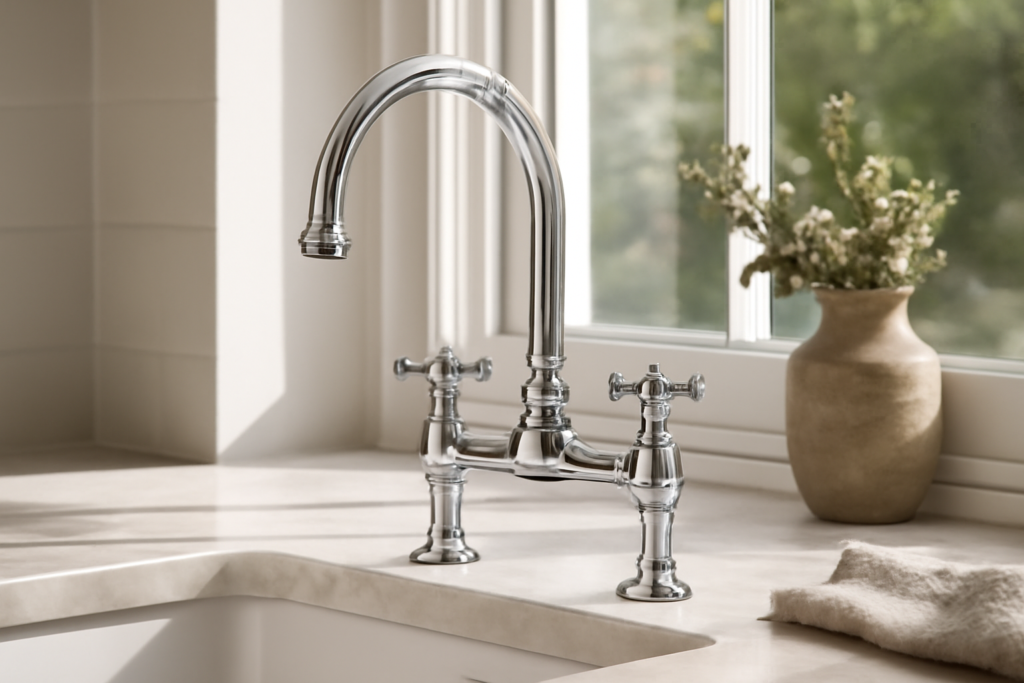
- Ionian bridge faucet — the signature. A traditional two-handle bridge (hot and cold joined above deck) with porcelain-capped lever or crosstop handles and an optional pull-out brass sidespray on its own deck mount. This is the faucet people mean when they say “the deVOL faucet.” Roughly $2,300-3,400 depending on finish and spray configuration.
- Armstrong line — the modern counterpoint: knurled detailing, cleaner cylinders, industrial-luxe rather than country house. Bridge, single-lever, and pull-down versions, roughly $1,800-3,500.
- Georgian and Edwardian bath collections — column-spout basin sets, exposed thermostatic shower systems, and tub fillers that carry the same design language into bathrooms; widespread lavatory sets run $1,200-2,500, exposed shower systems more.
- Pot fillers — the articulated wall-mount pot filler (U.4799 pattern) is arguably the most-specified luxury pot filler in America, $1,400-2,000.
- Hot water and filtration taps — small “country kitchen” filter faucets around $700-1,100, a relatively gentle entry point to the brand.
Price Reality and Where to Buy
Set expectations plainly: $1,500-4,000+ is the working range for kitchen faucets once you pick a brass or nickel finish, with chrome typically the cheapest finish tier and unlacquered/aged brass commanding a 15-30% premium. Add the matching Shaws fireclay sink ($1,500-2,500) that these faucets are so often specified with and the sink wall becomes a five-figure line item. Buy through authorized channels only — House of Rohl showrooms (Ferguson, local decorative plumbing showrooms), Build.com, Quality Bath, and PlumbingSupply-tier dealers — because the warranty follows authorized purchase, and the brand’s desirability makes it a counterfeit and gray-market target on marketplace sites. Stock finishes ship quickly; unusual finish/handle combinations can be 6-12 week special orders from England, so order the faucet when you order cabinets, not at trim-out.
Versus Waterworks and Newport Brass
In the luxury bracket, the natural cross-shops: Waterworks (Easton, Henry lines) is the American design-house rival — comparable or higher prices ($2,500-5,000+), arguably stronger fashion cachet, similar solid-brass build; choose on aesthetics and showroom relationship. Newport Brass is the value play in the space — American-assembled solid brass, enormous finish range, bridge models like the Chesterfield at $1,200-2,000 — roughly 30-40% below equivalent P&R, with less of the English pedigree and slightly less refined detailing. deVOL’s own Aged Brass taps and Barber Wilsons occupy the same English niche at similar-to-higher money. If the budget stops at $600-900, Kingston Brass and Signature Hardware sell bridge silhouettes that photograph adequately and feel exactly as much cheaper as they are.
Ownership Notes
A few practical realities from the trade: two-handle bridge faucets mean no single-lever convenience and no pull-down spray head — the sidespray does that work, and it is a two-hole or three-hole installation, so confirm your sink drilling (most Shaws installs are undermount with deck-drilled counters, giving you freedom). Water pressure should be verified for the bath thermostatic sets (they want 45+ psi to shine). Installation is standard plumbing — any competent plumber can set one — but the weight justifies solid mounting, and living-finish owners should install with gloves to avoid day-one fingerprint etching. Parts: cartridge and washer kits are orderable by model number through House of Rohl customer service, which is responsive by luxury-brand standards.
Living With One: Maintenance Reality
Day-to-day care is lighter than the price implies. Lacquered and plated finishes want nothing but a soft cloth and mild soap — no abrasives, no bleach sprays, which etch nickel over time. Living finishes want even less: wipe water off when you think of it, or don’t, and let the patina do its work. The ceramic disc valves are effectively maintenance-free for a decade-plus in normal water; in hard-water regions, a quarterly soak of the aerator and sidespray head in vinegar keeps flow crisp, and a whole-house softener is the real long-term kindness to any faucet at this level. Hold onto the installation sheet — model and finish codes on it make future parts orders a five-minute call rather than a photo-matching exercise.
Verdict: Worth It?
Judged as a machine for mixing water, no faucet is worth $2,800 — a $250 Delta does the job and will also last. Judged as the visual anchor of a $60,000-150,000 kitchen, the calculus changes: a Perrin & Rowe bridge in aged brass is a focal point you touch twenty times a day, built to a standard that makes replacement a choice rather than an eventuality, from a brand with real U.S. parts and warranty support. Buy it if the kitchen’s design leans English/classic, the budget already contains five-figure cabinetry, and you either love or can ignore patina. Skip it if you want spray-head convenience, minimalist design (look at Armstrong first, then elsewhere), or if the money is coming out of the appliance budget — no faucet outcooks a better range.