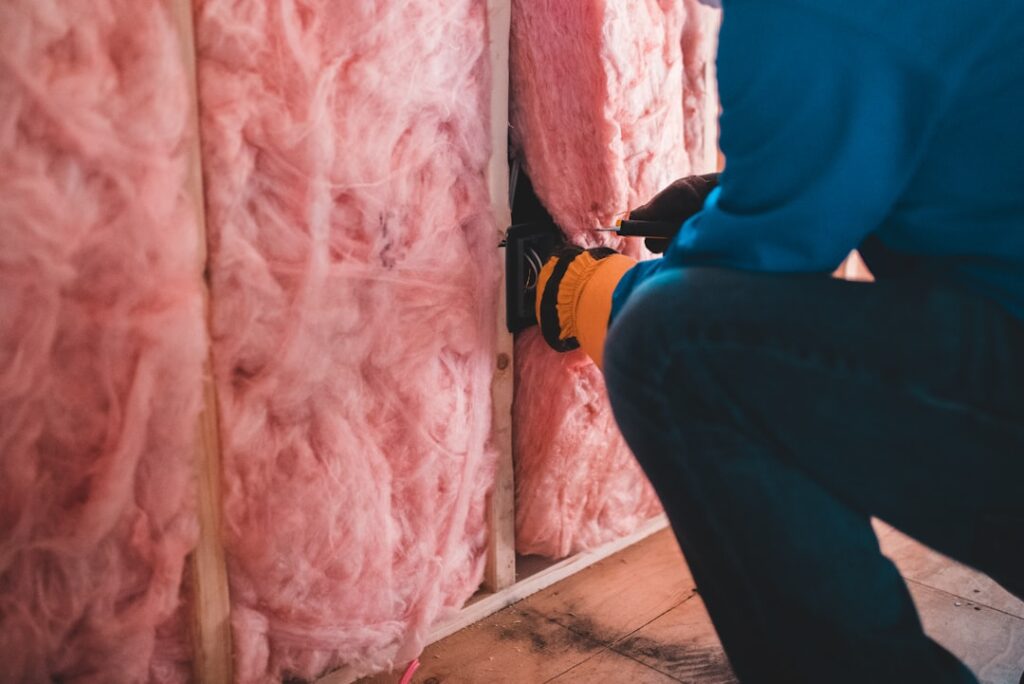
Walk the insulation aisle at any home center and the wall of pink insulation is impossible to miss — but the color tells you almost nothing about performance. Pink is a trademark, not a specification: it identifies Owens Corning fiberglass the way brown identifies UPS trucks. This guide explains where the pink comes from, whether color signals anything about R-value or quality, the actual R-values you get at each thickness, and how to handle the itchy stuff safely.
Why Is Insulation Pink?
Fiberglass is naturally a pale yellowish-white — molten glass spun into fibers has no inherent color. In the 1950s, Owens Corning began adding a red dye to its resin binder, producing the signature pink, and in 1980 the company licensed the Pink Panther as its mascot. The branding worked so well that in 1987 Owens Corning secured a trademark on the color pink for insulation — one of the first single-color trademarks ever granted in the United States. That’s why competitors’ fiberglass comes in other shades: Johns Manville’s is white or green, CertainTeed’s is white or yellowish, and Knauf’s EcoBatt is a natural brown because its ECOSE binder uses no added dye or formaldehyde. Same glass, different marketing.
Does the Color Mean Anything for Performance?
No. R-value — the measure of resistance to heat flow — comes from the density and thickness of the trapped-air fiber matrix, not the binder dye. A pink R-13 batt and a white R-13 batt insulate identically. What the color does reliably tell you is the manufacturer, which matters for product-line details: binder chemistry (Owens Corning’s EcoTouch line is formaldehyde-free, as are all major brands now), stiffness and how well batts friction-fit, and availability of specialty widths. Judge insulation by the printed R-value, the coverage label, and the fit in your cavity — never the hue. If you’re comparing fiber types entirely, see how fiberglass stacks up against mineral wool insulation, which trades a higher price for better sound blocking and fire resistance.
Pink Fiberglass R-Values by Thickness
Fiberglass batts deliver roughly R-3.1 to R-4.3 per inch depending on density. Owens Corning’s standard pink lineup breaks down like this:
| Product | Thickness | Fits | Typical use |
|---|---|---|---|
| R-13 | 3.5 in | 2×4 walls | Standard exterior walls |
| R-15 (high density) | 3.5 in | 2×4 walls | Code-upgrade walls |
| R-19 | 6.25 in | 2×6 walls, floors | Walls, crawlspace ceilings |
| R-21 (high density) | 5.5 in | 2×6 walls | Zone 5+ walls |
| R-30 | 9.5-10.25 in | Attics, 2×10 floors | Southern attics, floors |
| R-38 | 12 in | Attics | Mixed-climate attics |
| R-49 | ~15-16 in (layered) | Attics | Cold-climate attics |
Note the high-density trick: R-15 and R-21 pack more glass into the same cavity depth as R-13 and R-19. They cost 20-40 percent more per square foot but are the only way to hit higher wall R-values without furring out the studs. For attics, batts get layered — a common cold-climate recipe is R-30 between the joists plus R-19 laid perpendicular on top, and our R49 insulation guide covers exactly how many inches each material needs to hit attic code.
Loose-Fill Pink: Blown-In Fiberglass
Pink also arrives as loose fill. Owens Corning’s AttiCat system chops compressed fiberglass in a rented machine (free with a ~10-bag purchase at most home centers) and blows it into the attic at about R-2.2 to R-2.5 per inch. Coverage per bag drops as target R rises — around 65 square feet per bag at R-30 versus roughly 40 at R-49 — so a 1,000-square-foot attic at R-49 consumes 25-plus bags at $30-$40 each. Blown-in beats batts in attics with irregular joist spacing, wiring, and pipes because it fills every gap; batts win on floors you want to keep walkable and in open wall cavities. Whichever you blow, install insulation baffles at the eaves first so the fill doesn’t choke your soffit ventilation.
Is Pink Insulation Safe?
Modern fiberglass is not asbestos and is not classified as a human carcinogen — the International Agency for Research on Cancer removed glass wool from its “possibly carcinogenic” list in 2001 after reviewing decades of worker data. The real issues are mechanical and short-term: glass fibers irritate skin, eyes, and airways. Handling rules:
- Cover up: long sleeves, gloves, and safety glasses. A disposable coverall is worth $10 for a full attic job.
- Mask up: an N95 respirator handles batt work; blown-in installation in a confined attic deserves it doubly.
- Cut, don’t tear: compress the batt with a board and slice with a utility knife — tearing launches far more fibers.
- Wash smart: rinse exposed skin with cold water first (hot water opens pores and grinds fibers in), and wash work clothes separately.
Old itch aside, today’s binders are formaldehyde-free across every major brand, a change completed industry-wide around 2015.
What Pink Insulation Costs
Fiberglass remains the cheapest mainstream insulation per R. Current home-center pricing: R-13 kraft-faced batts run about $0.55-$0.80 per square foot, R-19 around $0.75-$1.05, R-30 $1.10-$1.50, and R-38 $1.40-$1.90. Unfaced versions cost slightly less. For comparison, mineral wool runs 25-50 percent more, and closed-cell spray foam costs $1.00-$1.50 per square foot per inch. Professional batt installation adds $0.80-$1.50 per square foot in labor; attic blow-ins are commonly quoted at $1.50-$2.50 per square foot to R-49 in retrofit work.
Faced vs. Unfaced Pink Batts
Kraft-faced batts carry an asphalt-coated paper facing that acts as a Class II vapor retarder and provides stapling flanges. The facing always goes toward the warm-in-winter side in heating climates — toward the living space. Unfaced batts suit layering over existing attic insulation (a second vapor retarder mid-stack can trap moisture), sound-deadening interior walls, and climates where a separate membrane strategy applies. The full placement logic lives in our vapor barrier insulation guide; the one-line version is: one vapor retarder, warm side, and never stack facings.
Installing Pink Batts Right
Installation quality moves real-world performance more than any brand choice. The standards bodies grade batt installs from Grade I (full loft, no gaps, split around wires) down to Grade III (compressions and voids over more than 2 percent of the area), and a Grade III install of R-13 performs closer to R-9 or R-10 whole-wall. The habits that keep you at Grade I: cut batts about 1/4 inch wider than the cavity for friction fit, never force a 16-inch batt into a 14.5-inch bay; split the batt like a book around romex runs instead of stuffing it behind them; notch neatly around outlet boxes rather than compressing; and fill the full depth to the back of the cavity — a batt hovering mid-cavity creates convection loops on both faces. In attics, run the first layer between joists and any second layer perpendicular across them to bury the wood, which otherwise bridges heat around your insulation.
Where Pink Fits — and Where It Doesn’t
Fiberglass earns its market share in dry, framed cavities: walls, vented attics, floors over basements. It’s the wrong tool against concrete (basement walls want foam that tolerates moisture), in tight rim-joist bays (air leakage dominates there; foam wins), and in soundproofing-critical assemblies where denser mineral wool adds real decibels. Price-per-R, though, nothing on the shelf beats it.
FAQ
Is pink insulation only made by Owens Corning?
Yes — the color is trademarked. Any pink fiberglass on a US shelf is Owens Corning; competitors sell chemically similar products in white, green, yellow, or brown.
What R-value is pink insulation?
Whatever the label says — pink batts span R-11 to R-49 depending on thickness and density. There is no inherent R-value to the color; a 3.5-inch standard batt is R-13, a 12-inch batt is R-38.
Does pink insulation contain fiberglass?
It is fiberglass: fine spun-glass fibers bonded with a dyed acrylic binder. It contains no asbestos and, in current formulations, no formaldehyde.
Can pink insulation get wet?
Wet fiberglass loses most of its R-value but recovers once fully dried if it hasn’t compacted or grown mold. Find and fix the leak, dry it within days, and replace anything that stays matted or smells musty.
The takeaway: buy the R-value, the fit, and the price — the Pink Panther is just along for the ride.