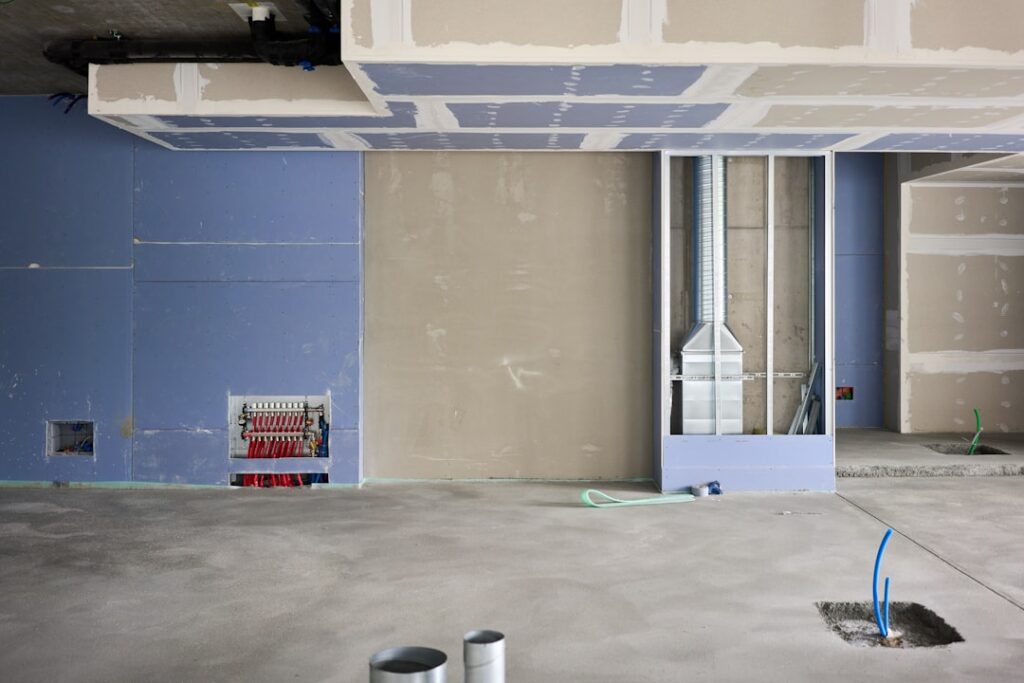
Settle the argument first: in a plasterboard vs drywall comparison, you’re mostly looking at one product wearing two passports. Both are gypsum plaster cores pressed between paper faces — the UK, Ireland, Australia, and New Zealand say plasterboard; North America says drywall, sheetrock (a USG brand name that went generic), gypsum board, or wallboard. But “mostly the same” isn’t “identical,” and the plasterboard vs drywall differences that do exist — sheet sizes, edge profiles, paper design, finishing culture, and how fire-rated boards are labeled — have real consequences when you’re ordering material, matching thickness in a renovation, or reading a spec written on the other side of the Atlantic. Here’s the practical breakdown.
Part of our Paint & Walls guide — explore the full guide →
Same Core, Same Job
Chemically and structurally, both products are calcined gypsum (calcium sulfate dihydrate) rehydrated into a set core, faced with heavy paper liners, made on the same kind of continuous board lines by the same multinational manufacturers — Saint-Gobain sells it as Gyproc plasterboard in Britain and CertainTeed drywall in the States; Knauf and Etex play both markets too. The gypsum core is why both perform identically in a fire’s first minutes: the crystal structure holds about 21 percent chemically bound water, and driving that water off consumes heat, holding the far side of the board near 100°C until calcination completes. Both install the same way — screwed to timber or steel framing, joints taped and filled — and both fail the same way when soaked. Whatever the label says, you’re hanging the same mineral.
Where the Real Differences Live
Sheet Sizes and Thicknesses
- US drywall: imperial — 4×8 ft standard (also 4×10, 4×12), thicknesses of 1/4, 3/8, 1/2, and 5/8 inch. Half-inch is the wall default; 5/8 Type X is the fire and ceiling workhorse.
- UK/AU plasterboard: metric — 1200 x 2400 mm standard (also 900 mm widths and 2700/3000 mm lengths), thicknesses of 9.5, 12.5, 15, and 19 mm. The everyday board is 12.5 mm — about 0.49 inches, a hair under US half-inch.
Those near-miss dimensions matter in renovation: patching a UK 12.5 mm wall with US 1/2-inch stock (or vice versa in an imported-material situation) leaves a subtle plane difference you’ll see in raking light unless you shim or skim. Metric stud spacing (600 mm centers vs 16/24 inch) compounds the mismatch if you’re framing to suit imported board.
Edges and Paper Faces
US boards come almost universally with tapered long edges — a shallow recess so tape and three coats of joint compound finish flush. UK plasterboard also offers tapered edge, but square-edge board remains common because of how British walls get finished (next section). Face papers differ subtly too: North American board is faced for direct decoration after joint finishing — the ivory face takes primer and paint straight away — while much UK board is faced to bond with a skim coat of finishing plaster. Boards are directional: the face for finishing is wrapped, the back is liner paper, and hanging a sheet backwards is a rookie error that shows through paint in both hemispheres.
The Finishing Culture Gap
Here’s the difference tradespeople actually feel. The American system finishes joints only: tape, two or three compound coats feathered over seams and screws, sand, prime — Level 4 or 5 finish, with the vast field of the board untouched. The traditional British system skims the entire wall: a plasterer trowels a 2 to 3 mm coat of finishing plaster (multi-finish) across every square inch of the board, producing a monolithic, glass-hard surface. Skimming adds cost — roughly £8 to £15 per square meter in the UK — and a day of drying, but yields a harder, more repairable surface with no photographed joints. Tape-and-joint (“dry lining” in UK terms) is growing fast in Britain for speed; full skim remains the quality benchmark there and is nearly extinct in mainstream US work. If you see a US spec calling for “veneer plaster over blueboard,” that’s the American cousin of the skim system — blueboard being gypsum board with special absorptive face paper made to grip plaster.
Specialty Boards: Same Ideas, Different Labels
Every performance variant exists in both markets under different names — this table of equivalences is worth saving:
- Fire resistance: US Type X (5/8 in, glass-fiber-reinforced core, one hour in standard assemblies) and Type C (enhanced) = UK/EU Fire Board or Type F to EN 520, usually pink-faced, in 12.5 and 15 mm.
- Moisture areas: US green board / purple board (mold- and moisture-resistant) = UK moisture-resistant (MR) board, green-faced. Both are splash-zone products only — inside actual showers, both markets now say use cement board or a foam tile-backer, not any paper-faced gypsum.
- Sound: US products like QuietRock (constrained-layer damped board) = UK acoustic boards such as Gyproc SoundBloc, a higher-density core in 12.5/15 mm.
- Impact: US abuse-resistant board = UK duplex/impact board (e.g., Habito), dense-core products that hold screws without anchors.
- Insulated backers: UK thermal laminates (plasterboard pre-bonded to PIR foam, e.g., 37.5 or 50 mm composites) are everywhere in British retrofit; the US instead insulates the cavity and rarely stocks laminated board at retail.
Cost Comparison
Commodity pricing tracks closely once units are converted. A US 4×8 sheet of 1/2-inch regular board runs about $10 to $18 ($0.31 to $0.56 per sq ft); a UK 1200 x 2400 sheet of 12.5 mm runs roughly £7 to £12 (about $0.28 to $0.48 per sq ft equivalent). Fire and moisture variants add 20 to 50 percent in both markets. The systems diverge on labor: US hang-and-finish typically prices $2 to $3.50 per square foot all-in, while UK board-and-skim lands around £20 to £35 per square meter — the skim premium buying that harder surface. Neither product is worth shipping across an ocean; buy local, always.
Practical Buying Implications
- Reading foreign specs: a UK drawing calling for “15 mm Fire Board” translates in the US to 5/8-inch Type X; “12.5 mm MR board” means 1/2-inch green board. Match the performance class, not the name.
- Matching old walls: measure actual thickness before buying patch material — older homes on both continents carry odd thicknesses (US 3/8-inch from mid-century, UK 9.5 mm) and lath-and-plaster walls that no modern board matches without shimming.
- Finishing choice: if you love the dead-flat look of skimmed walls, ask US plasterers about veneer plaster over blueboard; if you’re in the UK and want speed, tape-and-joint on tapered-edge board is a legitimate, code-happy system.
- Screws and centers: drywall screws at 200-300 mm/12-inch spacing, board hung with staggered joints, applies identically everywhere — the installation physics never needed translating.
Repair Differences: Patching Each System
The finishing gap shows up again when walls get damaged. A doorknob hole in an American tape-and-joint wall is a 30-minute amateur fix: a $12 self-adhesive mesh patch or a California patch cut from scrap, three thin compound coats, sand, paint. The same hole in a skimmed British wall wants a board patch plus a skim blend, and matching a troweled plaster surface takes genuine hand skill — which is why small-repair plasterers stay booked across the UK while American homeowners fix their own walls. Screw pops and hairline joint cracks behave differently too: on jointed walls they telegraph along tape lines and fix easily; skimmed walls crack less often but less predictably, typically at board joints behind the skim when framing moves.
Water damage levels the playing field — soaked gypsum of any nationality sags, crumbles, and grows mold within 24 to 48 hours, and the repair is the same everywhere: cut back to dry board at framing centers, replace, refinish. Keep a stub of the removed material when matching thickness, and in older UK homes assume nothing; a “12.5 mm wall” may turn out to be 9.5 mm board dot-and-dabbed over uneven brick with 10 to 25 mm of adhesive behind it, which changes both anchors and patch strategy. Cavity anchor choice follows thickness in both systems — a fixing rated for 1/2-inch board grips differently in 15 mm, so match the anchor to measured wall, not assumed wall.
Bottom Line
Plasterboard and drywall are the same gypsum sandwich divided by vocabulary and finishing tradition. The differences that bite are dimensional (metric vs imperial sheets that almost match), cultural (full skim vs joint-only finishing), and naming (Type X vs Fire Board). Translate the spec, verify the thickness with a tape measure, and pick the finishing system your local trades actually know — that last choice will affect your walls more than anything printed on the label.