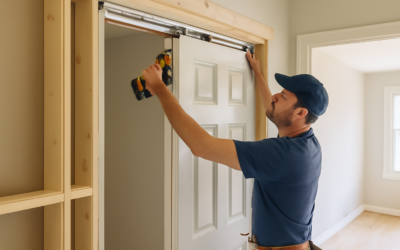
A pocket door slides into a hidden cavity in the wall instead of swinging into the room, which is why architects love them in tight floor plans where every square foot matters. The catch is the price — installing a pocket door is significantly more involved than hanging a standard pre-hung swing door. The realistic pocket door cost for most American homeowners lands between $500 and $3,500 fully installed, with the wide range coming down to whether you are framing a new wall or retrofitting an existing one. Knowing where your project falls on that spectrum before you call a contractor saves both time and money.
Part of our Windows & Doors guide — explore the full guide →
Average Cost Ranges
Real-world pricing in 2026 across the U.S. breaks down roughly like this:
- New construction, basic single door: $500 to $900 installed
- Retrofit into existing non-load-bearing wall: $1,200 to $2,200 installed
- Retrofit into existing load-bearing wall: $2,500 to $4,500 installed
- Double pocket doors (French style): $1,800 to $5,500 installed
- Soft-close upgrade: add $90 to $200 in hardware
Premium solid-wood door slabs from manufacturers like Sun Mountain or Simpson can push material costs another $400 to $1,500 above stock hollow-core options.
Material Costs Breakdown
The hardware and frame kit, not the door itself, is the most variable line item. The Johnson Hardware 1500 Series and the Hettich Slido Classic are the contractor-grade kits most pros specify. Expect these material costs:
- Hardware frame kit (Johnson 1500 or equivalent): $130 to $190
- Soft-close mechanism upgrade: $80 to $200
- Hollow-core door slab: $80 to $150
- Solid-core door slab: $200 to $450
- Premium custom-stain door slab: $500 to $1,500
- Edge pull and flush pull set: $25 to $90
- Trim and casing materials: $40 to $90
For a basic new-construction pocket door, materials run $300 to $500. The other 50 to 80% of total cost is labor.
Labor and Installation Time
A pocket door takes a finish carpenter or general contractor 4 to 8 hours for a new build install and 8 to 16 hours for a retrofit. Hourly rates of $65 to $110 across most U.S. markets put labor at $300 to $1,500 for new construction and $700 to $2,200 for retrofit work.
If electrical or plumbing has to be relocated out of the pocket cavity, add another $300 to $1,000 in subcontractor work. Light switches and outlets centered on the wall almost always need to move when retrofitting a pocket door.
Why Retrofit Costs Jump
Three factors send retrofit pocket door cost above new-construction pricing:
- Existing drywall has to be opened up, removed, and re-finished
- Studs in the pocket area have to be removed and the wall re-framed
- Electrical and plumbing inside the wall must be relocated
If the wall is load-bearing, a structural engineer letter ($300 to $800) and a temporary support wall during framing add another layer of cost. Permits in most jurisdictions run $80 to $300 for a structural pocket-door retrofit.
The Hidden Cost of Wall Repairs
Even non-structural retrofits trigger drywall repair, paint touch-ups, and trim replacement on both sides of the wall. Budget $300 to $700 for finishing work alone, plus paint to match — and assume the existing paint will not match exactly without a full-wall repaint. Many homeowners are surprised that a $1,500 pocket door retrofit ends up costing $2,200 once finishing is included.
DIY Versus Professional Installation
For a confident DIYer with framing experience, installing a pocket door in new construction is achievable in a long weekend. The hardware kit comes with detailed instructions, and the work is straightforward when wall studs are exposed. Material cost runs $250 to $500 and saves $400 to $900 in labor.
Retrofit installation is much harder to DIY successfully. Cutting into a finished wall, locating concealed wiring without a stud finder upgrade ($80 for a Bosch GMS 120 wall scanner is worth it), and getting the rough opening square enough for the slider to glide smoothly are all skills that take experience to do right. Most pocket-door retrofits are best left to a finish carpenter.
Pocket Door Versus Barn Door
Barn doors slide on an exposed track outside the wall, which avoids the framing complexity of a pocket door. Material and labor for a barn door installation runs $200 to $800 — roughly half a comparable pocket door. The trade-off is appearance: barn doors are exposed hardware and a hanging slab, while pocket doors disappear into the wall when open.
For tight floor plans where wall space is at a premium, barn doors actually need more clearance because they slide in front of the adjacent wall. Pocket doors win for true space savings; barn doors win for budget.
Where Pocket Doors Pay Off
Pocket doors deliver the most value in three locations:
- Master bath ensuites where a swing door eats vanity clearance
- Pantries off small kitchens
- Home offices opening into a hallway
- Closets in bedrooms where bifold doors look dated
A small bathroom where a swing door currently eats 9 square feet of usable space recovers that area entirely with a pocket door — often the difference between a cramped layout and one that feels generous.
Saving Money Without Cutting Corners
If pocket door cost is a stretch for your project, three strategies cut total spend without sacrificing quality:
- Time the install with another wall renovation when drywall is already open
- Reuse your existing door slab instead of buying new (most slabs work in pocket frames)
- Skip the soft-close upgrade on rarely used doors
Combining all three on a typical project drops total cost by 30 to 40%. The result is a door that hides into the wall like a magic trick — for the price of a basic swing door swap.