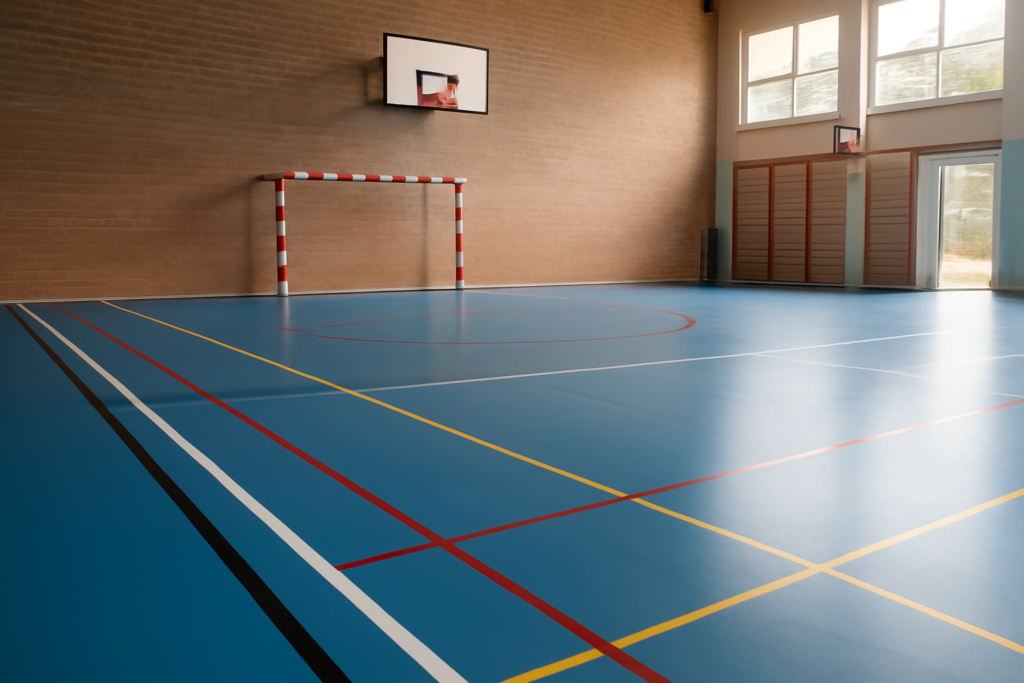
Athletic flooring decisions get made by people who rarely play on the surfaces they specify, which is why so many high school gyms have great basketball floors and terrible volleyball performance on the same court. Polyurethane sports flooring sits in a sweet spot between hardwood and rubber — fast cure times, customizable shock absorption, and color flexibility that woodsystems cannot match. This guide explains how PU systems are built, where they outperform competitors, and what facility managers should specify before requesting bids.
- How Polyurethane Sports Floors Are Built
- Pros of Polyurethane Sports Flooring
- Cons to Weigh Before Specifying
- System Types Explained
- Sport-by-Sport Suitability
- Installation Timeline and Process
- Cost Comparison
- Maintenance to Hit Lifecycle
- Comparison to Wood and Modular Tile
- Specifying With Confidence
How Polyurethane Sports Floors Are Built
A typical PU sports floor is a multi-layer poured system applied liquid over a prepared concrete substrate. The base is a primer for adhesion, followed by a 4 to 9 mm rubber granulate or foam shock pad, then a self-leveling polyurethane wear layer of 1.5 to 3 mm topped with a 2-component aliphatic seal coat for UV stability and color. Total system thickness usually lands between 8 and 14 mm.
Performance specs follow EN 14904 and DIN 18032 standards. Force reduction (shock absorption) ranges from 25% on point-elastic surfaces to 53% on combi-elastic systems. Coefficient of friction sits between 80 and 110 — sticky enough for fast cuts, smooth enough that pivoting does not stress knees. Vertical ball deflection is calibrated to match wood courts within 5%.
Pros of Polyurethane Sports Flooring
The category has real advantages over wood and modular tile systems, which is why it dominates European multi-sport facilities and is gaining ground in US recreation centers.
- Seamless installation — no joints, no gaps, no dirt-trap edges anywhere on the playing surface
- Custom shock absorption — pad layer thickness adjusts to specific sport requirements
- Color and graphics freedom — solid colors, gradients, full-court logos, all built into the wear layer
- Maintenance simplicity — auto-scrubber and neutral cleaner, no annual sand-and-refinish
- Hygienic surface — non-porous, easy to disinfect, no microbial harboring
Cons to Weigh Before Specifying
The downsides matter for some applications. PU floors require a flat, dry, clean concrete substrate — moisture above 4 lbs/1000 sq ft/24 hours causes blistering. Subfloor preparation often costs more than the coating itself in old buildings. Once installed, repairs are visible; patches show color slightly different from the original after UV exposure.
For competitive basketball at the collegiate or pro level, hardwood remains the preferred surface for ball response and player feel. PU systems can match wood ball bounce specs but have a slightly different audible feel that experienced players notice. For everything below NCAA Division I level, PU is fully competitive.
System Types Explained
EN 14904 classifies sports floors into four categories by how shock absorption is delivered. Each suits different sports.
- Point elastic (Type 1) — 4 mm pad, 1.5 mm PU; great for table tennis, dance, fencing; $7 to $11 sq ft
- Mixed elastic (Type 2) — 6 mm pad, 2 mm PU; suits multipurpose halls and elementary schools; $9 to $13 sq ft
- Combi elastic (Type 3) — pad plus subfloor panel, total 12 to 14 mm; suits high schools, club volleyball, basketball; $13 to $18 sq ft
- Area elastic (Type 4) — sprung subfloor with PU top; for serious basketball; $18 to $26 sq ft
Sport-by-Sport Suitability
Different sports load floors differently. Volleyball needs high force reduction (45%+) to protect knees during landings. Basketball wants moderate force reduction (35-45%) with high ball rebound. Badminton and table tennis prefer point-elastic with low rebound interference. Indoor soccer needs a slightly higher friction surface to handle ball control. Multipurpose facilities usually settle for a mid-range Type 2 or 3 system that compromises across sports rather than excelling at one.
Installation Timeline and Process
A typical 8,000 sq ft installation takes 7 to 14 days from start to first ball. Day 1 involves grinding and patching the concrete to a CSP 3 profile. Days 2-3 set the moisture-tolerant primer and shock pad. Days 4-6 pour the polyurethane wear layer in two coats with sanding between. Day 7-10 apply the colored seal coat and game-line graphics. Final cure is 5 to 7 days before sports use, though light foot traffic can begin in 24 hours.
Temperature and humidity control during install matter more than most facility managers realize. Polyurethane chemistry requires 60-80°F and under 75% relative humidity. Outside that envelope, the floor either fails to cure or skins over too fast and traps bubbles. HVAC must run continuously through the entire install and 7-day cure window.
Cost Comparison
For a 10,000 sq ft gymnasium, expect the following installed costs. Mid-tier Type 2 PU system around $90,000 to $130,000. Premium Type 3 system used in high school competition gyms around $130,000 to $180,000. Sprung Type 4 system for serious basketball around $180,000 to $260,000. Compare against maple hardwood at $200,000 to $320,000 for similar performance grade. The PU system saves money up front and on maintenance over a 25-year lifecycle.
Maintenance to Hit Lifecycle
Daily dust mop with a 36 inch microfiber. Weekly auto-scrub with neutral pH cleaner like Hillyard Top Clean. Avoid waxes, oil-based cleaners, and harsh disinfectants — they leave residue that changes ball friction. Re-stripe game lines every 7 to 10 years. Spot-repair any deep cuts with manufacturer patch kit within 30 days; ignored damage spreads through the wear layer.
Comparison to Wood and Modular Tile
Hardwood maple delivers premium ball response and the cultural resonance of traditional basketball culture, but it requires annual recoating, sand-and-refinish every 8 to 12 years, and is highly sensitive to humidity swings. Modular interlocking tile systems install fast and remove for events but have visible seams, lower force reduction, and worse ball response. PU sits between them with the lowest lifecycle cost when properly maintained.
Specifying With Confidence
For most schools and recreation centers, a Type 2 or Type 3 PU system covers volleyball, basketball, badminton, indoor soccer, and PE class with no compromises serious enough to matter. Specify EN 14904 compliance, force reduction in the 40 to 53% range, vertical deflection under 3.5 mm, and a 10 year material warranty. Insist on a mockup section to verify color and texture before full installation. Done right, polyurethane sports flooring delivers two decades of trouble-free service across every sport a gym hosts.
Prefer to explore on your own?
See how new flooring looks in your actual room in seconds — free, no signup.
Try the free Floor Studio →