Maple gym floors look beautiful and cost a fortune to install, refinish, and replace. Schools, recreation centers, and home gyms are switching to engineered alternatives that perform better on most metrics. Synthetic sports flooring delivers consistent shock absorption, multi-sport line painting, and a 15 to 25 year service life at half the lifecycle cost of hardwood. This guide explains the four major categories, where each one shines, and what to budget for a real installation.
- The Four Main Categories
- Vinyl Sheet Systems
- Rubber Sports Flooring
- Polyurethane Poured Systems
- Modular Tile Systems
- Real-World Cost for Common Installations
- Performance Standards to Demand
- Pros That Make the Switch Worth It
- Honest Drawbacks
- Maintenance That Extends Service Life
- Where to Buy and Who to Hire
The Four Main Categories
Synthetic sports flooring breaks into vinyl, rubber, polyurethane, and modular tile systems. Each is engineered to specific performance standards published by FIBA (basketball), FIVB (volleyball), or ASTM F2772 for sports performance generally.
- Vinyl sheet (PVC): Roll goods with foam-backed cushioning, $4 to $8 per sq ft installed
- Rubber: Vulcanized rolled or interlocking tile, $3 to $9 per sq ft
- Polyurethane (poured): Liquid-applied seamless system, $7 to $14 per sq ft
- Modular polypropylene tile: Snap-together plastic tile for outdoor and multi-sport, $5 to $10 per sq ft
Vinyl Sheet Systems
PVC sheet from Tarkett Omnisports, Gerflor Taraflex, or Mondo Sportflex dominates the elementary school and community center market. Sheet widths are 6 feet, rolls 60 to 100 feet long, and the entire floor heat-welds into a single waterproof surface. Foam backing in the 5 to 9mm range absorbs impact for jumping, running, and aerobics.
Lines and logos are inlaid by hand using contrasting vinyl strips before welding, which lets you mark basketball, volleyball, badminton, and pickleball on the same court without paint touch-ups.
Rubber Sports Flooring
Vulcanized rubber rolls and tiles from Ecore, Mondo Sportflex M, and Regupol fit weight rooms, cardio areas, and CrossFit gyms. Thickness ranges from 8mm for general fitness to 25mm for Olympic lifting platforms. Rubber absorbs dropped barbells, deadens sound transmission to floors below, and resists almost every chemical you would clean it with.
The trade-off is feel. Rubber is dense, slow, and not appropriate for sports requiring quick lateral cuts. Use it in lifting zones, not on basketball courts.
Polyurethane Poured Systems
Pour-in-place polyurethane is the premium tier. Installers mix two-part liquid resin on site, pour it over a primed concrete substrate, and trowel a seamless 8 to 15mm system in two days of work plus a week of curing. Junckers Unobat, Robbins Pulastic, and Mondo Sport Impact are the industry leaders.
Performance is unmatched. Ball bounce, shock absorption, and friction all hit the highest FIBA category. The cost reflects it. Expect $9 to $14 per sq ft for a competition-grade installation.
Modular Tile Systems
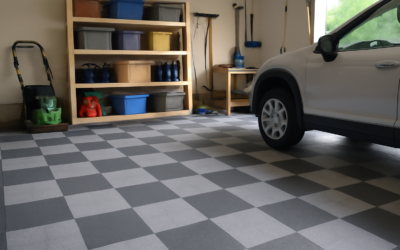
Snap-together polypropylene tiles from Sport Court, VersaCourt, and SnapSports are the easy choice for residential basketball, outdoor sport courts, and temporary indoor installations. Tiles measure 12 by 12 inches, install over almost any flat surface without adhesive, and can be relocated.
The grid pattern is visible up close. Ball response is slightly different from a continuous surface. For backyard half-courts or driveway pickleball, this is the practical winner.
Real-World Cost for Common Installations
- Home gym, 400 sq ft rubber roll: $2,000 to $3,500
- School elementary multipurpose, 4,500 sq ft vinyl: $24,000 to $36,000
- Competition basketball court, 8,000 sq ft polyurethane: $80,000 to $112,000
- Backyard half-court, 1,000 sq ft modular tile: $5,500 to $9,000
Performance Standards to Demand
For sports use, the contractor should be able to cite the ASTM F2772 area-elastic or point-elastic rating, EN 14904 shock absorption percentage, and rolling load capacity. A floor that flexes correctly under a 220-pound runner protects ACLs and reduces fatigue. Generic gym mat marketed as “sports flooring” without these specs is unsafe for organized play.
Pros That Make the Switch Worth It
Synthetic sports flooring out-performs hardwood in three measurable ways. Shock absorption is consistent across the entire surface, not just the points where the maple subfloor sleepers sit. Multi-sport line painting is permanent and changeable. Maintenance is dramatically simpler. No annual screen-and-recoat, no sanding, no humidity control crisis when the HVAC fails.
Lifecycle cost over 25 years runs 30 to 50 percent less than hardwood when you include refinishing every 8 to 10 years on maple.
Honest Drawbacks
Resale and aesthetics still favor wood for college and professional venues. Synthetic floors look industrial, and the colors fade slightly over a decade of UV exposure even indoors. Repair of a punctured PVC sheet requires a welding kit and matched stock, which means small dealers cannot fix it without ordering new material.
Static electricity is another quirk in dry climates. Some PVC products build up enough charge to startle players in winter unless you specify an antistatic top layer.
Maintenance That Extends Service Life
Daily dry mop with a microfiber 36-inch flat mop. Weekly damp mop with a neutral-pH product like Hillyard Top Clean or Bona Sport. Annual deep clean with an autoscrubber using soft brushes, never aggressive pads. Avoid solvent cleaners and oil-based products entirely. Spot-repair damage within 30 days to prevent dirt and moisture from spreading under the wear layer.
Where to Buy and Who to Hire
Major manufacturers (Tarkett, Gerflor, Mondo, Junckers, Ecore) sell through certified installer networks. Buying material direct and hiring a general contractor usually voids the warranty. Get three quotes from MFMA-affiliated or factory-trained installers before signing, and ask for references from installations five-plus years old that you can visit in person.
Prefer to explore on your own?
See how new flooring looks in your actual room in seconds — free, no signup.
Try the free Floor Studio →