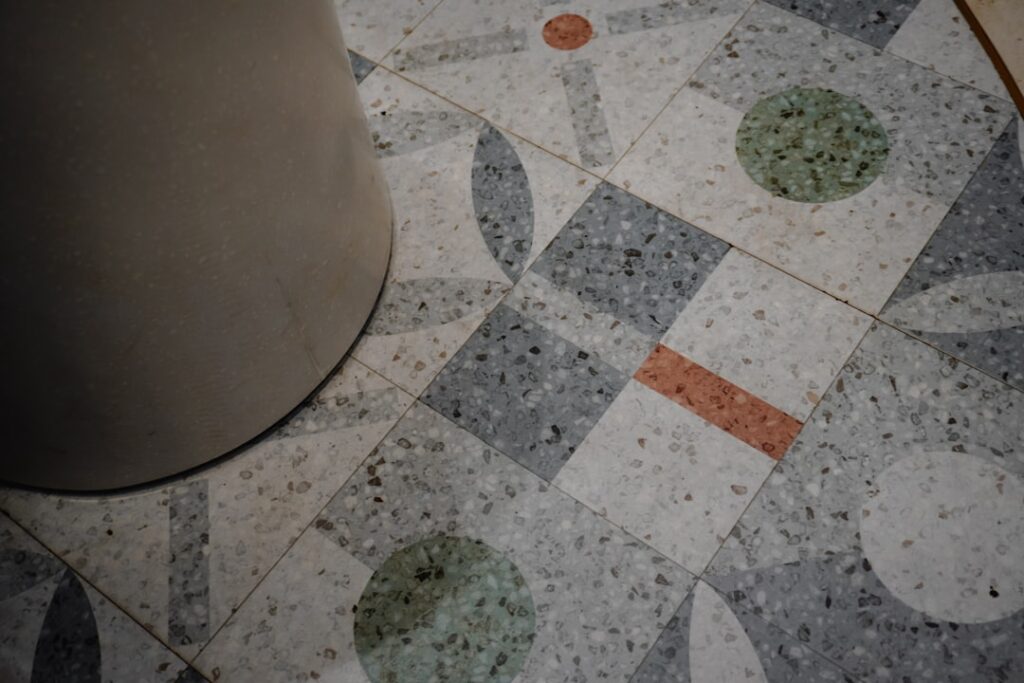
The seamless mosaic floors in airports, museums, and 1950s schools are not pre-made tile. They are poured terrazzo flooring, a custom composite of marble or glass chips suspended in cement or epoxy matrix, ground and polished in place. This buying guide explains the two main system types, what custom installation actually costs in 2026, the design control you gain over tile-based alternatives, and the real reasons most homeowners ultimately decide for or against this premium surface.
What Poured Terrazzo Really Is
Two distinct systems live under the terrazzo umbrella. Cement terrazzo uses Portland cement matrix poured 1.5 to 2.5 inches thick, with brass or zinc divider strips creating the design pattern and managing crack control. Epoxy terrazzo uses a 100 percent solids epoxy matrix poured at 3/8 inch thick, allowing the system to install over wood subfloors and most existing slabs.
Both systems are ground and polished after curing, exposing the aggregate (marble chips, glass, mother-of-pearl, or recycled materials) and producing a continuous, jointless surface. The visual result is similar, but the construction, weight, and use cases differ significantly.
Real Costs in 2026
Poured terrazzo is one of the most expensive flooring categories because it is essentially a custom installation built on site by specialty crews. Pricing varies with aggregate choice, pattern complexity, and substrate prep.
- Cement terrazzo (1.5 inch thick): $25 to $50 per sq ft installed
- Epoxy terrazzo (3/8 inch thick): $30 to $55 per sq ft installed
- Premium aggregate (mother-of-pearl, custom glass): add $5 to $20 per sq ft
- Custom logos or inlay patterns: add $15 to $40 per sq ft
- Substrate prep and divider strips: $3 to $8 per sq ft
For a typical 1,000 sq ft residential entry and great room, plan on $30,000 to $60,000 fully installed. Commercial installations often push above $75 per sq ft when custom logos and metal inlays are involved.
Where Poured Terrazzo Earns the Cost
The strongest residential matches are entry foyers, great rooms, and ground-floor open-plan kitchens where the seamless surface visually unifies the space. Modern homes designed around concrete or steel structure benefit most because the floor reads as part of the architecture rather than a finish layer.
Commercial venues that justify the cost include high-traffic lobbies, museums, hospitals, and university buildings where the 75 to 100 year service life amortizes the upfront premium. A poured terrazzo floor installed in 1955 may still be in service in 2055 with periodic re-polishing.
The Real Pros
Lifespan is the headline. Properly installed poured terrazzo lasts the life of the building. Examples from the 1920s and 1930s in commercial buildings across Chicago, Miami, and Los Angeles are still in original service today, having been re-polished multiple times without replacement.
Design control is the second major benefit. You choose the matrix color, the aggregate (any combination of marble, granite, glass, or recycled materials), the divider strip pattern, and any custom inlays. The result is a floor that does not exist anywhere else in the world.
Maintenance is also genuinely low for the lifetime cost. Daily sweeping, weekly damp mopping with neutral pH cleaner, and a re-polish every 10 to 20 years is the entire program. Compare that to LVP or carpet, both of which need full replacement every 12 to 25 years.
Honest Drawbacks
Cost is the obvious one. At $25 to $55 per sq ft installed, poured terrazzo costs 3 to 6 times what mid-range LVP or laminate runs. Even a small foyer can hit $5,000 to $10,000 in flooring alone.
The schedule is also long. A 1,000 sq ft cement terrazzo install takes 3 to 4 weeks from substrate prep to final polish, with multiple cure stops along the way. Epoxy terrazzo cuts that to 10 to 14 days, but neither is a fast project. Plan accordingly if your construction schedule is tight.
The surface is hard, cold, and unforgiving. Standing for hours on terrazzo without anti-fatigue mats is uncomfortable. Dropped glassware breaks. Pets with overgrown nails can scratch the polish, requiring spot re-polishing. The same toughness that gives terrazzo its lifespan also makes it intolerant of forgetting these realities.
Cement vs Epoxy: Which to Choose
Cement terrazzo is the traditional system and the right choice for ground-floor slabs in commercial-grade buildings. It handles outdoor patios in non-freezing climates, accepts custom aggregates including chunks 1 to 2 inches across, and develops a depth of polish that epoxy cannot match.
Epoxy terrazzo is the modern choice for second floors, retrofits, and any project where weight or cure time matters. It installs at 3/8 inch versus 1.5 to 2.5 inches for cement, weighs about 4 lbs per sq ft versus 18 to 25 lbs, and accepts a much broader color palette in the matrix. Most residential remodels use epoxy for these reasons.
Decision shorthand: ground floor with no schedule pressure, choose cement. Anything else, choose epoxy.
Top Suppliers and Installers
The poured terrazzo market is dominated by specialty contractors with multi-decade portfolios and relationships with the major matrix and aggregate suppliers.
- National Terrazzo and Mosaic Association (NTMA): certified installers nationwide with documented training
- Wausau Tile and Terrazzo: matrix and aggregate supplier with full design service
- Doyle Dickerson Terrazzo: custom epoxy systems with custom aggregate sourcing
- Roman Mosaic and Tile: high-end residential and museum work, custom inlay design
- Master Terrazzo Technologies: commercial epoxy systems with rapid-cure options
Installation Process
Substrate prep is the first and most critical step. Concrete must be ground or shot-blasted to expose aggregate, cracks must be repaired with epoxy injection, and moisture testing must confirm under 4 lbs per 1,000 sq ft per 24 hours. Wood subfloors need a self-leveling underlayment plus an isolation membrane to manage seasonal movement.
Divider strips (brass, zinc, or aluminum) are installed next, screwed to the substrate at every design line and at maximum 5-foot intervals for crack control in cement systems. The matrix is then mixed and poured into each section, screeded smooth, and allowed to cure.
Grinding starts 24 to 72 hours after pour for epoxy systems and 5 to 10 days for cement systems. Initial grinding uses 30 grit, progressing to 60, 120, 220, 400, 800, and finally 1500 grit for high-polish finishes. The final step is sealing with a penetrating sealer like NTMA Sealer 200 or a topical wax for added gloss.
Maintenance Schedule
Daily care: dry sweep or vacuum, then damp mop with neutral pH cleaner like Hillyard Top Clean SC or NTMA-approved cleaner. Never use acidic cleaners (vinegar, lemon, citrus oils) on cement terrazzo because the cement matrix etches. Epoxy terrazzo is more chemical-resistant but still benefits from neutral cleaners.
Re-polish every 10 to 20 years in residential settings and every 5 to 8 years in commercial high-traffic areas. The process restores the original gloss and removes accumulated micro-scratches, costing $4 to $9 per sq ft. With this maintenance cadence, poured terrazzo flooring lasts 75 to 100+ years.
Frequently Asked Questions
Can poured terrazzo crack?
Cement terrazzo can develop hairline cracks at substrate movement points, which is why divider strips are placed every 5 feet maximum. Epoxy terrazzo is much more flexible and rarely cracks. Both systems can be repaired by a trained installer, often with results that are essentially invisible.
Is poured terrazzo a DIY project?
No. The mixing chemistry, divider strip layout, grinding sequence, and polishing process all require specialized equipment and trained crews. DIY attempts almost always result in poor results and expensive professional remediation.
Can I install terrazzo over radiant heat?
Yes for both cement and epoxy systems, with proper expansion joint placement and a maximum surface temperature of 85°F. Terrazzo’s high thermal mass makes it excellent for radiant systems because it stores heat and releases it slowly throughout the day.
Prefer to explore on your own?
See how new flooring looks in your actual room in seconds — free, no signup.
Try the free Floor Studio →