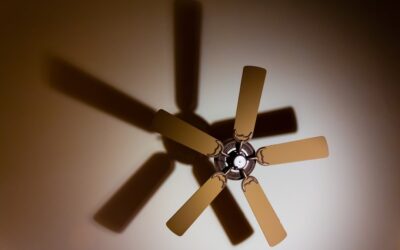
Stand under a weak ceiling fan in August and you will feel almost nothing but a faint stir of warm air. A genuinely powerful ceiling fan is a different machine entirely, capable of creating a breeze you feel across an entire great room and dropping the perceived temperature by 4 to 8°F. The catch is that “power” gets advertised loosely, and a fan with five big blades can still move less air than a tight three-blade design. Knowing which numbers actually predict airflow lets you buy strength instead of marketing.
CFM Is the Only Power Number That Counts
Airflow is measured in cubic feet per minute, or CFM, and it is the single most honest spec on the box. A weak fan moves 1,500 to 3,000 CFM. A solid performer hits 5,000 to 6,000. A genuinely powerful ceiling fan moves 7,000 CFM or more, and the strongest residential models top 9,000. The Big Ass Fans Haiku L pushes well past 7,000 CFM, while industrial-styled fans like the Hunter Original at 52 inches deliver strong, steady airflow for large living spaces.
Manufacturers must publish CFM on the Energy Guide label, so ignore vague phrases like “high velocity” and read the actual figure. More blades do not mean more air. Blade pitch, motor torque, and RPM determine airflow.
DC Motors Changed the Game
For decades, AC motors powered ceiling fans. DC (direct current) motors now dominate the high-performance category for good reason. They produce more torque per watt, so they spin heavier or steeper blades without straining, and they use up to 70% less electricity than a comparable AC fan. A powerful DC fan often draws just 30 to 35 watts at full speed, versus 75 to 100 watts for a strong AC model.
DC motors also run quieter and offer more speed settings, typically six instead of three, plus instant reverse for winter heat circulation. The upfront cost runs $50 to $100 higher, but the energy savings and smoother operation usually justify it.
Blade Pitch and Span
Blade pitch is the angle of the blades relative to horizontal, and it is where many fans quietly fail. A flat 10 to 12-degree pitch slices through air without grabbing much of it. A powerful fan uses a 14 to 18-degree pitch, which scoops far more air per rotation but demands a stronger motor to drive it.
- 42 inches: rooms up to 144 sq ft
- 52 inches: 144 to 225 sq ft
- 60 to 72 inches: great rooms, open-plan spaces, and high ceilings
For real moving power in a large space, go with a 60-inch or larger fan and a steep pitch. Two well-placed 52-inch fans can also outperform one undersized 60-inch unit in a long room.
Why Powerful Does Not Have to Mean Loud
The frustration with many strong fans is noise: motor hum, blade wobble, and rattling light kits. Quality changes that. Sealed bearings, a precision-balanced blade set, and a quality DC motor let a fan move 7,000 CFM while staying under the hum threshold you would notice from across the room. If reviews mention clicking, humming, or wobble, walk away. A well-built powerful fan should be nearly silent on its lower speeds and produce only a soft rush of air at full tilt.
Ceiling Height and Downrod Length
A powerful fan needs room to work. Mounting blades too close to the ceiling chokes airflow because the fan cannot draw enough air from above. Keep at least 8 to 12 inches of clearance between blades and ceiling, and keep blades a minimum of 7 feet off the floor. On a 10-foot ceiling, a 12 to 24-inch downrod positions the fan in the sweet spot. Hugger mounts sacrifice some airflow, so use them only when an 8-foot ceiling leaves no choice.
Outdoor and Damp-Rated Power
Covered patios and sunrooms benefit enormously from a powerful fan, but you need the right rating. Damp-rated fans handle humidity and indirect moisture. Wet-rated fans, sealed against direct rain, suit open porches. Outdoor fans often run larger, 60 to 72 inches, because patios are big and have no walls to contain the breeze. The Hunter Outdoor Elements series is a common pick for high airflow in exposed settings.
What You Should Expect to Pay
A truly powerful ceiling fan with a DC motor, 7,000-plus CFM, and quiet operation generally costs $200 to $450. Premium smart models from Big Ass Fans run higher. You can find strong AC fans for $130 to $200, but they will use more electricity and offer fewer speed settings. Below $100, you are almost always buying airflow you will find disappointing the first hot week of summer.
Year-Round Use With the Reverse Switch
A powerful fan is not just a summer tool. Every quality fan has a reverse switch, and in winter it earns its keep. Warm air rises and collects at the ceiling, wasting your heating. Set the fan to spin clockwise on its lowest speed and it gently pushes that trapped warm air back down along the walls without creating a chilly draft. In a room with 9 or 10-foot ceilings, this can let you lower the thermostat a couple of degrees while feeling just as warm, trimming heating costs over a season.
The key in winter is low speed. A powerful fan running high in reverse would create the very draft you are trying to avoid. Use its strength in summer counterclockwise on high, and its finesse in winter clockwise on low.
Smart Features Worth Having
Many powerful DC fans now ship with full-function remotes and smart-home integration. A remote that controls all six speeds and reverses direction without a wall switch is genuinely useful on a high great-room fan you cannot easily reach. App and voice control through Alexa or Google Home let you adjust airflow without getting up, and some models include a timer and a “breeze mode” that varies speed to mimic natural wind. These are conveniences rather than performance features, but on a premium fan they add real day-to-day value.
When you shop for a powerful ceiling fan, let CFM lead the decision, favor a DC motor for efficiency and quiet, choose a steep blade pitch and a span sized to your room, and give the fan proper ceiling clearance. Hit those marks and you will feel the difference the moment you turn it on, a real, room-filling breeze that makes the air conditioner work less and your summer evenings noticeably more comfortable.