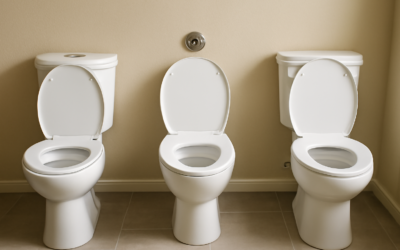
Walk into a hotel lobby restroom and that startling “whoosh” you hear when someone flushes is a pressure-assist toilet. The same technology in a home bathroom solves a frustrating problem, weak gravity flushes that need plunging twice a week, but it comes with a tradeoff most homeowners do not fully understand. A pressure flush toilet uses compressed air inside a sealed inner tank to launch water at roughly 70 psi, eliminating clogs that defeat low-flow gravity models. This guide explains exactly how the technology works, where it makes sense, and the brand-by-brand differences that matter when you stand in the showroom.
Part of our Bathroom Remodeling & Flooring guide — explore the full guide →
How Pressure Assist Actually Works
A traditional gravity toilet relies on a 12 to 15-inch water column in the tank dropping into the bowl, generating about 1.5 gallons per minute of flow. A pressure-assist toilet wraps a sealed inner pressure tank around the standard water tank. As the inner tank fills, incoming line pressure (40 to 80 psi in most homes) compresses the air space inside. When you flush, that pressurized air pushes the water out at high velocity.
The result is a flush that moves 350 to 1,000 grams of solid waste in a single use, compared to 250 to 500 grams for a typical 1.28 GPF gravity toilet. The Maximum Performance (MaP) score, an industry-standard test, ranks toilets on this metric directly.
Where Pressure Assist Shines
Not every household benefits. The technology is the right choice in five specific situations:
- High-traffic guest bathrooms or commercial spaces: Where a clogged toilet creates an embarrassing problem.
- Households with frequent clog problems: Especially in homes with older 3-inch drain lines or long horizontal runs.
- Master bathrooms in homes with septic systems: The forceful flush moves waste further down the line, reducing buildup.
- Bathrooms where reliable line pressure is consistent: Requires 25 psi minimum, ideally 45 to 70 psi.
- Homes wanting the lowest water use per effective flush: 1.0 to 1.28 GPF pressure models match the bowl performance of 1.6 GPF gravity units.
The Noise Tradeoff
The honest disadvantage is sound. A gravity toilet flush registers 65 to 70 decibels at 3 feet. A pressure-assist model produces 75 to 88 decibels, comparable to a vacuum cleaner. In a small powder room with hard surfaces, that bounces and amplifies.
Three mitigations help. Install carpet or a fabric ceiling element in the bathroom to absorb sound. Choose newer models with insulated tanks like the Kohler Highline Pressure Lite, which runs 8 decibels quieter than older designs. Avoid pressure assist in bathrooms that share a wall with a bedroom or office.
Top Picks for 2026
Four manufacturers dominate the residential pressure-assist market.
- American Standard Cadet PRO ($350 to $480): Uses Sloan Flushmate 503 tank. MaP score 1,000 grams. The default option for solid mid-range performance.
- Kohler Highline Pressure Lite ($420 to $570): Quieter Flushmate IV system, smoother trim, slightly higher seat at 17 inches.
- Gerber Avalanche ($380 to $510): Heavy-duty commercial-grade build, MaP 1,000. Common in property management installs.
- Mansfield Quantum ($300 to $400): Budget pressure-assist with reliable Flushmate cartridge. Best dollar-per-performance.
Every residential pressure toilet on the market uses one of three Flushmate cartridges manufactured by Sloan. The cartridges are interchangeable and replacement parts cost $80 to $150.
Installation Requirements
Pressure toilets install nearly the same as gravity models with a few extra considerations.
- Water pressure: Confirm 25 psi minimum at the supply valve. Below that, the system will not pressurize correctly.
- Supply line: Standard 3/8-inch braided stainless line, same as gravity.
- Wax ring: Use a deep-flange wax ring rated for pressure-assist (Fluidmaster PerfectSeal Max). Standard wax rings can shift under flush thrust.
- Floor flange: Must be securely anchored. Loose flanges cause leaks at the base over time.
- Shutoff valve: Replace with a quarter-turn ball valve. Older multi-turn valves rust closed.
The install takes 45 to 90 minutes for a competent DIYer. A plumber charges $200 to $400 in labor on top of the toilet cost.
Maintenance Differences
The Flushmate cartridge is the heart of the system, and it lasts 7 to 10 years before needing replacement. Signs that the cartridge is failing:
- Weaker flush than at install.
- Water ghosting in the bowl between uses.
- Audible hissing from the tank between flushes.
- Cartridge replacement takes 30 minutes with a wrench and the new Flushmate kit.
Hard water above 10 grains per gallon shortens cartridge life by 25 to 40 percent. Install a softener or expect to swap cartridges every 5 years in those conditions.
Comparison With Modern Gravity Toilets
The gap between pressure assist and high-end gravity has narrowed significantly. Toto’s Tornado Flush and Kohler’s AquaPiston gravity systems now achieve MaP scores of 800 to 1,000 grams without the noise.
- Gravity advantages: Quieter, simpler internal mechanism, easier to repair with standard parts.
- Pressure advantages: Stronger flush velocity, better at moving waste through long horizontal runs, no water ghosting.
- Cost comparison: A premium gravity toilet (Toto Drake II, Kohler Memoirs) runs $400 to $700, similar to a mid-range pressure assist.
If clogging is not currently a problem in your bathroom, a high-end gravity unit will probably serve you better. If clogging is the reason you are shopping, pressure assist solves it definitively.
Common Misconceptions
Three myths persist in showrooms.
First, pressure toilets do not use more water. Most 1.28 GPF pressure models meet EPA WaterSense certification, identical to gravity flow rates. Second, they are not commercial-only. Residential models have existed since the 1990s and are widely available. Third, they are not maintenance nightmares; the Flushmate cartridge is one part with a single failure mode, easier to diagnose than the multiple valves in a gravity toilet.
Final Decision Framework
Buy a pressure flush toilet if you have ongoing clog problems, a septic system with long line runs, or a high-traffic bathroom. Skip it if your bathroom is adjacent to a quiet space or if your home water pressure is unreliable. Match the model to your actual bowl-clearing problem and the technology delivers exactly what its name promises.