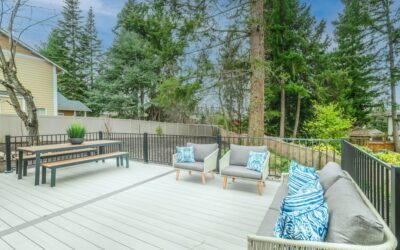
Most homeowners shopping for a low-maintenance deck assume composite and PVC are the same product. They are not. Composite deck boards contain wood fibers and will darken, stain, and mildew over time in humid climates. A PVC deck is 100 percent polyvinyl chloride — no organic content — which means no food source for mold, no water absorption, and a realistic 25 to 50-year service life. The trade-off is a higher upfront cost and different installation requirements. This guide covers when PVC makes sense, which brands deliver, and what it actually costs to build.
Part of our Decks & Outdoor guide — explore the full guide →
PVC vs. Composite vs. Wood
Pressure-treated southern yellow pine still dominates American deck construction at $2 to $4 per square foot in material cost, but it demands annual cleaning and re-staining. Wood-plastic composites like Trex Enhance and TimberTech Edge run $4 to $8 per square foot and reduce maintenance significantly — but still absorb some moisture and can mildew. Cellular PVC boards from Azek TimberTech Advanced and Deckorators Voyage push $7 to $12 per square foot but deliver truly set-and-forget performance. For coastal, humid, or heavily shaded decks, the upcharge for PVC pays for itself in avoided replacement.
Top Brands Worth Specifying
The all-vinyl decking category has matured. These four manufacturers consistently deliver on durability, color retention, and warranty coverage.
- TimberTech Azek Vintage Collection: The category leader. Cap-layer technology, 50-year limited fade and stain warranty, $9-$12 per square foot.
- Deckorators Voyage: Mineral-based composite core wrapped in PVC, very low thermal expansion, $8-$10 per square foot.
- Wolf PVC Decking: All-PVC construction, scratch-resistant, includes fasteners in the system, $7-$9 per square foot.
- AERATIS Porch Flooring: Tongue-and-groove PVC specifically for covered porches, paintable surface, $8-$10 per square foot.
The Real Advantages of All-PVC
PVC boards don’t rot, don’t feed mold, don’t attract termites, and don’t absorb water. Pour a glass of red wine on a capped vinyl board, rinse with a hose an hour later, and no stain remains. Snow shovel season doesn’t scratch the surface. The color stays within 5 Delta-E of the original hue for 20-plus years (Azek publishes lab data). For pool decks, oceanfront properties, and shaded north-facing decks in the Pacific Northwest, PVC is often the only product that makes sense.
Where PVC Has Weaknesses
No material is perfect. PVC expands and contracts with temperature swings more than wood or composite — roughly 3/16″ over a 16-foot board across a 100 F temperature range. That requires disciplined end-gap spacing and specific fastener patterns. PVC also gets noticeably hot in full sun — lighter colors can hit 140 F on a 90 F day, though that is still cooler than darker composites. Finally, PVC boards don’t have the warm density of hardwood underfoot; some homeowners describe the feel as slightly plasticky.
Installation: Frame Spacing and Fasteners
Most PVC manufacturers require joists at 16 inches on center for standard applications, and 12 inches on center for diagonal board layouts or picture-framed perimeters. The joists themselves should be pressure-treated 2×8 or 2×10 lumber, spaced from a 6×6 post structure. Hidden fastener systems like Camo Edge, TigerClaw, and the manufacturer’s proprietary clips give the cleanest finish and eliminate face-screw popouts over time. End-gap the boards 1/8″ to 3/16″ per the brand’s technical sheet — skipping this is the number-one installation mistake and causes buckling in the first summer.
Cost to Build a Vinyl Deck
A 16×20 foot (320 square foot) cellular vinyl deck with railing in 2026 runs $18,000 to $32,000 fully built. Material breakdown: $2,500 to $4,000 for pressure-treated framing, $2,800 to $4,800 for PVC decking, $2,000 to $4,500 for PVC or aluminum railing, $400 to $800 for hidden fasteners and hardware, plus permit fees of $150 to $600 depending on municipality. Labor adds $10,000 to $18,000 for quality carpentry in most US markets. DIY homeowners who frame accurately can save 40 to 50 percent of total cost.
Railings, Stairs, and Accessories
Cellular vinyl deck systems typically pair with matching PVC railing (Azek Reserve, TimberTech Impression Rail) or powder-coated aluminum (Fortress Fe26, Westbury Tuscany). Aluminum costs slightly more but offers slimmer profiles and better sight lines. Cable railings give the most contemporary look but require beefier 4×4 or 6×6 end posts to resist cable tension. For stairs, most manufacturers offer matching stringers cut on-site from PVC sheet stock, and solid-riser closed stairs are far quieter than open-riser designs.
Maintenance: The Easy Part
This is the headline reason people buy PVC. Annual maintenance amounts to a spring and fall cleaning with a garden hose and a soft-bristle deck brush, plus mild dish soap for any stubborn dirt. Avoid pressure washers over 2,000 PSI at close range — they can pit the cap layer. Never use bleach, acetone, or solvent-based cleaners; they can cloud the finish. For stuck-on tree sap or bird droppings, a 50/50 vinegar-and-water mix breaks them down without damaging the board.
Is PVC Right for Your Project?
PVC makes the strongest case on decks built in humid, coastal, or heavily shaded environments, on raised decks where replacement would be expensive and disruptive, and on properties owned long-term where the 25 to 50-year lifecycle actually plays out. Pressure-treated wood still wins on small, ground-level decks in dry climates where the homeowner doesn’t mind annual staining. For anything in between, composite decking splits the difference. Match the material to the environment and your tolerance for future maintenance — that is the single decision that determines satisfaction a decade from now.