When homeowners tell me they want “a deck,” the real conversation is just beginning, because the range of deck options in 2026 is wider than it’s ever been — four fundamentally different surface materials, a half-dozen railing systems, framing choices that outlive the boards, and style decisions that change how the whole backyard lives. The good news is the decision tree is logical once someone lays it out. Here’s the full map I walk clients through: every major decking material with honest pros and cons, the railing and structural choices underneath, and the style questions that should be answered before anyone prices a single board.
Part of our Decks & Outdoor guide — explore the full guide →
The Four Surface Materials
Pressure-treated wood
Treated southern yellow pine is still over half the decks built in America, and the reason is simple: it’s the cheapest path to a real deck, widely available, and structurally proven. The tradeoff is maintenance — cleaning and re-staining every 2 to 3 years — and the boards themselves crack, cup, and splinter as they weather. Modern treatments are kinder than the old chemistry, but PT pine is a commitment to ongoing work. Lifespan 15 to 25 years with diligent care, less with neglect.
Cedar and redwood
The natural step up: dimensionally stabler than pine, naturally rot-resistant, beautiful in a way plastic never quite matches, and cooler underfoot than any composite. They still demand the same refinishing rhythm, they’re soft enough to dent, and clear vertical-grain stock has gotten genuinely expensive. Tropical hardwoods (ipe, cumaru) sit above this tier — nearly indestructible, gorgeous, pricey, and hard on tools and installers.
Composite
Wood-plastic composite — Trex, TimberTech, Fiberon, and company — is the default upgrade choice now. Capped composites (a polymer shell over the composite core) resist stains and fading dramatically better than the early uncapped generation that gave the category a bad name. No staining ever; maintenance is washing. Honest downsides: it gets hotter than wood in full sun (darker colors especially), it flexes more so joist spacing sometimes tightens, and it’s plastic-looking up close in the cheaper lines. Warranties run 25 to 50 years.
PVC and aluminum
Full PVC boards (AZEK and similar) carry no wood fiber at all — the most stain-, moisture-, and mold-proof surface you can buy, the best choice over water or in relentless shade, lighter than composite, and the priciest of the plastics. Aluminum decking is the niche champion: powder-coated interlocking planks that never rot, stay surprisingly cool, span further than any plank, and often form a waterproof ceiling for the space below. It reads industrial-modern, which is either the goal or a dealbreaker.
Cost Reality Check
Installed costs vary hugely by region and complexity, but these 2026 ranges keep clients honest (per square foot, professionally built, including framing):
| Surface | Installed $/Sq Ft | Annual Upkeep | Expected Life |
|---|---|---|---|
| Pressure-treated pine | $25–$45 | $1–$3/sq ft (periodic refinish) | 15–25 yrs |
| Cedar/redwood | $30–$55 | Similar refinish cycle | 20–30 yrs |
| Capped composite | $40–$75 | Washing only | 25–50 yrs |
| PVC | $50–$90 | Washing only | 30–50 yrs |
| Aluminum | $55–$100 | Minimal | 40+ yrs |
| Ipe/tropical hardwood | $50–$90 | Oiling to hold color (optional) | 40+ yrs |
Add the non-material line items people forget: demolition of an old deck ($5 to $15 per square foot), stairs (each step is real money in labor), permits ($100 to $500 in most jurisdictions), and railing, which gets its own section below because it can rival the deck surface in cost.
The pattern that matters: wood is cheaper on day one, plastics are cheaper by year ten. A 300-square-foot PT deck refinished every 2 to 3 years quietly consumes thousands in stain and labor (or your weekends) over its life. Buyers who plan to stay put usually come out ahead on composite or PVC; a five-year house can take the PT savings guilt-free.
The Frame Underneath
Whatever the surface, the structure is almost always pressure-treated lumber — and it’s the frame, not the boards, that determines how long the deck actually lasts. Two upgrades worth their cost on any material: joist and beam flashing tape over every horizontal frame surface (stops the rot that starts where fasteners penetrate the tops of joists), and hidden-fastener-compatible framing layout if you’re running composite or PVC. For premium builds, steel framing (Fortress and similar) eliminates frame rot entirely and keeps composite surfaces dead flat — worth a look when the surface warranty outruns the wood beneath it. Footings, ledger attachment, and guard details are code items; whatever you build, this is the layer where permits and inspections earn their keep.
Railing: The Style Decision Hiding in the Safety Item
Railing routinely runs 20 to 40 percent of a deck budget, and it defines the look more than the deck boards do. The menu: matched wood (cheapest, most maintenance), composite/PVC rail systems that pair with the decking lines, powder-coated aluminum balusters or full aluminum rail (the current mainstream pick — clean, durable, mid-priced), steel cable rail (the view-preserving option, roughly $60 to $150 per linear foot installed), and glass panels (maximum view, maximum fingerprints, top dollar). On low platform decks under 30 inches, code in most jurisdictions doesn’t require a guard at all — skipping railing on a ground-hugging deck saves thousands and looks intentional with wraparound steps or built-in bench edges.
Styles and Configurations
Beyond materials, the shape of the thing:
- Platform decks — low, close to grade, often railing-free with wide stairs on multiple sides. The easiest DIY-able style and the most connected to the yard.
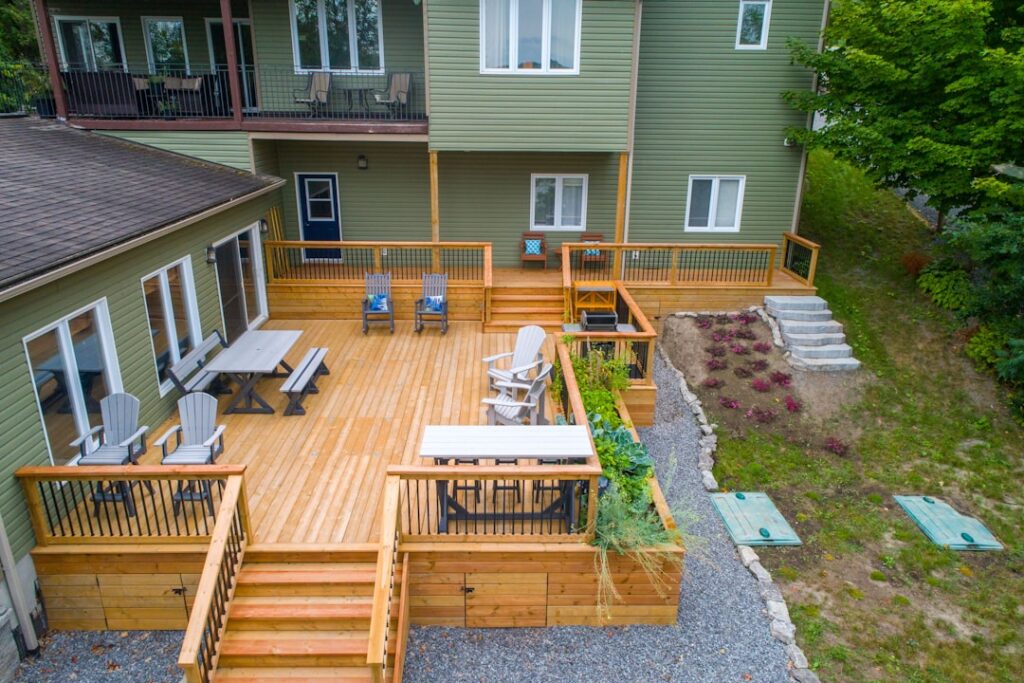
- Elevated and walkout decks — the classic second-story deck off a kitchen. Structure and stairs dominate the budget; the space underneath begs for an under-deck drainage ceiling to create a dry patio below.
- Multi-level decks — stepped platforms that zone dining, lounging, and hot-tub areas without railings between; expensive per square foot but the most livable big-deck format.
- Wraparound and pool decks — continuous circulation; PVC and aluminum earn their premium around water.
- Design details worth their cost: picture-frame borders (a contrasting perimeter board that hides cut ends), diagonal or herringbone board patterns, built-in benches and planters, integrated lighting in stair risers and post caps.
One more decision inside every plastic-decking choice: color and grain. Today’s better composite lines offer multi-tonal streaking that reads convincingly as wood at ten feet, and light colors run meaningfully cooler barefoot — a real consideration in the Sun Belt, where I steer everyone away from dark chocolate boards facing south.
Fasteners, Patterns, and the Small Choices That Show
Two smaller decisions punch above their weight on the finished look. First, fastening: face screws are cheapest and completely serviceable on wood, but on composite and PVC, hidden clip systems that grip a groove in the board edge give you an uninterrupted surface — a $2 to $4 per square foot upgrade that most people, seeing the two side by side, immediately want. Cortex-style plugged screws split the difference where face-fastening is unavoidable at borders and stairs. Second, board direction: running boards parallel to the house reads calm and traditional; diagonals and herringbone fields add visual energy and, usefully, stiffen the frame — at the cost of 10 to 15 percent more material waste. Neither choice costs much to think about and both are permanent, which is exactly the kind of decision worth making on paper instead of on delivery day.
How I’d Choose, by Situation
Budget-first and handy: pressure-treated frame and boards, built with flashing tape and quality fasteners, and the discipline to actually refinish it — nothing else touches the price. Busy family, staying ten-plus years: capped composite with aluminum railing, the combination that has quietly become the American default because it’s the maintenance sweet spot. Shade, coastal, or over-water sites: PVC. Modern architecture or a rooftop application: aluminum. Lovers of real wood who’ll pay for the look: cedar if you enjoy the ritual, ipe if you want wood that acts like stone. And whichever way you lean, order physical samples and lay them in your actual sun for an afternoon — heat and color in a backyard tell you things a showroom never will. A deck is a 25-year purchase disguised as a summer project; an hour of honest material comparison now is the cheapest part of the whole build.