Engineered quartz is one of the toughest countertop surfaces you can buy, but it is not indestructible. A dropped pot, a hot pan, or a settling cabinet can leave a chip, crack, burn, or a failing seam that mars an otherwise flawless surface. The good news is that quartz countertop repair is often possible without replacing the entire slab, and many minor issues can even be handled at home. This guide walks through the common damage types, repair methods, costs, and when to call in a professional.
Part of our Countertops guide — explore the full guide →
- Why Quartz Damages the Way It Does
- Repairing Chips
- Repairing Cracks
- Repairing Burns and Discoloration
- Repairing Seams
- What Quartz Repair Costs
- DIY vs. Hiring a Professional
- Common Mistakes to Avoid
- Preventing Future Damage
- Repairing Around Sinks and Cooktops
- Color Matching and Realistic Expectations
Why Quartz Damages the Way It Does
Quartz countertops are made of roughly 90 to 95 percent ground natural quartz bound with resins and pigments. That resin makes the surface non-porous and stain-resistant, but it is also the material’s weak point: the resin is heat-sensitive and can scorch or discolor under a hot pan, and the manufactured surface can chip at edges and around sink cutouts where it is thinnest. Understanding this helps you both prevent damage and choose the right repair, because a resin burn is handled differently than a structural crack.
Repairing Chips
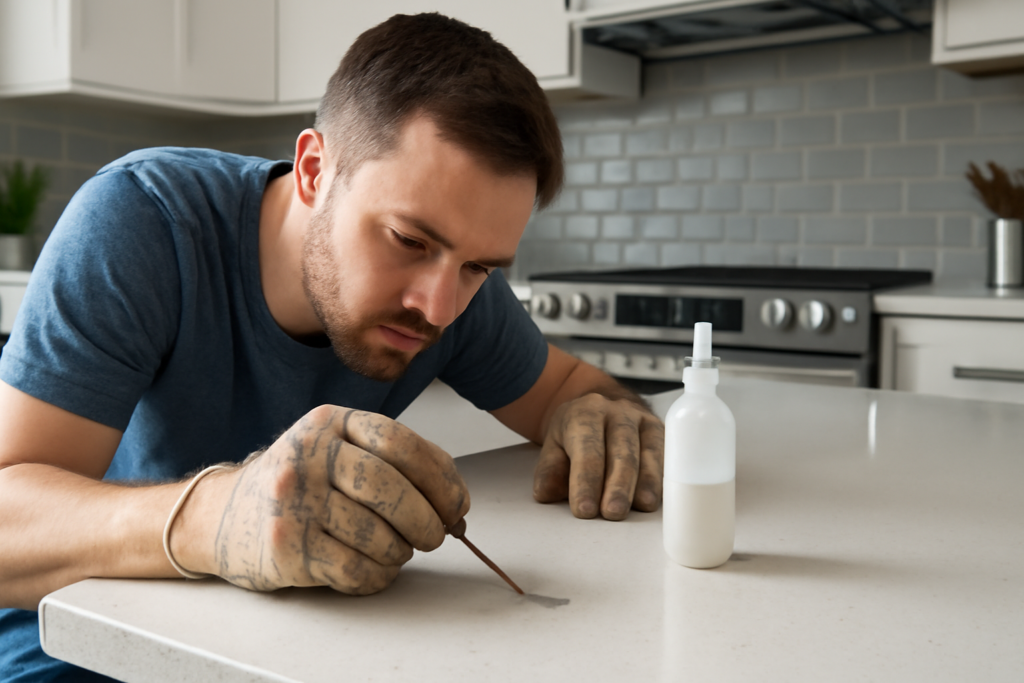
Chips are the most common quartz damage, typically appearing along the front edge or near the sink. Small chips can often be filled at home. The process uses a color-matched epoxy or acrylic adhesive:
- Clean the chip thoroughly with acetone or rubbing alcohol and let it dry so the filler bonds well.
- Mask around the chip with painter’s tape to protect the surrounding surface.
- Mix a clear or color-matched epoxy, tinting it if needed to match the quartz pattern.
- Fill the chip slightly proud of the surface, since the filler shrinks slightly as it cures.
- Let it cure fully, then carefully scrape and sand the excess flush with fine wet sandpaper and polish.
A DIY quartz repair kit runs about $15 to $40. For a highly visible chip or a busy multicolor pattern, a professional can better blend the fill.
Repairing Cracks
Cracks are more serious and often signal an underlying issue such as an unsupported span, a settling cabinet, or stress near a cooktop cutout. Hairline surface cracks can sometimes be stabilized and filled with clear epoxy much like a chip, but a crack that goes through the slab or continues to spread needs professional attention. A pro will inject epoxy, clamp and support the area, and address the root cause, such as adding support brackets under an unsupported overhang. Ignoring a structural crack risks the slab separating entirely, so do not just cosmetically fill a crack that keeps growing.
Repairing Burns and Discoloration
Because quartz resin is heat-sensitive, a hot pan can leave a white, yellow, or brown scorch mark. Light surface scorching can sometimes be reduced by gently buffing with a fine polishing compound, but deep burns that have discolored the resin are difficult to fully remove and may require a professional to grind and refinish the area or, in bad cases, replace the affected section. This is why manufacturers stress using trivets; a burn is one of the hardest quartz problems to fix invisibly. Never attempt aggressive sanding yourself on a burn, as you can create a dull, uneven patch that looks worse than the mark.
Repairing Seams
Where two quartz pieces meet, the seam is joined with color-matched epoxy. Over time a seam can develop a visible gap, lift at the edge, or discolor. A professional fabricator can re-seam by cleaning out the old epoxy, re-leveling the slabs, and applying fresh color-matched adhesive. A lifting or separating seam often indicates the substrate cabinets are not level or the slabs shifted, so the repair should include correcting the support. Seam repair is generally a job for a pro because achieving a tight, invisible line requires the right tools and color-matching skill.
What Quartz Repair Costs
Repair costs are far lower than replacement. A DIY chip repair kit is $15 to $40. Professional repairs vary by severity:
- Minor chip repair: roughly $100 to $250 for a pro visit.
- Crack repair: about $200 to $600 depending on length, location, and whether support work is needed.
- Seam repair or re-seaming: around $200 to $500.
- Burn refinishing: $150 to $500, with no guarantee of a perfect result on deep burns.
Compare that to $2,000 to $5,000 or more to replace a full quartz countertop, and even a professional repair is usually the sensible choice for localized damage.
DIY vs. Hiring a Professional
Small, non-structural chips and minor edge nicks are reasonable DIY projects with a repair kit and patience. Anything structural, in a highly visible spot, involving a multicolor pattern that is hard to match, or affecting seams and burns is better left to a professional stone fabricator or a countertop repair specialist. Professionals have color-matching systems, proper polishing tools, and the experience to make a repair nearly invisible. When in doubt, get a repair quote before attempting a DIY fix that could make the damage harder to correct later.
Common Mistakes to Avoid
The biggest mistake is using the wrong filler; ordinary hardware-store epoxy without color matching leaves an obvious blob. Use a quartz-specific kit or a pro. Another error is over-sanding around a repair and dulling the factory polish, which is very hard to restore on quartz. Homeowners also sometimes cosmetically fill a spreading crack without fixing the support underneath, so the crack returns. And attempting to remove a heat burn with aggressive abrasives usually enlarges the damaged area. Go slow and test in an inconspicuous spot.
Preventing Future Damage
The best repair is the one you never need. Always use trivets or hot pads under hot cookware, since heat is quartz’s main enemy. Use a cutting board rather than cutting directly on the surface, which can dull knives and, over time, mar the finish. Wipe up spills of harsh chemicals promptly, and avoid abrasive scrubbers that dull the polish. Reinforce or support overhangs longer than about 10 to 12 inches to prevent stress cracks. These simple habits keep quartz looking new for decades.
Repairing Around Sinks and Cooktops
The most damage-prone areas of a quartz counter are the cutouts, where the material is thinnest and stress concentrates. Around an undermount sink, the front edge and the corners of the cutout are common chip and crack sites, often from a dropped pot or from the sink pulling down over time if the mounting clips loosen. Around a cooktop, hairline cracks can radiate from the corners because of thermal stress and the reduced material width. Repairing these spots requires extra care: the fix must address not just the visible crack but the underlying support, so a professional will often reinforce the area with a rodded or bracketed support beneath the slab. If a sink is sagging, resecuring it before repairing the surface prevents the crack from simply reopening.
Color Matching and Realistic Expectations
Quartz comes in solid tones and in complex patterns with veining and speckles, and the pattern hugely affects how invisible a repair can be. A busy, multicolor quartz hides a well-blended epoxy repair remarkably well, since the eye is already reading a varied surface. A solid, uniform color, especially pure white or black, is the hardest to repair invisibly, because any slight difference in the fill shows against the even field. Set realistic expectations: a good repair on patterned quartz can be nearly undetectable, while a repair on solid white may remain faintly visible up close even when professionally done. Knowing this helps you decide whether to attempt a DIY fill, hire a pro, or, for a very prominent flaw in a solid color, consider replacing just the affected section.
Quartz countertop repair lets you fix chips, cracks, burns, and seams without the cost and disruption of replacing an entire slab. Tackle small chips yourself with a color-matched kit, but call a professional for structural cracks, seams, and burns where matching and support matter most. Combine timely repairs with heat protection and gentle care, and your quartz counters will stay beautiful for the long haul.