The quartzite vs quartz debate comes down to a fundamental question: do you want the one-of-a-kind beauty of a natural stone or the predictable consistency of an engineered surface? Both are durable, both look stunning in kitchens and bathrooms, and both command premium price tags — but they are fundamentally different materials with different strengths, weaknesses, and long-term value propositions.
This comparison guide is written specifically for homeowners weighing whether quartzite’s higher cost is justified. We cover composition, appearance, durability, maintenance, kitchen performance, and resale value so you can make a confident decision.
What Is Quartzite?
Quartzite is a natural metamorphic rock formed when sandstone is subjected to extreme heat and pressure deep within the earth. The quartz grains in the original sandstone fuse together into an interlocking crystalline structure that is extraordinarily hard — 7 on the Mohs hardness scale, harder than granite (6 to 7) and significantly harder than marble (3 to 5).
Each quartzite slab is unique. The natural formation process creates dramatic veining, mineral deposits, and color variations that cannot be replicated artificially. Popular quartzite varieties include Taj Mahal (warm white with gold veining), Sea Pearl (gray-green with ocean-like movement), Fantasy Brown (brown and gray swirls), and Super White (a marble-like appearance with superior hardness). These slabs are quarried, cut, and polished — no resins, pigments, or binders are added.
What Is Quartz?
Quartz countertops (also called engineered quartz) are manufactured products made from approximately 90 to 94 percent ground natural quartz crystals bound with 6 to 10 percent polymer resins and pigments. The mixture is poured into molds, compressed under vacuum, and cured to create dense, non-porous slabs.
Leading manufacturers include Caesarstone, Silestone, Cambria, and MSI. Because quartz is engineered, manufacturers have precise control over color, pattern, and consistency. You can order multiple slabs for a large kitchen knowing they will match perfectly. Popular styles include white quartz with subtle veining (designed to mimic marble or quartzite), solid colors, and aggregate patterns.
Side-by-Side Comparison Table
| Feature | Quartzite (Natural) | Quartz (Engineered) |
|---|---|---|
| Composition | 100% natural metamorphic stone | 90 – 94% ground quartz + resin binder |
| Hardness (Mohs) | 7 | 6 – 7 |
| Porosity | Slightly porous (requires sealing) | Non-porous (no sealing needed) |
| Heat resistance | Excellent — handles hot pots | Moderate — resins can scorch above 300 °F |
| Scratch resistance | Excellent | Very good |
| Stain resistance | Good when sealed; vulnerable when unsealed | Excellent — non-porous surface |
| UV resistance | Excellent — color does not fade | Limited — resin can yellow in direct sunlight |
| Appearance | Unique, dramatic natural veining | Consistent, controlled patterns |
| Slab matching | Difficult — each slab is unique | Easy — manufactured for consistency |
| Sealing required | Yes — every 1 to 2 years | No |
| Material cost (per sq ft) | $70 – $200+ | $50 – $150 |
| Installed cost (per sq ft) | $100 – $250+ | $75 – $175 |
Appearance: Natural Beauty vs Engineered Consistency
This is where the quartzite vs quartz decision often begins and ends for many homeowners. Appearance preferences are subjective, but the differences are objective.
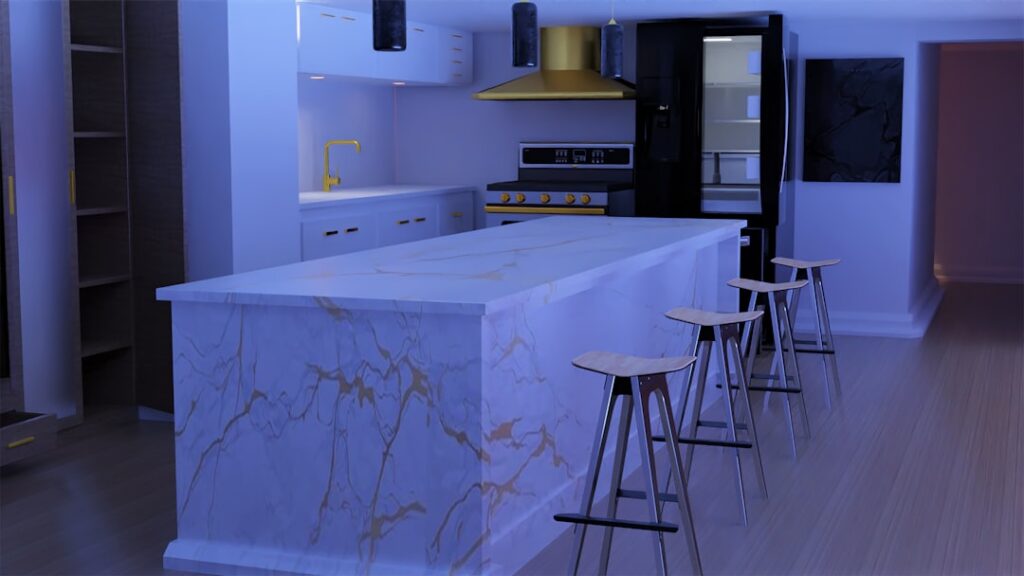
Quartzite offers depth, movement, and uniqueness that no manufactured product can fully replicate. Light passes into the crystalline structure and reflects back, creating a luminosity that is particularly striking in white and cream varieties like Taj Mahal and Mont Blanc. The veining is organic — sweeping, unpredictable, and sometimes dramatic. No two slabs are identical, and no two kitchens with quartzite will ever look the same.
The downside of uniqueness is unpredictability. You must select your specific slabs in person at a stone yard because photographs do not capture the color, veining, and translucency accurately. Adjacent slabs from the same block can differ noticeably, making large kitchens challenging to design with consistent aesthetics.
Quartz offers beauty through control. Modern manufacturing has advanced to the point where quartz can closely mimic the veining of marble, quartzite, and other natural stones — but it does so with reliable consistency. Every slab from a production run looks essentially identical, which simplifies design decisions, eliminates the need for slab-yard visits, and guarantees a cohesive look across large installations.
However, even the best engineered quartz lacks the depth and luminosity of natural quartzite. When you place a quartzite slab next to a quartz slab that was designed to mimic it, the natural stone’s translucency and dimensional quality are immediately apparent. Whether that difference justifies the premium is a personal call.
Durability and Hardness
Both quartzite and quartz are exceptionally durable countertop materials, but they resist different threats.
Quartzite wins on heat resistance. As a natural stone formed under extreme geological heat, quartzite handles hot pots, pans, and baking sheets without flinching. You can place a 500-degree pan directly on a quartzite surface without damage. Quartz, by contrast, uses polymer resins that can scorch, discolor, or crack above 300 degrees Fahrenheit. Trivets are recommended for quartz but optional for quartzite.
Quartzite wins on UV resistance. Natural stone does not fade in sunlight. Quartz resins can yellow or discolor when exposed to prolonged direct sunlight, making quartzite the better choice for outdoor kitchens and countertops near large windows.
Quartz wins on stain resistance. Quartz is non-porous — liquids sit on the surface and cannot penetrate. Quartzite is slightly porous and requires sealing. When properly sealed, quartzite resists stains well, but if the sealant wears off and a spill (red wine, citrus, coffee) sits on the surface, it can penetrate and stain.
Scratch resistance is comparable. Quartzite is slightly harder (7 Mohs vs 6 to 7 Mohs for quartz), giving it a marginal edge in scratch resistance. In practice, both surfaces resist scratches well, and neither should be used as a cutting board surface.
Maintenance Requirements
Maintenance is where the practical differences between these materials become most apparent in daily life.
Quartzite maintenance: Seal the surface every one to two years with an impregnating stone sealer (a 15-minute DIY process). Clean daily with a pH-neutral stone cleaner or mild dish soap and water. Avoid acidic cleaners (vinegar, lemon, bathroom cleaners) that can etch the surface over time. Wipe up spills promptly, especially wine, citrus, and tomato-based sauces. The maintenance is not burdensome, but it is not zero.
Quartz maintenance: No sealing required — ever. Clean with any non-abrasive household cleaner or simply soap and water. Quartz is almost maintenance-free. Use trivets for hot items and avoid abrasive scrubbing pads that can dull the finish. That is the extent of quartz maintenance.
For busy households that want beautiful countertops with minimal upkeep, quartz’s maintenance advantage is significant. For homeowners willing to spend 15 minutes once or twice a year on sealing and be mindful of spills, quartzite’s maintenance requirements are entirely manageable.
Kitchen Scenarios: Which Performs Better?
Different kitchen lifestyles favor different materials. Here are common scenarios and the better choice for each.
Avid home cook who uses heavy pots and baking sheets: Quartzite — its heat resistance means you can move pans from oven to counter without reaching for a trivet every time.
Family with young children: Quartz — the non-porous surface resists juice spills, marker stains, and the general chaos of kids without needing regular sealing.
Entertainer who hosts wine-and-cheese nights: Quartz — red wine spills are a non-issue on the non-porous surface. On unsealed quartzite, a red wine spill could leave a permanent mark.
Design-focused homeowner who wants a statement kitchen: Quartzite — the natural beauty and uniqueness of a quartzite slab like Taj Mahal or Sea Pearl create a visual centerpiece that engineered quartz cannot match.
Outdoor kitchen or sunlit breakfast bar: Quartzite — UV resistance prevents the fading and yellowing that affects quartz in direct sunlight.
Rental property or short-term ownership: Quartz — the lower cost and zero-maintenance nature make it the practical choice when you will not be living with the countertops for decades.
Cost Comparison
Quartzite is consistently more expensive than quartz, but the premium varies by variety and project scope.
| Cost Category | Quartzite | Quartz |
|---|---|---|
| Material (per sq ft) | $70 – $200+ | $50 – $150 |
| Fabrication (per sq ft) | $15 – $30 | $10 – $25 |
| Installation (per sq ft) | $15 – $25 | $15 – $25 |
| Total installed (per sq ft) | $100 – $250+ | $75 – $175 |
| Average kitchen (40 sq ft) | $4,000 – $10,000+ | $3,000 – $7,000 |
| Sealing (annual) | $15 – $30 (DIY) | $0 |
The premium for quartzite over quartz is typically 30 to 50 percent for comparable quality levels. Entry-level quartzite overlaps with premium quartz pricing, so the gap is not always dramatic. The most expensive quartzite varieties (rare slabs with exceptional veining) can exceed $200 per square foot, creating a wider gap. For most natural stone countertop projects, expect to pay $1,000 to $3,000 more for quartzite than for a comparable quartz design.
Long-Term Value and Resale Impact
Both quartzite and quartz add significant value to a home, but their long-term value curves differ.
Quartzite is perceived as a luxury, high-end material by home buyers and appraisers. Its natural stone status, rarity, and visual drama signal quality in the same way marble does — but with far better durability. Quartzite countertops in a well-maintained kitchen can last a lifetime (50+ years) and never look dated because the patterns are natural, not trend-driven.
Quartz is widely recognized as a premium countertop material, and it consistently appears in buyer preference surveys as a top-three desired feature. However, because quartz patterns follow design trends (the Calacatta look, concrete look, etc.), specific patterns may eventually feel dated. The material itself lasts 25 to 30+ years without issue.
In luxury home markets ($500,000+), quartzite countertops differentiate a listing and can contribute to faster sales. In the broader market, quartz is equally effective at attracting buyers because most consumers recognize it as a quality material. The difference in resale impact is measurable but modest — quartzite provides a slightly higher return in high-end markets, while quartz provides a better return relative to its lower cost in mid-range markets.
For additional options in the natural stone category, explore our quartzite countertops guide.
Frequently Asked Questions
Is quartzite more expensive than quartz?
Yes. Quartzite typically costs 30 to 50 percent more than quartz at comparable quality levels. Installed quartzite ranges from $100 to $250+ per square foot, while installed quartz ranges from $75 to $175 per square foot. The premium reflects quartzite’s natural rarity, higher fabrication difficulty, and unique beauty.
Is quartzite harder than quartz?
Yes, slightly. Quartzite rates 7 on the Mohs hardness scale, while quartz (engineered) rates 6 to 7. Both are extremely hard and scratch-resistant, but quartzite has a marginal edge. In practical use, the difference in scratch resistance is negligible.
Does quartzite need to be sealed?
Yes. Quartzite is slightly porous and should be sealed every one to two years with an impregnating stone sealer. The process takes about 15 minutes and costs $15 to $30 in materials. Without sealing, quartzite is vulnerable to staining from wine, citrus, and other pigmented liquids.
Can you put hot pots on quartzite?
Yes. Quartzite is formed under extreme geological heat and handles hot cookware without damage. This is one of its key advantages over quartz, which can scorch or discolor from direct heat above 300 degrees Fahrenheit. While trivets are always a good practice, quartzite does not require them.
Does quartz yellow in sunlight?
Some quartz products can yellow or fade when exposed to prolonged direct sunlight due to UV degradation of the polymer resin binder. This is primarily a concern for outdoor installations and countertops directly adjacent to large south-facing windows. Quartzite, as a natural stone, is completely UV-resistant.
Which is better for a kitchen: quartzite or quartz?
It depends on your priorities. Choose quartzite for unmatched natural beauty, heat resistance, and long-term uniqueness. Choose quartz for lower cost, zero maintenance, superior stain resistance, and consistent aesthetics. Both are excellent kitchen countertop materials.