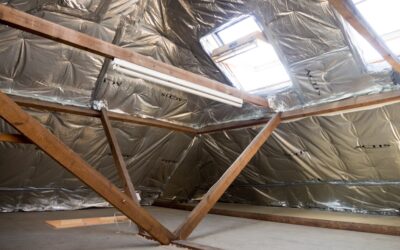
No home-efficiency product carries a wider gap between marketing claims and physics than attic foil. Sellers promise 30–50 percent energy savings; the measured reality is a 5–10 percent cut in cooling costs in hot climates, and close to nothing in cold ones. That doesn’t make radiant barrier insulation a scam — installed correctly in the right climate, it’s a legitimately cost-effective upgrade that drops attic temperatures 20–30°F and takes real load off your AC. It just isn’t insulation in the normal sense, and understanding the difference is the whole game. Here are the facts, minus the sales pitch.
How a Radiant Barrier Actually Works
Heat moves three ways: conduction (through materials), convection (moving air), and radiation (infrared energy across open space). Ordinary insulation — fiberglass, cellulose, foam — resists conduction and convection; that’s what R-value measures. A radiant barrier addresses only the third mode.
On a summer afternoon, your shingles hit 150–170°F. The hot roof deck then radiates infrared energy downward across the attic air space onto your insulation and ceiling below, like a broiler element. A radiant barrier is a sheet of aluminum with two relevant properties: low emissivity (it radiates only ~3–5 percent of the energy a normal surface would, versus ~90 percent for wood) and high reflectivity (it bounces ~95 percent of incoming infrared). Hang it under the roof deck and the broiler effect largely stops: the attic below runs 20–30°F cooler on peak afternoons.
Two physics rules follow directly:
- It needs an air gap. A radiant barrier sandwiched tight between two materials becomes a conductor — foil only works facing an open air space of at least 3/4 inch.
- It has no meaningful R-value. A single foil sheet is roughly R-0. Ignore any product quoting a big “equivalent R”; that’s the air space and test-condition fine print talking. This is also why dedicated foil sheets differ from foil-faced bubble products, which this site covers separately.
Climate Fit: Where Foil Earns Its Keep
| Climate | Cooling savings | Verdict |
|---|---|---|
| Hot-humid / hot-dry South (TX, FL, AZ, GA, southern CA) | 5–10% of cooling costs; more with attic ductwork | Worth doing |
| Mixed climates (TN, NC, MO, mid-Atlantic) | 2–5% | Marginal — only if ducts are in the attic and install is cheap |
| Cold North (MN, WI, New England) | ~1–2%, with a small winter penalty possible | Skip — spend on more attic insulation instead |
The single biggest multiplier is ductwork in the attic. If your AC ducts run through a 130°F attic, every degree you shave off attic temperature reduces duct heat gain directly. Homes with attic air handlers and leaky ducts see the top of the savings range; homes with ducts in conditioned space see the bottom.
In cold climates the math inverts: winter roof heat loss is dominated by conduction through insulation, which foil doesn’t slow, and blocking radiant gain on sunny winter days is a (small) negative. Northern attics want depth — get to R-49 or better first; the R49 insulation guide covers what that takes.
Install Patterns: Staple-Up vs. Deck-Applied
Staple-up foil (retrofit standard)
Rolls of reinforced foil ($0.15–$0.30/sq ft) staple to the underside of the rafters, draping slightly, with the air gap between foil and roof deck. Cover the rafter faces, leave a few inches open at the ridge and at the eaves so the ventilation path keeps flowing, and don’t block soffit intake — if your eaves are already tight, add insulation baffles to preserve the channel. DIY cost for a 1,500 sq ft attic: $250–$500 and two sweaty mornings. Pro install: $800–$2,000.
Perforated foil is mandatory here — the micro-perforations let water vapor pass so you don’t create a condensation plane above the ridge vent path.
Deck-applied (new construction / reroof)
Radiant-barrier OSB sheathing (LP TechShield and similar) comes with foil laminated to the underside — foil faces down into the attic, air gap automatic. It adds only $8–$15 per sheet over plain OSB, which makes it a no-brainer on any new build or full re-deck in the South. If you’re reroofing anyway, this beats stapling foil later on both cost and performance.
Over-the-insulation lay-down: don’t
Laying foil flat on top of attic insulation works briefly, then dust settles. A dusty radiant barrier loses most of its reflectivity within a few years — emissivity climbs with every gray layer. Every serious guideline says foil goes at the roofline, not the floor.
Real Numbers for a Real House
Take a 2,000 sq ft single-story in Dallas, $250/month summer electric bills, ducts in the attic:
- Cooling portion of summer bill: ~$150/month.
- Radiant barrier savings at 8 percent: ~$12/month in season, call it $60–$90/year.
- DIY staple-up cost: ~$400 → payback 5–7 years.
- Pro install at $1,500 → payback 15+ years — this is why quotes matter more than physics for retrofits.
Secondary benefits don’t show on the bill: the AC cycles less at peak (longer equipment life), rooms under the attic stay comfortable during heat waves the AC couldn’t previously hold, and shingle temperature rises only 2–5°F — no meaningful effect on shingle life, per industry testing.
Radiant Barrier vs. More Insulation: The Order of Operations
If your attic has less than code-level insulation, depth wins first — a jump from R-19 to R-49 outperforms foil everywhere in the country. The right sequence for a southern attic:
- Air-seal the attic floor (top plates, can lights, chases).
- Insulate to R-38–R-49 — see the attic insulation guide for methods and costs.
- Confirm ventilation: intake at soffits, exhaust at ridge.
- Then add the radiant barrier as the finishing layer if you’re in the hot half of the map.
Foil sold as a substitute for steps 1–3 is where the industry earns its bad reputation. Foil as step 4 is honest engineering.
Shopping Checklist
- Perforated, reinforced (scrim) foil, emissivity ≤ 0.05 stated on the datasheet.
- Double-sided foil for staple-up (top face works even after the bottom dusts—it faces down anyway; double-sided also forgives install orientation).
- Fire rating: Class A/Class 1 flame spread.
- Skip “paint-on radiant barriers” for DIY — interior radiation control coatings test at e≈0.15–0.25, meaningfully worse than foil’s 0.03–0.05.
- Beware bundled “energy audits” selling $3,000 foil jobs; the material under discussion costs a few hundred dollars.
DIY Staple-Up: The Two-Morning Method
If you’re doing the retrofit yourself, work in early morning before the attic heats — a southern attic is dangerous by 10 a.m. in summer, so this is genuinely a two-morning or off-season project. Tools: a hammer stapler or electric staple gun with 5/16-inch staples, a utility knife with spare blades, a straightedge, headlamp, knee boards to span joists, and a helper to feed rolls. Start at one gable end and run foil perpendicular to the rafters in horizontal courses, beginning at the top: staple the first course a few inches below the ridge (leaving the ridge-vent gap open), overlap the next course 2 inches over the one above, and continue down, stopping short of the insulation line at the eaves so soffit air flows freely. Staple every 12–18 inches into rafter faces, let the foil sag slightly between rafters — the droop actually adds a second reflective air space — and don’t fight for perfection around wiring and bracing; a 95 percent coverage job delivers 95 percent of the benefit. Cut around junction boxes, keep foil 3 inches clear of recessed light housings and flues, and never staple over knob-and-tube wiring. A 1,500 sq ft attic takes two people roughly 6–8 working hours. The finished job should look like a loosely-lined tent interior: shiny side down, gaps top and bottom, and daylight still visible at the soffits.
FAQ
Will a radiant barrier interfere with my WiFi or cell signal?
A full foil layer at the roofline can measurably attenuate signals passing through the roof. Most homes notice nothing because signal enters through walls and windows; rural homes relying on a rooftop cellular path occasionally do.
Does it cause roof condensation?
Not when you use perforated foil and preserve soffit-to-ridge ventilation. Solid (non-perforated) foil in a humid attic is asking for trouble.
Radiant barrier or solar attic fan?
Barrier first — it’s passive, cheaper, and addresses the cause. Fans move the symptom around and cost watts to run.
How long does it last?
Aluminum doesn’t degrade; stapled foil lasts the life of the roof structure. The only aging mechanism is dust, which is why roofline mounting (foil facing down, where dust can’t settle on the working face) keeps performance essentially permanent.
Radiant barrier insulation is a hot-climate finishing move: modest, real, and cheap if you staple it yourself. Get the depth and the air sealing right first, hang the foil facing an air gap, and let the attic run 25 degrees cooler every July afternoon.