Walk into a modern kitchen or living room and you will notice the ceiling is smooth and uncluttered, yet the room is bright and evenly lit. That effect comes from fixtures installed up inside the ceiling itself. Understanding the recessed lighting meaning is simple once you picture it: recessed lighting is any light fixture mounted into a hollow opening in the ceiling so the light shines down while the fixture body stays hidden above the surface. People also call these “can lights” or “pot lights,” and they are the backbone of clean, contemporary lighting design.
What Recessed Lighting Actually Means
The word “recessed” is the whole idea. Instead of a fixture that hangs down or mounts flat against the ceiling, a recessed light sits inside a cavity, flush with the ceiling plane. Only a trim ring and the light itself are visible from below, giving the room a streamlined look with no protruding fixture. Because the housing lives in the space above the drywall, recessed lights free up visual space and headroom, which is why designers reach for them in rooms where a bulky fixture would feel intrusive.
The Parts of a Recessed Light
A traditional recessed light is built from a few distinct components, and knowing them helps you shop and troubleshoot:
- Housing — the metal canister mounted above the ceiling that holds the electrical connection and the lamp
- Trim — the visible ring or insert at the ceiling surface that finishes the opening and shapes the beam
- Bulb or LED module — the light source itself, increasingly a built-in LED rather than a replaceable bulb
Modern LED disc or wafer lights have simplified this. These slim units combine the light and trim into one thin fixture that clips into the ceiling opening and connects to a small junction box, eliminating the bulky can entirely.
Housing Types
If you go with traditional cans, the housing type depends on your ceiling and insulation. New-construction housings mount to joists before drywall goes up, while remodel housings clip into an existing finished ceiling through the cut hole. Just as important is the insulation rating: an IC-rated housing may be in direct contact with insulation without a fire risk, while a non-IC housing requires clearance around it. In an insulated attic, always choose IC-rated, and for energy efficiency look for airtight housings that stop conditioned air from leaking into the attic.
Trim Styles and What They Do
The trim is where you control both looks and light behavior. Different trims serve different jobs:
- Baffle trim — a ribbed interior that absorbs glare, the most common choice for general room lighting
- Reflector trim — a shiny interior that maximizes brightness, good for kitchens and task areas
- Adjustable or gimbal trim — tilts to aim light at art, a fireplace, or a wall
- Wall-wash trim — throws light across a wall to highlight texture or a bookshelf
- Shower trim — a sealed lens rated for wet locations above a tub or shower
Choosing the right trim lets one type of fixture do everything from soft ambient light to sharp accent lighting.
Where Recessed Lighting Works Best
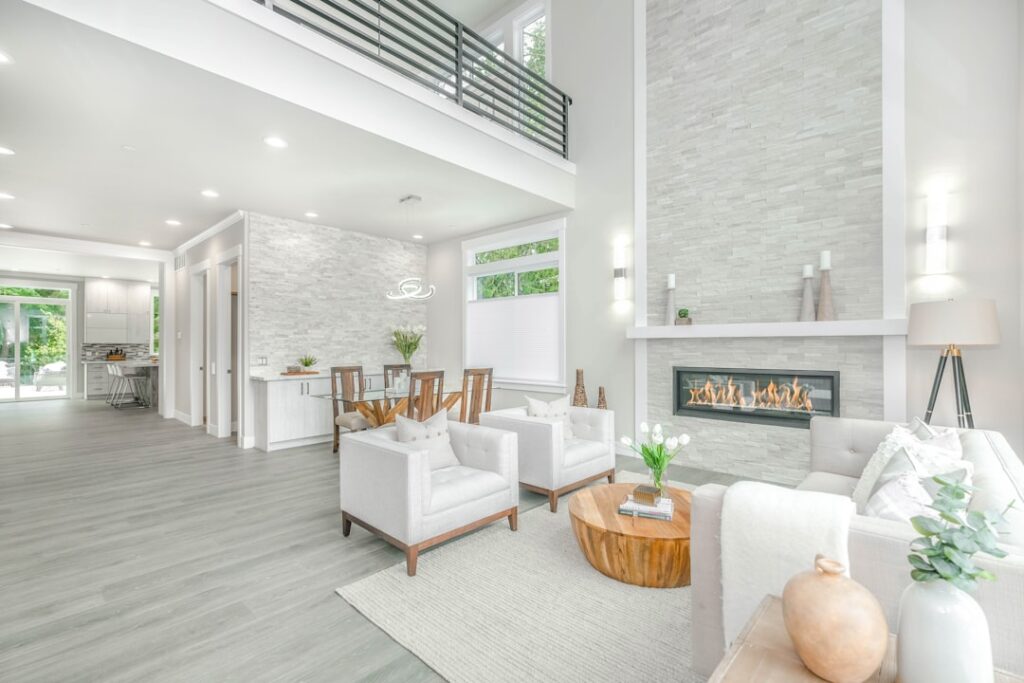
Because it disappears into the ceiling, recessed lighting is ideal for spaces with low ceilings, open floor plans, and clean modern aesthetics. It excels at general ambient light spread evenly across a room, at task lighting over kitchen counters, and at accent lighting aimed at features. Many rooms use a layered approach, combining several recessed cans for overall illumination with a decorative pendant or chandelier as a focal point. In a kitchen, for example, a grid of recessed lights handles the workhorse lighting while a fixture over the island adds character.
Spacing and Planning
Getting even light means spacing the fixtures thoughtfully. A common rule of thumb divides your ceiling height by two to get the spacing between lights, so an 8-foot ceiling suggests roughly 4 feet between fixtures. Keep cans about 2 to 3 feet off the walls to avoid harsh scallops, and plan the layout on paper before cutting a single hole. Over a work surface like a counter, position the lights slightly forward so your body does not cast a shadow onto the task area.
Color Temperature and Dimming
The feel of a room depends heavily on the light’s color temperature. Warm 2700K to 3000K light suits living rooms and bedrooms, while cooler 3500K to 4000K works for kitchens and workspaces. Many modern LED recessed lights offer selectable color temperature on the fixture itself. Pair them with a compatible dimmer and you can take the same lights from bright task mode to soft evening ambiance.
Recessed Lighting Versus Other Fixtures
Understanding the term also means knowing when recessed is the right tool and when it is not. Compared to a flush-mount ceiling fixture, recessed lights spread illumination more evenly and disappear visually, but a single flush mount is cheaper and simpler to install. Compared to pendants and chandeliers, recessed lights provide broad, functional light without becoming a focal point, which is why designers pair the two: cans for coverage, a decorative fixture for style. Track lighting offers similar aimability to gimbal recessed trims but sits below the ceiling rather than inside it. For a clean look with maximum flexibility, recessed remains the versatile backbone.
Installation and Cost Snapshot
Knowing what installing recessed lights involves rounds out the picture. Retrofitting into an existing finished ceiling uses remodel-rated housings or slim LED wafers that need only a hole cut with a hole saw and a connection to a junction box. New construction lets you mount housings to the joists before drywall, which is easier. Expect roughly $100 to $200 per fixture installed by an electrician, less if you do the labor yourself on an accessible circuit. Wafer-style LEDs have made DIY installation far more approachable, since they eliminate the bulky can entirely.
The Bottom Line
Now that the recessed lighting meaning is clear, it is easy to see why it dominates modern homes. These fixtures tuck into the ceiling for a clean, unobtrusive look while delivering flexible ambient, task, or accent light depending on the trim you pick. Whether you install traditional cans or the newer slim LED wafers, thoughtful spacing and the right color temperature turn a flat ceiling into well-lit, comfortable space.