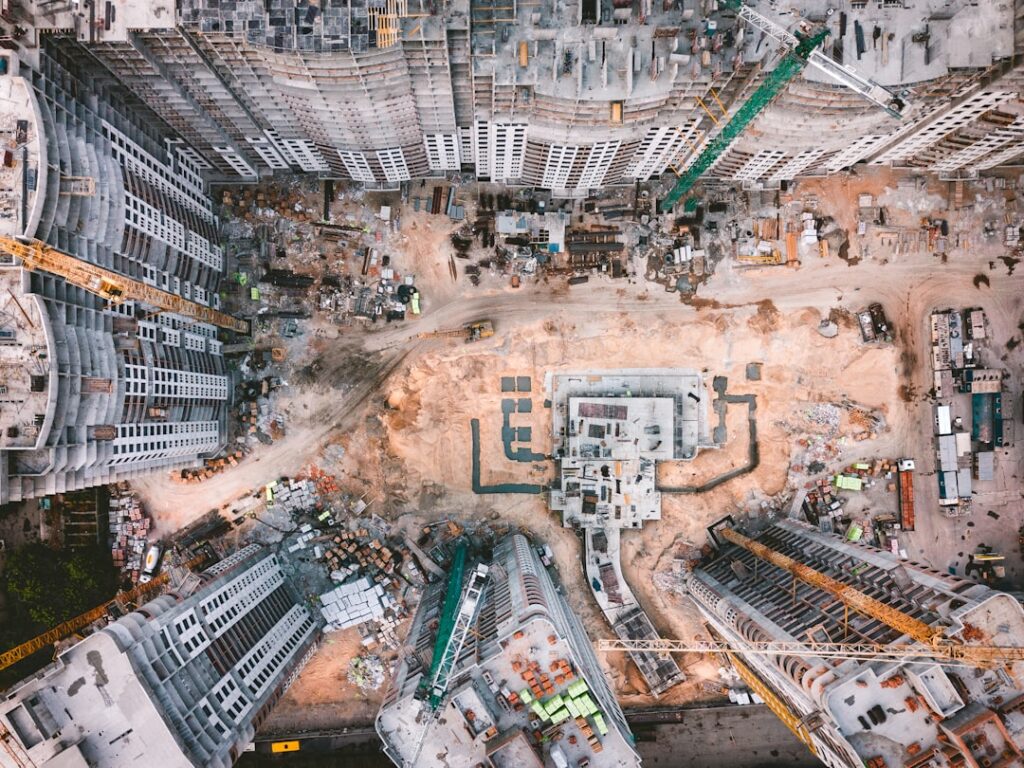
Concrete is a strange material: crush it and it shrugs off thousands of pounds per square inch, but pull or bend it and it snaps at a tenth of that. Reinforced concrete solves the problem by embedding steel — which is superb in tension — exactly where the concrete wants to tear. Every driveway that doesn’t shear at the crack, every footing that bridges a soft spot, every suspended slab in existence works because steel and concrete split the job. This guide explains why reinforcement matters, when rebar, wire mesh, or fibers is the right choice, and the placement rules that make reinforcement actually work instead of just riding along in the pour.
Why Concrete Needs Reinforcement: Tension
A typical 4,000 PSI slab resists about 4,000 pounds per square inch of compression but only 300-500 PSI of tension — roughly 10%. Real slabs live in bending: a wheel load on a driveway, soil settling under one corner, frost heaving one edge. Bending puts the bottom (or top) of the slab in tension, and tension is where concrete fails first. Steel rebar, by contrast, yields at 60,000 PSI in tension (Grade 60). Cast the steel into the tension zone and the pair behaves like a single composite material: concrete handles compression, steel catches the tension, and — critically — steel holds cracks tightly closed after they form so the slab keeps acting as one piece.
That last point deserves emphasis: on grade-supported residential slabs, reinforcement’s main job is usually crack control, not preventing cracks. Concrete shrinks about 1/16″ per 10 feet as it cures; it will crack somewhere. Reinforcement keeps those cracks hairline and interlocked instead of wide, offset, and growing. Joints do the other half of that job — see our concrete expansion joint guide for spacing.
Rebar: Sizes, Grades, and Where It Goes
Rebar is numbered in eighths of an inch of diameter. Residential work lives almost entirely in three sizes:
| Size | Diameter | Weight/ft | Typical residential use |
|---|---|---|---|
| #3 | 3/8″ | 0.376 lb | Driveways, patios, sidewalk mats, stirrups |
| #4 | 1/2″ | 0.668 lb | Footings, slabs, foundation walls, piers — the default bar |
| #5 | 5/8″ | 1.043 lb | Heavier footings, retaining walls, grade beams |
Grade 60 (60,000 PSI yield) is the standard; 20-foot sticks of #4 cost roughly $8-14 each depending on the steel market, and home centers stock 2-, 4-, and 10-foot lengths at a per-foot premium. Typical layouts:
- Driveways/thick patios: #3 or #4 bar in a grid at 12-18″ on center, mid-depth of the slab.
- Footings: two or three #4 bars running continuously, 3″ up off the soil, lapped 24″ (about 40 bar diameters) at splices and bent around corners.
- Foundation and retaining walls: #4 or #5 vertical bars tied into the footing plus horizontal bars per plan — engineered territory. Wall layouts appear in our concrete wall guide.
- Piers and footings for decks: vertical #4s in the tube; details in concrete piers.
Cut rebar with an angle grinder or rebar cutter; tie intersections with 16-gauge tie wire and a twist tool. Wear safety glasses — grinder sparks and whipping wire ends earn their reputation.
Welded Wire Mesh
Welded wire reinforcement (WWR) is a grid of steel wires welded at intersections — the classic sheet is 6×6 W1.4/W1.4: 6″ squares of roughly 10-gauge wire. Sheets (5’x10′, about $10-15) beat rolls, which fight you with memory curl and rarely sit flat. Mesh suits slabs where loads are modest and the goal is shrinkage-crack control: patios, sidewalks, shed pads, garage floors.
The catch is position. Mesh only works in the middle-to-lower third of the slab thickness, and the time-honored practice of “hooking it up” with a rake mid-pour mostly leaves it lying on the subgrade doing nothing. Support it on chairs or dobies (small concrete blocks, ~$0.30-0.60 each) every 2-3 feet before the pour. Unsupported mesh is decoration.
Fiber Reinforcement
Fibers are mixed throughout the concrete rather than placed in it:
- Synthetic microfibers (polypropylene, ~$8-12 per yard of concrete): millions of hair-fine strands that dramatically reduce plastic-shrinkage cracking in the first hours. They do not add meaningful structural capacity.
- Synthetic macrofibers: heavier polymer strands that can replace light mesh for temperature/shrinkage duty in flatwork when dosed per manufacturer specs.
- Steel fibers: industrial floors and shotcrete; overkill and finish-hostile for house projects.
Bagged products like Quikrete Crack-Resistant and Sakrete Crack Resistant come pre-fibered — convenient for sidewalks and small pads, and both are covered in our Quikrete concrete mix and Sakrete guides. The rule to tattoo on the project plan: fibers control shrinkage cracks; they are not a substitute for rebar where structure is involved — footings, walls, piers, cantilevers, or any slab spanning soft ground.
Which Reinforcement for Which Project
| Project | Recommended reinforcement |
|---|---|
| Sidewalk, 4″ on good base | Fibers, or 6×6 mesh on chairs; joints every 4-6 ft |
| Patio, 4″ | Fiber mix or mesh; #3 grid if soil is questionable |
| Driveway, 4-5″ | #3-#4 grid 12-18″ o.c. mid-depth (mesh acceptable on excellent base) |
| Garage slab | #4 @ 16″ o.c. or heavy mesh on chairs |
| Footings | 2-3 continuous #4 bars, always |
| Retaining/foundation walls | #4-#5 vertical + horizontal per engineering |
| Steps | #3-#4 grid tied into a solid base |
Placement Rules That Make or Break It
- Cover: steel needs concrete around it to bond and to resist rust — minimum 3″ of cover against earth, 1.5-2″ against forms or exposed faces. Steel touching soil or air rusts, expands, and spalls the concrete off (rebar rust jacking).
- Chairs and dobies: support every bar and sheet at the design height before concrete arrives. Nobody positions steel accurately during a pour.
- Laps: overlap spliced bars 40 diameters — 20″ for #4 — and tie them. Butted bars transfer nothing.
- Corners: bend bars around footing and wall corners or add L-shaped corner bars; corners are natural crack magnets.
- Keep it out of joints: stop reinforcement at expansion/isolation joints, otherwise the steel pins together what the joint is trying to let move.
- Base beats steel: no reinforcement rescues a slab on mud. Compacted gravel and uniform bearing do more for a driveway than doubling the rebar — the groundwork is covered in our concrete slab guide.
Does Every Slab Need Reinforcement?
Honest answer: a 4″ slab on well-compacted base carrying foot traffic can perform for decades with nothing but proper joints — plenty of 60-year-old unreinforced sidewalks prove it. Reinforcement buys insurance against the things you can’t guarantee: soil movement, tree roots, loads at edges, marginal compaction. Given that steel or fiber adds maybe 5-10% to a project’s cost, most pros reinforce everything beyond a stepping-stone pad. Anything structural — footings, walls, piers, suspended sections — isn’t a judgment call; codes require steel, and inspectors look for it before the pour.
Reinforced Concrete FAQ
Rebar vs mesh for a driveway — which wins?
Rebar. A #3 or #4 grid holds position better, survives the pour, and bridges subgrade weak spots that snap light mesh. Mesh is acceptable on a thick, well-compacted base with careful chair support; rebar forgives more.
Can I use fiber mix and skip everything else?
For a sidewalk or small patio on good base — yes, with proper joints. For driveways, garages, and anything carrying real loads or crossing suspect soil, add steel.
Does rebar rust inside concrete?
Not with adequate cover — concrete’s high pH passivates steel. Rust starts when cover is thin, cracks stay wide, or deicing salts reach the bar. Epoxy-coated (green) bar adds protection where chlorides are heavy.
What about fiberglass (GFRP) rebar?
It’s real: no rust, lighter than steel, similar cost these days. It can’t be field-bent and behaves differently in design, so use straight-run applications or follow an engineered spec.
Reinforcement is cheap while the forms are open and impossible after the truck leaves. Decide what the concrete must survive, put the right steel in the right place at the right height, and the slab keeps its cracks to itself for the rest of its life.