A well-executed vintage kitchen does not look like a costume party. The best retro kitchen decor blends one strong era reference with modern function so the space stays usable for daily cooking. Get the proportions wrong and the room reads as kitsch. Get them right and you have a kitchen that looks magazine-worthy and does not date itself the way an all-grey-shaker remodel will in five years.
Part of our Kitchen Remodeling guide — explore the full guide →
This guide breaks down the three dominant retro eras, the colors and materials that define each, and the modern hacks that make them livable in 2026.
Pick One Era and Commit
The biggest mistake homeowners make is pulling in pieces from across three different decades. A 1955 chrome dinette set next to 1972 harvest gold appliances reads as random rather than designed. Pick a single decade and let one or two contrast pieces from adjacent years create interest.
- 1940s: white cabinets, red accents, scalloped edges, painted wood floors
- 1950s diner: chrome, red and turquoise vinyl, checkerboard tile, pastel appliances
- 1960s mod: bold geometrics, white laminate, oranges and avocado green
- 1970s warm earth: harvest gold, avocado, brown wood paneling, mushroom motifs
Color Palettes That Actually Read as Vintage
Authentic mid-century paint colors are softer and more muted than the saturated versions sold today as “retro.” Sherwin-Williams Resort Tan SW 7550 nails 1950s warmth. Benjamin Moore Buxton Blue HC-149 captures the powder-blue Frigidaire era. For 1960s pop, look at Behr Kumquat M210-7 or Farrow & Ball Charlotte’s Locks.
Pair one bold color with two neutrals. A turquoise kitchen with white cabinets and chrome hardware looks intentional. The same turquoise paired with red, yellow, and pink reads as a clown car.
Appliances: The Centerpiece of Any Vintage Kitchen
You have three paths to retro appliances, each with cost and reliability tradeoffs.
True vintage hunting means scouring estate sales and Facebook Marketplace for working 1950s GM Frigidaires or 1965 Hotpoints. Expect $400 to $2,500 per piece, plus $200 to $600 in restoration. They look unbeatable but need a vintage appliance specialist for repairs.
Reproduction lines from Big Chill, Smeg, and Elmira Stove Works give you the look with modern internals. Smeg’s FAB28 fridge runs $2,400 to $3,200 in a dozen colors. Big Chill’s classic stove starts around $4,800 but plugs into a standard outlet and includes self-cleaning.
The budget option is sticker treatments and replacement handles on existing appliances. Chrome handle kits run $30 to $60 and instantly add a 1950s vibe to a generic white fridge.
Cabinets and Countertops Done Right
Skip the Shaker doors entirely. Retro kitchen decor demands flat-front or slab cabinets with simple chrome bar pulls or porcelain knobs. Paint existing cabinets in a glossy enamel like Benjamin Moore Advance, which holds up to grease and cleans easily.
For countertops, period-correct options include classic boomerang Formica laminate (still made by Wilsonart in original 1950s patterns at $4 to $7 per square foot), butcher block, or solid color quartz with a subtle aggregate. Save the marble for traditional kitchens. Real marble in a 1965-style room fights the era.
Flooring That Anchors the Look
Black and white checkerboard tile is the obvious choice for diner-era kitchens, but it gets overdone. Consider these alternatives that read just as vintage but feel fresher.
- Sheet vinyl in marbled patterns, sold by Armstrong and Tarkett, $3 to $5 per square foot
- Linoleum in solid colors with a contrast border, real linoleum from Forbo Marmoleum at $5 to $8
- Painted plywood floors in glossy red oxide or robin’s-egg blue, total cost under $200
- VCT tile in 12×12 squares, the same flooring used in 1960s schools, around $1.50 per square foot
Hardwood works for warmer 1940s and 1970s kitchens. Stay away from wide-plank rustic looks, which scream farmhouse rather than retro.
Lighting Sets the Era
One properly chosen pendant transforms a kitchen. For 1950s, hunt for milk glass globes or cone-shaped chrome pendants. Schoolhouse Electric reproduces these starting at $189. The 1960s love a sputnik chandelier or oversized starburst, while the 1970s embrace amber glass and brass.
Layer in under-cabinet lighting too. Modern LED tape hidden behind a vintage-style valance gives you period-correct brightness without sacrificing function. Aim for 3000K warm white, never the bluish 5000K daylight tone, which kills any retro mood instantly.
Accessories: The Cheapest Way to Add Character
Display vintage Pyrex on open shelves. The original 1950s and 1960s pieces sell for $15 to $80 each on eBay, and a small collection of three or four mixing bowls instantly grounds the room. A reproduction Sunbeam Mixmaster, a chrome canister set, and a wall clock with simple Arabic numerals fill out the look.
Curtains in red gingham, cotton stripes, or a single bold print like Marimekko’s Unikko bring the windows in line. Skip valances, which read as 1990s country rather than mid-century.
Common Mistakes That Sink the Look
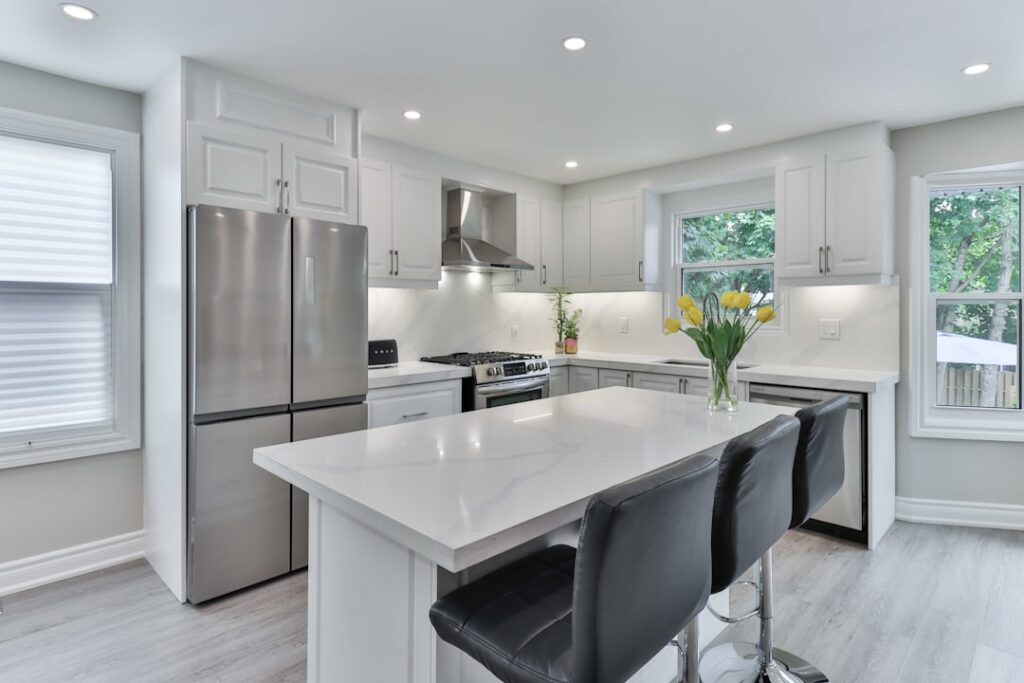
Three things kill the most well-intentioned retro kitchens. Stainless steel appliances in any quantity destroy the era reference. Granite countertops with their busy speckle patterns fight every vintage style. And modern recessed can lighting in straight grids reads contemporary no matter what else is in the room.
Address those three first, even on a tight budget. Swapping a stainless fridge for white, replacing speckled granite with solid quartz or laminate, and removing two of every four can lights gets you 80 percent of the way to a convincing retro kitchen decor scheme. Add accessories last, after the bones are right.