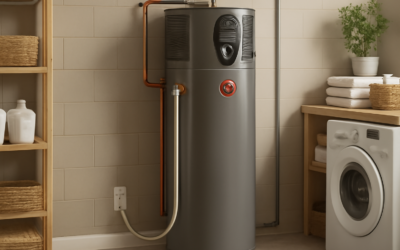
If you are staring down a failing tank and trying to decide whether to spend real money, the rheem heat pump water heater is one of the smartest upgrades I install these days. The ProTerra hybrid line sips electricity compared to a standard electric tank, and between the energy savings and a federal tax credit, it can pay for the premium faster than most people expect. Here is what you actually need to know before you buy one.
- How a Hybrid Heat Pump Water Heater Works
- Picking the Right Size: 40, 50, 65, or 80 Gallon
- What It Costs and How the Numbers Work
- The 25C Tax Credit and Utility Rebates
- Install Requirements People Overlook
- The Ambient Temperature Catch
- Modes, Controls, and Day-to-Day Use
- Recovery Time and Real Efficiency Expectations
- My Bottom Line
How a Hybrid Heat Pump Water Heater Works
A conventional electric water heater uses resistance elements, basically giant versions of the coils in a toaster, to heat water directly. That is simple but expensive to run. A heat pump water heater flips the approach. It uses a small compressor and fan on top of the tank to pull heat out of the surrounding air and move it into the water, the same way your refrigerator moves heat, just in reverse.
Because it is moving heat instead of creating it, a heat pump is roughly three to four times more efficient. That efficiency shows up in the UEF rating (Uniform Energy Factor). A standard electric tank runs a UEF around 0.90 to 0.95. The ProTerra hits a UEF near 4.0 on the 50-gallon model. That number is the whole story: you get about four units of hot water heat for every unit of electricity you pay for.
The “hybrid” part means it still has backup resistance elements. On a normal day it runs in efficient heat-pump mode. When you have a house full of guests draining the tank, it can kick in the electric elements to keep up. You control that balance through the top-panel dial or the app.
Picking the Right Size: 40, 50, 65, or 80 Gallon
Rheem offers the ProTerra in four common capacities, and sizing matters more with a heat pump than with a standard tank because the recovery is slower in efficient mode. Here is how I size them:
- 40 gallon: Good for 1-2 people, an apartment, or a small condo. Tight footprint but limited buffer.
- 50 gallon: The sweet spot for most families of 2-4. This is the model I install most often, and its first-hour rating covers back-to-back showers.
- 65 gallon: A family of 4-5, or a household with a big soaker tub. Taller unit, so check ceiling clearance.
- 80 gallon: Larger households of 5+ or homes with high peak demand. It is a big tank, often 6 feet tall, so measure your space carefully.
When in doubt, go one size up rather than down. The heat pump recovers slower than a gas unit, so the extra stored gallons cover your peak morning demand without forcing the resistance elements on, which is where you lose efficiency.
What It Costs and How the Numbers Work
Equipment pricing on the ProTerra typically runs $1,600 to $2,500 depending on size and where you buy. Professional installation adds roughly $600 to $1,500 depending on your local labor rates, whether you need a new 240-volt/30-amp circuit, and any condensate or venting work. So a fully installed job commonly lands between $2,500 and $4,000.
That sounds steep next to a $600 standard electric tank, but run the operating math. A typical household spends around $500 or more per year heating water with resistance electric. A heat pump water heater usually cuts that to $110 to $150 per year. Saving $350 or more annually adds up fast, and that is before incentives.
The 25C Tax Credit and Utility Rebates
This is where the deal gets good. The federal Energy Efficient Home Improvement Credit (25C) covers 30 percent of the project cost, up to $2,000 per year for a qualifying heat pump water heater. The ProTerra models meet the efficiency threshold, so a $3,300 installed job could net you roughly $990 back at tax time, capped at that $2,000 ceiling.
Stack that with local utility rebates, which frequently run $300 to $1,000 for switching from resistance electric to a heat pump, and your out-of-pocket cost can drop dramatically. Keep every receipt and the manufacturer’s certification statement, and confirm current eligibility rules for the tax year of your install, because these programs get updated. Check your utility’s website before you buy; some require pre-approval.
Install Requirements People Overlook
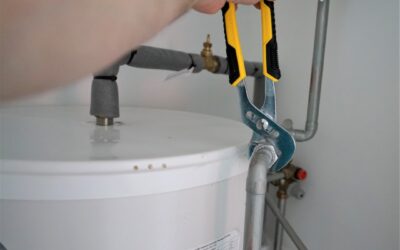
A heat pump water heater is not a like-for-like swap, and the install details are where jobs go sideways. Before you commit, walk through these:
- Air space: The unit pulls heat from the surrounding air, so it needs volume, generally around 700 to 1,000 cubic feet of open space, or ducting kits to draw and exhaust air. A sealed closet will starve it and force the elements on.
- Condensate drain: Because it dehumidifies the air, it produces condensate, sometimes a gallon or more a day. You need a floor drain, a condensate pump, or a nearby drain line.
- Electrical: It runs on a 240-volt, 30-amp circuit. If you are replacing a gas unit, you will need an electrician to run a new circuit.
- Noise: The fan and compressor make roughly 45 to 55 dB, similar to a window AC or dishwasher. Do not put it next to a bedroom wall.
- Clearance and height: These tanks are taller than standard. Measure before delivery day.
The Ambient Temperature Catch
Here is the one thing salespeople gloss over: a heat pump water heater works best in warm surrounding air. The ProTerra operates most efficiently when ambient temperature stays between about 40°F and 90°F. Below roughly 40°F, the heat pump struggles and the unit leans on its resistance elements, which erases your efficiency advantage.
That makes location critical. An unconditioned garage in a cold climate is a poor spot. A basement, a mechanical room, or anywhere that stays above 50°F year-round is ideal. As a bonus, the unit’s cooling and dehumidifying byproduct is welcome in a humid basement in summer, but that same effect can add a slight chill in winter. Match the machine to a space that stays reasonably warm and you will get the full UEF 4.0 payoff.
Modes, Controls, and Day-to-Day Use
The ProTerra gives you several operating modes, and knowing when to use each one is how you maximize savings. Energy Saver mode runs the heat pump alone and only fires the elements when demand outpaces recovery; this is where you live most of the year. Heat Pump mode locks out the resistance elements entirely for maximum efficiency, ideal if your household demand is modest. High Demand mode leans harder on the elements for houseguests, and Electric mode turns it into a standard resistance tank for emergencies. There is also a Vacation setting that idles the tank and reheats before you return.
The built-in Wi-Fi and the EcoNet app let you monitor energy use, get leak alerts, and schedule modes from your phone. I tell clients to leave it in Energy Saver, watch the app for a month, and only switch to High Demand if they actually run out of hot water. Most never need to. The leak-detection alert alone has saved a couple of my customers from a flooded basement.
Recovery Time and Real Efficiency Expectations
Set expectations on recovery. In efficient heat-pump mode, a ProTerra recovers slower than a gas tank, which is exactly why sizing up matters. A 50-gallon unit delivers a first-hour rating in the mid-60-gallon range, enough for two or three back-to-back showers, but if you drain it hard the heat pump alone needs a couple of hours to fully recover. That is the tradeoff for the low operating cost.
Set the tank temperature to 120°F for a good balance of safety, efficiency, and available hot water. Every 10°F higher costs you efficiency and raises scald risk. If you have a large soaker tub, a mixing valve set slightly higher with 120°F at the taps is the smarter play than cranking the whole tank. Done right, a household that was spending $500-plus a year on resistance electric routinely drops to that $110-150 range, and the app will show you the proof month over month.
My Bottom Line
For most homeowners with a basement or a warm utility space and a 240-volt circuit already nearby, the rheem heat pump water heater is an easy recommendation. The efficiency is real, the ProTerra build quality is solid, and the combination of energy savings, the 25C tax credit, and utility rebates can shrink the effective cost below a premium standard tank. Get the sizing right, respect the ambient-temperature and condensate requirements, and you are looking at a decade-plus of cheap hot water. Just do not stuff it in a freezing garage and expect the numbers to hold.