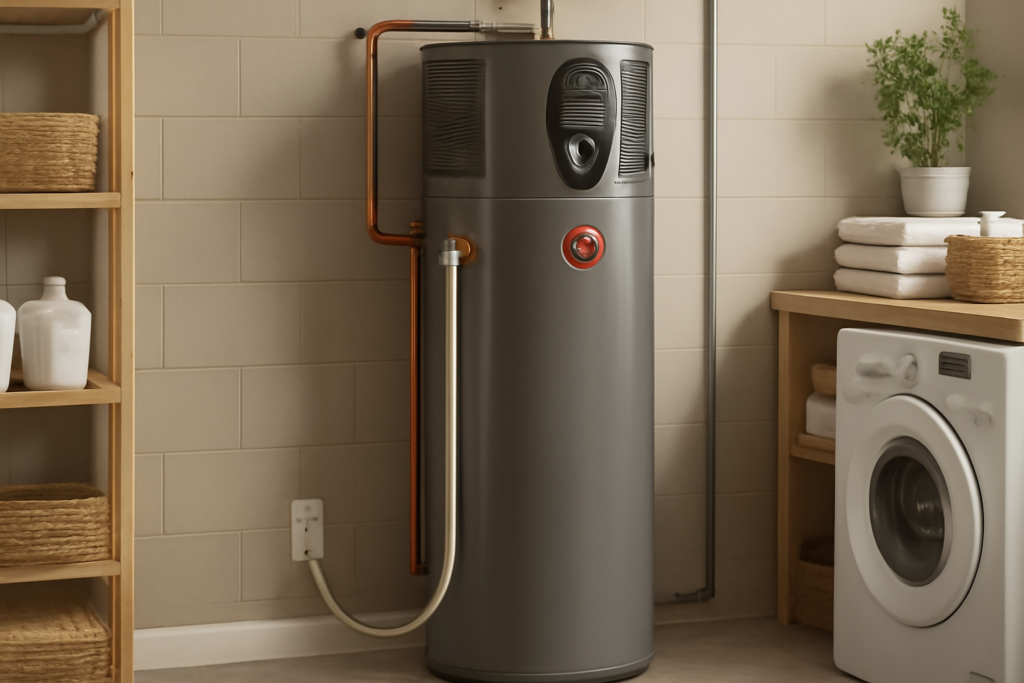
If you want to slash the second-biggest energy bill in your house, a Rheem hybrid water heater deserves a hard look. This is a heat-pump water heater, and it does not burn fuel or rely mainly on resistance coils to make hot water. Instead it pulls heat out of the surrounding air, which makes it two to three times more efficient than a standard electric tank. I have put several Rheem ProTerra units in over the past few years, and the utility savings are real.
- How a Heat-Pump Water Heater Works
- The Efficiency Numbers That Matter
- Space and Air Requirements You Cannot Skip
- Noise: What to Actually Expect
- Federal and Utility Rebates
- Sizing and Install Costs
- Maintenance and Long-Term Ownership
- When a Hybrid Is Not the Right Call
- Is a Rheem Hybrid Water Heater Right for You?
How a Heat-Pump Water Heater Works
The trick is that it moves heat rather than creating it. On top of the tank sits a small compressor and evaporator, the same refrigeration cycle that runs your air conditioner or refrigerator, just aimed at your water. It captures heat energy from the ambient air in the room, concentrates it through the refrigerant loop, and dumps it into the tank. Because it is relocating existing heat instead of generating it from scratch, it does the job with a fraction of the electricity.
Rheem builds these as true hybrids. When demand spikes, say four people showering back to back, the unit can fire backup electric resistance elements to keep up, then drop back to efficient heat-pump mode. You control that behavior on the built-in display or the Rheem EcoNet app, choosing Energy Saver, Heat Pump-only, High Demand, or Electric modes depending on the day.
The Efficiency Numbers That Matter
Efficiency is measured by Uniform Energy Factor, or UEF, and this is where a Rheem hybrid water heater embarrasses a conventional tank. A standard electric heater posts a UEF around 0.90 to 0.95. The Rheem ProTerra hits a UEF near 4.0. That is not a typo; it delivers roughly four units of heat for every unit of electricity because most of the energy is scavenged from the air, not paid for at the meter.
In dollars, the Department of Energy estimates a heat-pump water heater saves a family of four around $400 to $550 a year versus a standard electric tank. Over a 10-year life, that is $4,000 to $5,000 back in your pocket. Rheem’s own figures claim up to 75% lower water-heating costs. The exact number depends on your electricity rate and how much hot water you use, but the savings are substantial in almost every case where you are replacing electric resistance.
Space and Air Requirements You Cannot Skip
Here is the catch that trips people up: a heat-pump water heater needs air to harvest heat from. Rheem specifies roughly 700 to 1,000 cubic feet of surrounding space for the unit to breathe. That is about a 10-by-10 room with an 8-foot ceiling, give or take. Cram one into a tight closet and it will starve, run the backup elements constantly, and throw away the efficiency you paid for.
If your only space is a small utility closet, you have options. Rheem sells ducting kits that let you draw air from and exhaust to adjacent rooms, or you can louver the closet door. The best homes for these units are basements and garages, which have plenty of air volume. A bonus in warm climates: because the unit pulls heat out of the air, it gently cools and dehumidifies the space around it, which is a welcome side effect in a muggy basement.
Noise: What to Actually Expect
Because there is a compressor and a fan, a hybrid unit is not silent like a standard tank. Rheem rates the ProTerra around 49 decibels, roughly the hum of a modern refrigerator or a quiet dishwasher. In a basement or garage you will never notice it. If the tank sits directly below a bedroom or next to a home office, put it in Energy Saver mode and consider the placement, because the low-frequency hum can carry through floors. This is worth planning around before install, not after.
Federal and Utility Rebates
This is where the deal gets genuinely good. Because heat-pump water heaters are a climate priority, the incentives stack.
- Federal tax credit: the Energy Efficient Home Improvement Credit covers 30% of the cost, up to $2,000, for a qualifying ENERGY STAR heat-pump water heater. Most Rheem ProTerra models qualify.
- Utility rebates: many local electric utilities offer $300 to $1,000 back on top of the federal credit. Check your provider’s efficiency program before you buy.
- State and IRA programs: depending on your state and income, additional point-of-sale rebates may apply.
Stack a $600 utility rebate with the $2,000 federal credit and a $1,800 unit can net out under $1,000. Keep every receipt and the manufacturer’s certification statement for your tax filing.
Sizing and Install Costs
Rheem hybrids come in 40, 50, 65, and 80-gallon capacities. Because the heat-pump recovery is slower than gas, I lean toward a 65 or 80-gallon for a family of four or more so the larger tank buffers demand and keeps the unit in efficient mode. A 50-gallon suits two to three people comfortably.
The unit itself runs $1,500 to $2,200. Installation adds $500 to $1,500 depending on your situation. Budget for a few extras that standard tanks do not need:
- A condensate drain. Like an AC, the unit produces condensate that must drain to a floor drain or run through a small condensate pump.
- A 240-volt, 30-amp circuit per the NEC, same as a standard electric tank, so an electric-to-hybrid swap usually reuses existing wiring.
- A T&P relief valve and discharge pipe, plus a drain pan in finished spaces.
Set the thermostat to 120°F for safety and efficiency. If you are converting from a gas tank, you will need an electrician to run the 240V circuit, and pulling a permit is standard practice.
Maintenance and Long-Term Ownership
A hybrid needs a little more attention than a plain tank, but nothing difficult. Twice a year, pull and rinse the air filter on the top of the unit, the same idea as cleaning an AC filter. A clogged filter chokes the heat pump and drives up backup-element use. Once a year, flush the tank to clear sediment and check the anode rod every few years, exactly like a standard tank, since the rust chemistry is the same. Keep the condensate line clear so it never backs up.
Reliability has been solid in my experience, but the compressor is the one part that separates a hybrid from a simple tank. Rheem backs the ProTerra with a 10-year warranty on the tank and parts, which covers that compressor. Register the unit and keep your paperwork so a claim is painless if the sealed system ever hiccups.
When a Hybrid Is Not the Right Call
Honesty matters here. A heat-pump water heater is not for every house. If your utility closet is genuinely tiny and you cannot duct or louver it for airflow, the unit will run on backup elements and you lose the whole advantage. If you live somewhere with very cheap natural gas and already have a gas tank, the operating-cost math is closer, though the rebates still tilt things toward the hybrid. And in an unconditioned space that drops below about 40°F in winter, the heat pump loses efficiency and leans harder on the electric elements. In a heated basement or a mild-climate garage, none of that applies, and the unit shines.
Is a Rheem Hybrid Water Heater Right for You?
If you have the space, roughly 700 to 1,000 cubic feet in a basement or garage, and you are currently paying to run an electric tank, a Rheem hybrid water heater is one of the best efficiency upgrades in the whole house. The four-to-one UEF, the $400-plus in annual savings, and the stacked federal and utility rebates make the payback period genuinely short. Plan for the air volume, the condensate drain, and the modest compressor hum, size the tank a notch larger than you would a gas unit, and let a licensed pro handle the electrical. Do that, and you will get hot water for a fraction of what you pay today.