If you have ever replaced a rusted-out tank two or three times in twenty years, the Rheem Marathon water heater is the unit built to end that cycle. Instead of a glass-lined steel tank that eventually corrodes and leaks, the Marathon uses a seamless polybutene plastic tank that cannot rust, which is exactly why it carries a limited lifetime warranty on the tank for as long as you own the home.
- What Makes the Marathon Different
- Sizes, Ratings, and What They Cost
- Insulation and Standby Heat Loss
- The Warranty, Read Carefully
- Recovery Rate and Sizing for Your Household
- Marathon Versus a Standard Steel Tank
- Installation Notes From the Field
- Maintenance You Actually Need to Do
- Who Should Buy One
- Bottom Line
I have pulled dozens of leaking steel heaters out of flooded utility closets, and the failure is almost always the tank itself, not the elements or thermostats. That is the whole pitch here. You spend more up front and, in theory, never buy another tank.
What Makes the Marathon Different
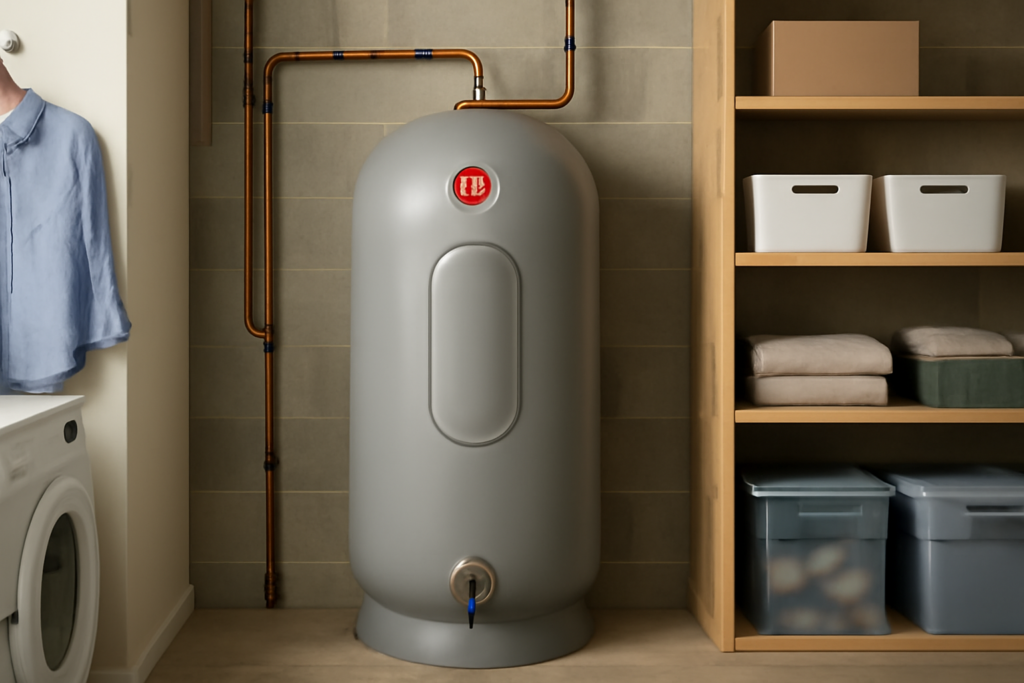
The tank is blow-molded polybutene wrapped in filament-wound fiberglass, then encased in a rigid polyurethane foam jacket. There is no steel touching the water and no glass lining to crack, so the two things that kill ordinary heaters, rust and lime-cracked glass, simply do not apply. It is also one of the few tanks that does not use a sacrificial anode rod, because there is no metal to protect. That means no rotten-egg smell from anode reactions and no anode to replace every five years.
The whole cabinet is a molded plastic shell, so the outside will not sweat or rust either. Marathons weigh less than steel tanks of the same capacity, which makes them easier to carry up a set of basement stairs on a hand truck.
Sizes, Ratings, and What They Cost
The Marathon line is electric only. Common models and rough 2026 street prices:
- MR50245 — 50 gallon, tall, around $1,400 to $1,700
- MR85245 — 85 gallon, the big one for large families, roughly $2,200 to $2,600
- MR105 / 105 gallon — the flagship, north of $2,800
- Smaller 30 and 40 gallon units run $1,100 to $1,500
Compare that to a standard 50-gallon electric heater at $550 to $750 and you can see the premium. Most models ship with two 4,500-watt elements on a 240-volt, 30-amp circuit. First-hour ratings land around 84 gallons on the 50, which is generous because the foam insulation keeps the stored water hotter longer.
Insulation and Standby Heat Loss
The reason people keep these in unheated garages is the insulation. The foam jacket gives the tank an effective R-value in the R-16 range, far above the R-6 to R-8 of a builder-grade steel unit. Standby loss is low enough that the water stored overnight barely drops. On a heat-pump-free electric setup, that insulation is doing real work on your bill. Set the thermostat to 120°F for a safe, efficient balance; every 10°F higher adds noticeable cost and scald risk.
The Warranty, Read Carefully
The headline is a limited lifetime warranty on the tank for the original owner in a single-family residence. That is genuinely strong. But read the fine print:
- Elements and thermostats are typically covered for a shorter term, often 6 years.
- The lifetime tank coverage is non-transferable in most cases, so it does not follow the house to the next buyer.
- Commercial or multi-family installs drop to a much shorter warranty.
- You must keep the unit installed to code with a working T&P valve and, in some areas, an expansion tank.
Keep your receipt and register the unit. When the tank genuinely cannot fail, the warranty math shifts toward the parts, so factor a possible element replacement into your long-term thinking.
Recovery Rate and Sizing for Your Household
Electric heaters recover slower than gas, and the Marathon is no exception. With two 4,500-watt elements running in the standard non-simultaneous mode, a 50-gallon Marathon recovers roughly 21 gallons per hour at a 90°F rise. That is fine for a family of three or four with staggered showers, but a house with four teenagers and back-to-back morning showers will drain a 50 faster than it reheats. This is exactly why the line goes all the way up to 85 and 105 gallons.
Rough sizing guide by bedrooms and bathrooms:
- 1 to 2 people: 30 to 40 gallon
- 2 to 3 people: 40 to 50 gallon
- 3 to 5 people: 50 to 66 gallon
- 5+ people or a large soaking tub: 85 gallon or the 105
Because the Marathon holds its temperature so well overnight, you can often size a notch smaller than you would with a poorly insulated steel tank and still have hot water waiting in the morning.
Marathon Versus a Standard Steel Tank
It helps to see the tradeoff side by side. A builder-grade 50-gallon electric heater costs $550 to $750, carries a 6-year tank warranty, loses more heat to standby, and needs anode replacement every 3 to 5 years to hit that warranty. Over 30 years you might buy three or four of them, plus anodes, plus the labor for each swap and the risk of a flooded floor when one finally lets go.
The Marathon costs two to three times as much once, never rusts, never needs an anode, and loses less standby heat. If you are the long-term owner, the lifetime tank warranty and the eliminated replacement cycles usually win. If you might move in five years, the non-transferable warranty erodes most of that advantage and a standard tank makes more financial sense.
Installation Notes From the Field
Electrically, a Marathon installs like any other electric tank: 240V, 10-gauge wire on a 30-amp double-pole breaker for the 4,500-watt elements. Plumbing is standard 3/4-inch connections. A few specifics worth knowing:
- The plastic tank connections are threaded metal fittings molded into the shell; use two wrenches and do not overtighten, because you are torquing against plastic.
- Always install a T&P relief valve and route the discharge line down to within 6 inches of the floor.
- If you are on a closed system with a check valve or PRV, add a thermal expansion tank to protect the T&P valve.
- The taller footprint matters: the 50-gallon is roughly 62 inches tall. Measure your closet height before you buy.
Because it is electric only, there is no gas line, no venting, and no combustion air to worry about, which makes it a clean swap for an existing electric heater and a simple choice for a closet with no chimney.
Maintenance You Actually Need to Do
The Marathon is low-maintenance but not no-maintenance. There is no anode rod to swap, which removes the single most-skipped chore on a normal heater. What is left:
- Flush the tank once a year. Sediment still settles on the bottom even without a steel tank. Drain a few gallons through the bottom valve until it runs clear.
- Test the T&P valve annually. Lift the lever, confirm water discharges, and let it snap back.
- Check the elements if recovery slows. A burned-out lower element cuts your hot water in half. They are cheap and replaceable.
- Watch the temperature setting. On very hard water, keeping it at 120°F reduces scale buildup on the elements.
Who Should Buy One
The Marathon makes the most sense if you are the long-term owner of the home, you are on electric with no interest in a heat pump unit, and you have had bad luck with rusted tanks or hard water eating your heaters. In those cases the lifetime tank warranty pays for itself over one or two replacement cycles you never have to make.
It makes less sense if you plan to sell within a few years, since the warranty does not transfer, or if you could instead install a heat-pump water heater and cut your electric use by roughly two-thirds. A hybrid heat-pump model often qualifies for federal and utility rebates that a standard-resistance Marathon does not.
Bottom Line
The Rheem Marathon water heater is a niche product that does one thing extremely well: it removes tank corrosion from the equation entirely. Pay the roughly $1,000 premium over a builder-grade tank, install it to code with a T&P valve and expansion tank, flush it once a year, and you have a heater that should outlast the roof over it. For a homeowner staying put, that is one of the better long-run buys in the utility room.